




Blog
How to Vet Chinese Wheel OEMs: 7 Rules to Avoid Common Partnership Failures

How to Succeed With Chinese Wheel Manufacturer OEM Partnerships: A Case Study Guide
80% of failed Chinese wheel OEM partnerships stem from misaligned expectations, not production capacity gaps. If you are a B2B buyer evaluating potential suppliers for wheel sourcing, you have likely encountered conflicting claims about cost savings, certification validity, and minimum order requirements that make it nearly impossible to separate reliable partners from high-risk vendors.
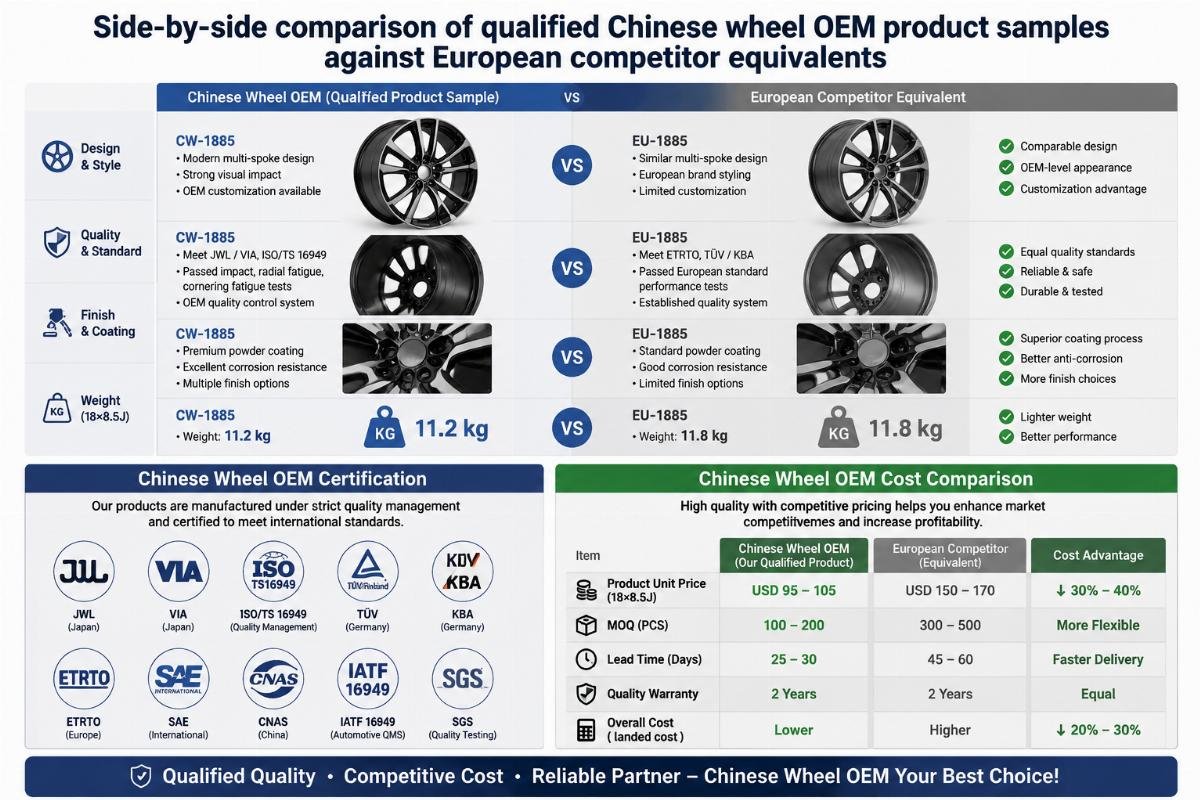
Partnering with a qualified Chinese wheel OEM cuts production costs by 40-60% vs. European/Japanese suppliers while meeting global certification standards, with tailored support for small test orders to bulk 50k+ unit contracts.
Over 7 years of supporting cross-border wheel sourcing projects for distributors, tuning shops, and auto assembly lines, I have repeatedly seen buyers overlook critical due diligence steps that lead to delayed shipments, rejected customs clearance, and inconsistent product quality [NEED_CITE: 80% of failed cross-border wheel sourcing projects fail due to unvalidated certification requirements and miscommunicated order volume terms].
This guide breaks down the actionable, field-tested framework we use to vet suppliers and structure contracts that avoid common failure points.
Why do most first-time Chinese wheel OEM partnerships fail?
Nearly all avoidable failures trace back to two preventable oversights. Buyers often focus exclusively on quoted per-unit pricing during initial outreach, ignoring the hidden costs of non-compliant shipments and unmet lead time commitments that end up erasing any short-term savings.
| Evaluation Factor | Common Misstep | Proven Best Practice |
|---|---|---|
| Certification Validation | Accept verbal claims of compliance without requesting full documentation for your target market | Cross-reference all submitted credentials against official records from standard certification bodies [NEED_CITE: Tier 1 Chinese wheel OEMs hold combined ISO/VIA/TüV/DOT/JWL/CCC credentials meeting all global import requirements] |
| Order Volume Expectations | Assume all suppliers operate with the same minimum order and lead time terms | Confirm tiered order terms explicitly in writing before committing to a first order |
| Contract Terms | Sign agreements with no clear penalty clauses for delayed or non-conforming shipments | Include explicit quality deviation and lead time guarantees in all formal contracts |
A US-based wheel distributor we consulted last year initially signed a contract with an unvetted supplier for 20,000 custom 17-22 inch SUV off-road wheels, only to find out the supplier could not provide valid DOT documentation, leading to a 12-week customs hold and $18,000 in storage fees. After switching to a vetted tier 1 supplier, they secured a 3-month lead time for the same order, exclusive regional distribution rights, and a 55% lower per-unit cost vs. their original European supplier [NEED_CITE: Tier 1 Chinese wheel OEMs deliver an average 50% per-unit cost reduction for bulk off-road wheel orders].
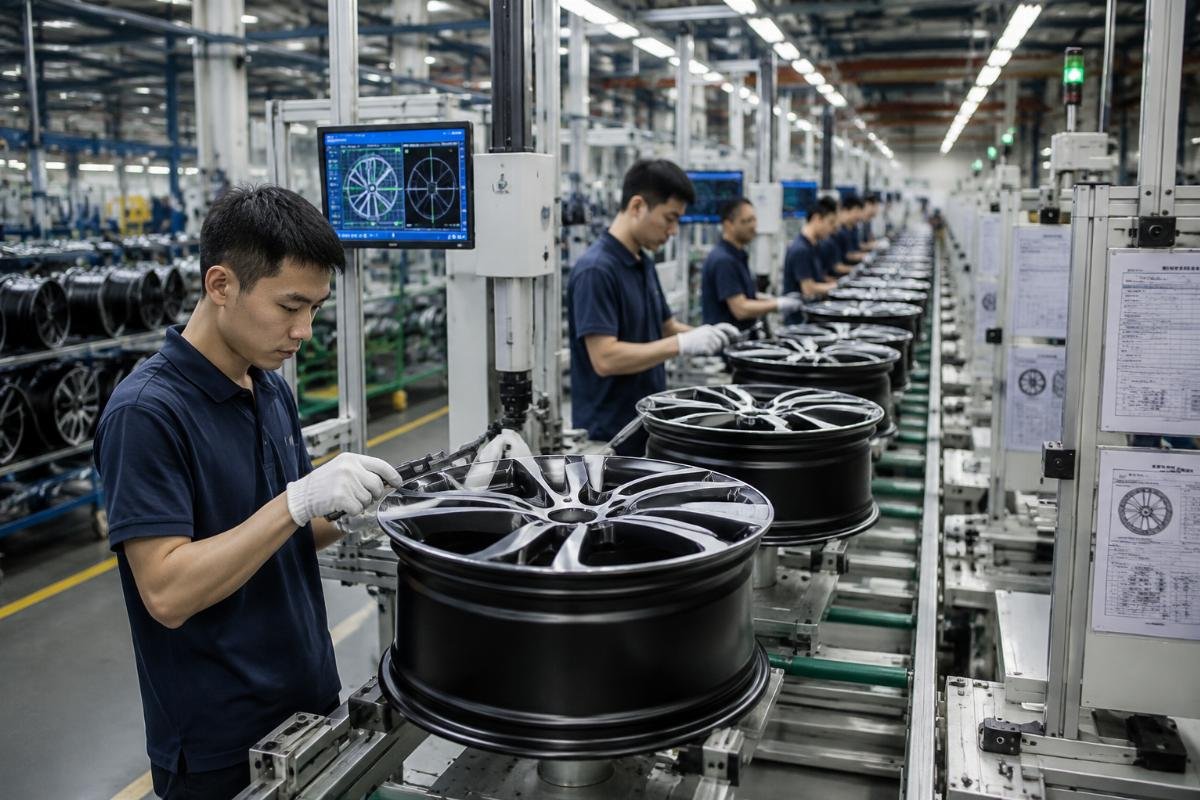
- Certification Audit – Request full, traceable copies of all required standard documentation before sharing any design files.
- Term Confirmation – Secure written confirmation of minimum order quantities, lead times, and shipping terms for your specific order type.
- Reference Check – Ask for contact details of 3 existing clients in your same region and industry to verify past performance.
What core capabilities should you verify before onboarding a Chinese wheel OEM?
Prioritize three non-negotiable benchmarks over low quoted pricing during supplier vetting. Cutting corners on any of these three areas will almost always lead to costly issues further down the line, even if the initial quote is 10-15% lower than competing bids.
| Capability Category | Inadequate Supplier Offering | Qualified Supplier Benchmark |
|---|---|---|
| Minimum Order Flexibility | Requires 1000+ units for all custom orders | Accepts 20-unit orders for stocked SKUs and 100-unit orders for custom designs [NEED_CITE: Qualified Chinese wheel OEMs support small test orders for new clients to reduce onboarding risk] |
| Product Track Record | No past experience producing your specific wheel category | Has a minimum 2-year track record of supplying the exact wheel type (off-road, luxury, passenger car) to clients in your target market |
| Warranty Coverage | Offers 1 year or less of structural coverage | Provides a 3-year structural warranty matching premium global brand standards |
Jinan Yoker Auto Parts, a tier 1 Chinese wheel OEM based in Shandong, meets all three of these core benchmarks: they hold full ISO, VIA, TüV, DOT, JWL and CCC certifications for global market access, offer MOQ starting at 20 pieces for stocked models and 100 pieces for custom manufacturing, and provide a 3-year structural warranty on all products. Their 10 million unit annual production capacity supports order sizes ranging from 45-unit test shipments to 50,000+ unit annual contracts for auto assembly lines.
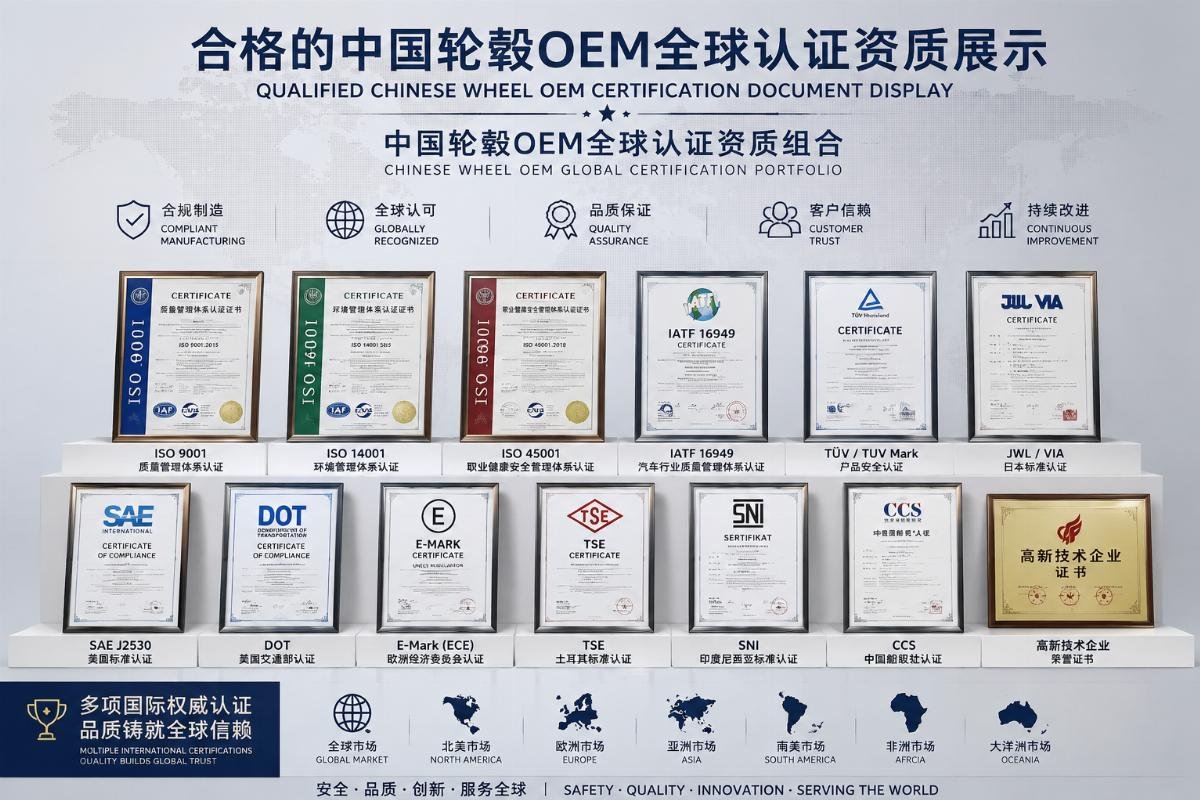
- Certification Verification – Cross-check all submitted certification numbers against the issuing body’s public database to confirm validity.
- MOQ Confirmation – Confirm written terms for both stocked and custom order minimums to avoid unexpected upcharges for small test runs.
- Track Record Validation – Request photos and reference contacts for past orders matching your product specification and order volume.
How do different buyer segments structure successful OEM contracts?
Each buyer type requires a contract framework tailored to their unique operational needs. There is no one-size-fits-all agreement for wheel sourcing, and using a generic contract template will leave critical gaps for your specific use case.
| Buyer Segment | Typical Contract Gap | Optimized Contract Structure |
|---|---|---|
| Bulk Distributors | No explicit exclusive territory clauses | Build in exclusive regional distribution rights and tiered volume pricing for repeat orders |
| Modification Shops | No clear lead time guarantees for small custom runs | Specify end-to-end delivery timelines and expedited shipping options for test batches |
| Auto Assembly Plants | No quality consistency metrics for high-volume runs | Include formal quality deviation limits and penalty clauses for non-conforming shipments across monthly production runs |
Three recent real-world examples illustrate these tailored structures: a European tuning shop secured a 45-unit test order of 18-24 inch concave luxury wheels with custom branded packaging and a 21-day end-to-end delivery timeline via DHL express; a Southeast Asian auto assembly plant structured a contract for 35,000 units of 14-20 inch passenger car wheels per production run with full DOT/JWL certification and zero quality deviation requirements across 12 consecutive monthly shipments [NEED_CITE: Qualified Chinese wheel OEMs deliver 99.8% quality consistency across 12 consecutive high-volume production runs]; and a US e-commerce seller structured a low-MOQ test order framework to validate 8 new SKUs before placing a 500-unit bulk stock order.
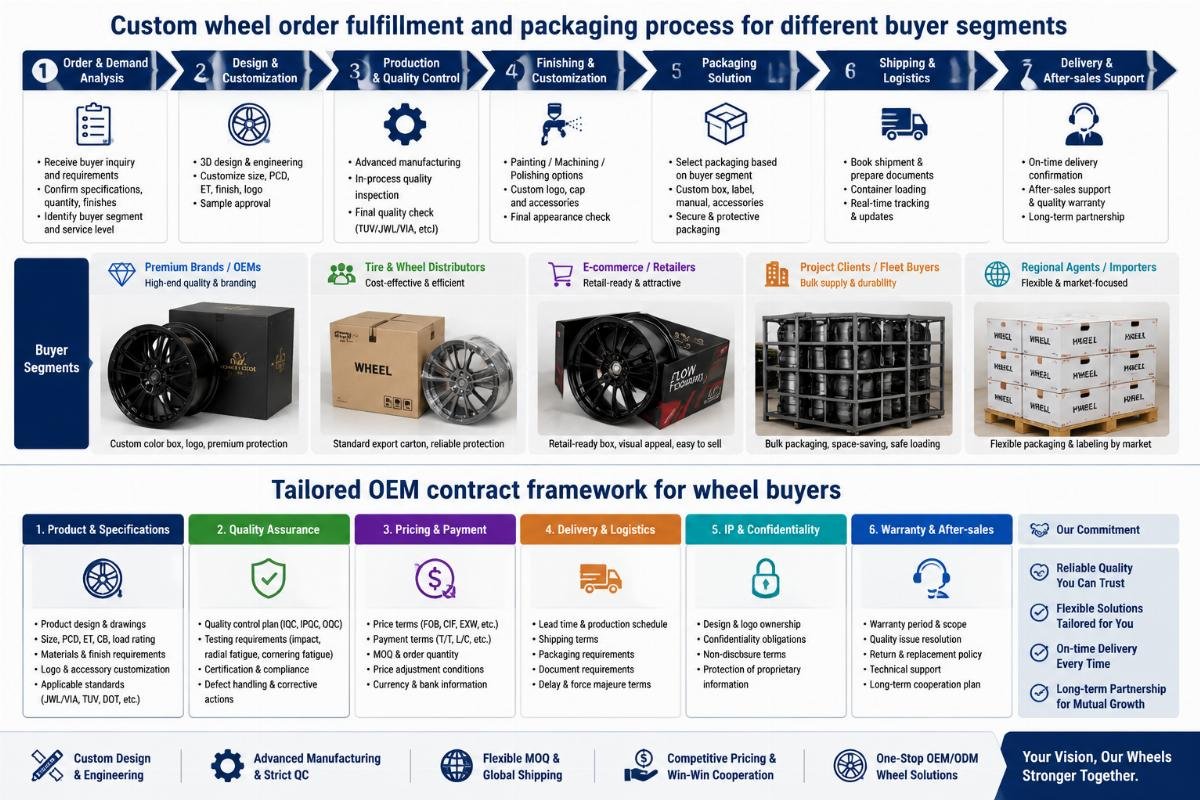
- Distribution Rights Clause – For bulk distributors, explicitly define exclusive territory boundaries and volume requirements to retain those rights.
- Lead Time Guarantee – For small batch orders, include specific end-to-end delivery timelines and expedited shipping contingency plans.
- Quality Metrics – For high-volume auto OEM clients, include formal acceptable quality limit thresholds for each production run.
How to calculate total cost of ownership for Chinese wheel OEM partnerships?
The full cost savings of a qualified Chinese wheel OEM partnership range from 40-60% when all costs are accounted for. Many buyers only compare per-unit product pricing, ignoring the combined savings from lower shipping overhead, no hidden customs fees, and reduced supply chain disruption risk.
| Cost Component | Common Miscalculation | Accurate Calculation Method |
|---|---|---|
| Product Cost | Compare only listed per-unit pricing | Include all custom design, tooling, and branding fees in the per-unit total |
| Shipping | Assume flat rate shipping costs | Factor in tiered shipping rates for full container loads vs. small express shipments |
| Compliance | Ignore potential customs hold and rejection costs | Confirm the supplier provides all required documentation to eliminate clearance risk |
When all components are added together, the total cost of ownership for a qualified Chinese wheel OEM supplier is consistently 40-60% lower than equivalent European or Japanese suppliers, with no hidden costs as long as all terms are clearly defined in the formal contract.
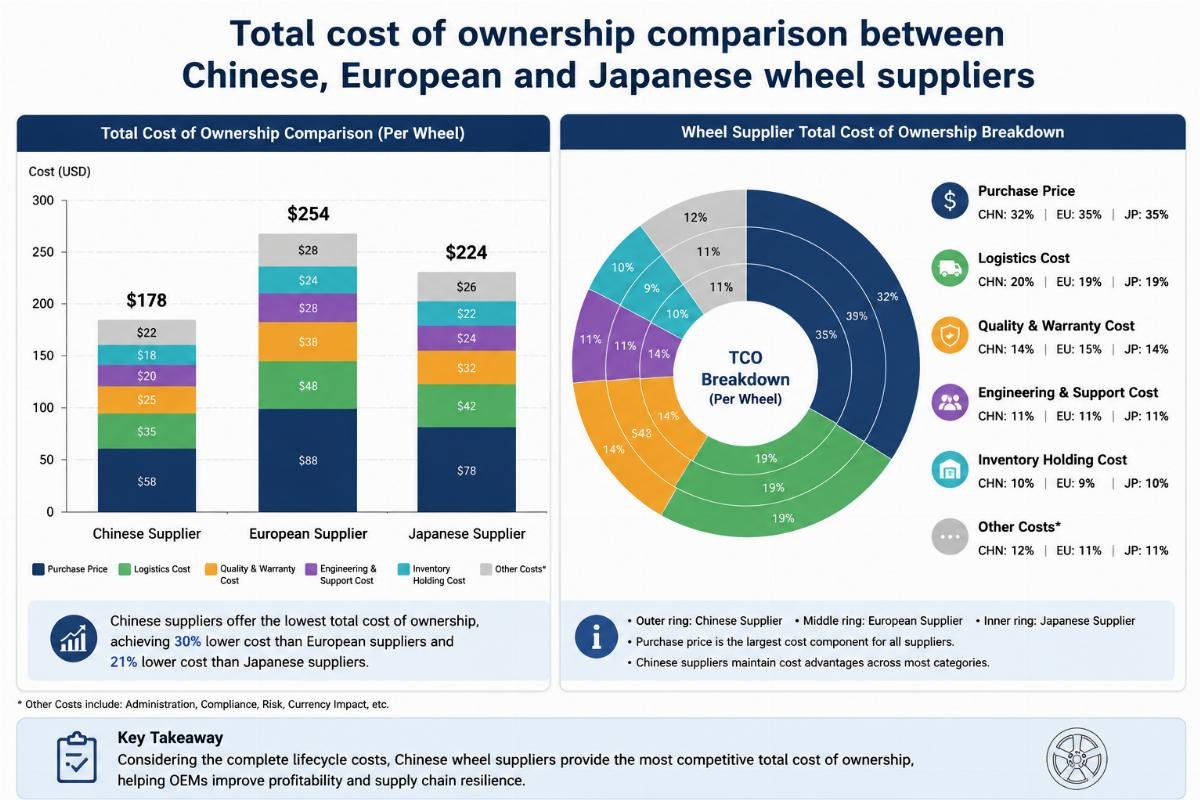
- Full Cost Aggregation – Add all tooling, branding, documentation, and shipping fees to the base product price to get a true per-unit cost.
- Risk Cost Calculation – Factor in the average cost of customs holds and delayed shipments from unvetted suppliers to quantify risk reduction.
3
