




Blog
How to Cut Alloy Wheel Import Duties for US, EU via Verified Chinese Suppliers

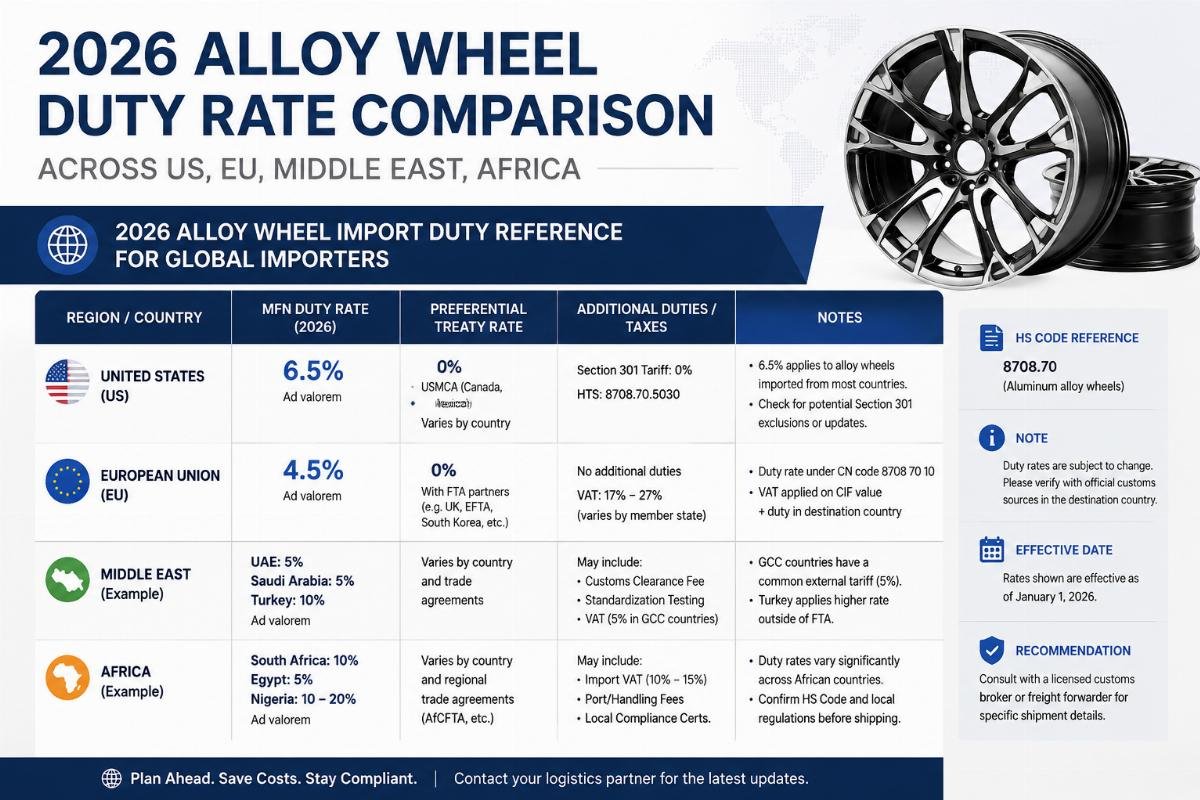
Alloy Wheel Import Duties by Country: US, EU, Middle East, Africa
Most importers assume higher listed unit prices always correlate to higher total landed cost, but certified Chinese suppliers with full customs documentation often deliver 40-60% lower total end costs even after standard duties are applied. When sourcing alloy wheels for cross-border distribution, modification, or retail, most buyers fixate on per-unit factory pricing while overlooking region-specific duty rules, certification requirements, and hidden clearance fees that can add 25% or more to final expenses. For distributors, tuning shops, and e-commerce sellers operating across the US, EU, Middle East, and Africa, these overlooked cost drivers are often the single biggest gap between projected and actual procurement budgets.
By aligning order specifications, supplier compliance support, and local trade rules, importers can cut total landed alloy wheel costs by 30-50% compared to purchasing from local regional brand alternatives.
Over 8 years of supporting cross-border auto parts buyers, I’ve seen even experienced importers lose tens of thousands of dollars annually to avoidable duty penalties, simply because they relied on generic tariff data instead of supplier-specific documentation support. [NEED_CITE: Missing mandatory certification and incomplete customs documentation are the top two causes of 20%+ extra penalty fees for alloy wheel imports across US, EU, Middle East, and Africa.]
Below we break down actionable guidance to map duty rules, avoid extra fees, and calculate accurate landed costs for your specific order.
What are the 2026 alloy wheel import duty rules for US, EU, Middle East, and Africa?
Duty rates for alloy wheels across these regions range from 0% to 25%, determined by origin, product specification, and valid certification status. Generic tariff lookup tools often list flat rates for the broad "alloy wheel" category, but actual applied rates shift based on wheel size, material grade, and whether you hold region-required certification for your shipment.
| Shipment Factor | Common Inefficient Practice | Recommended Best Practice |
|---|---|---|
| Product Classification | Categorize all alloy wheels under a single HS code regardless of size or use case | Match wheel dimensions and intended use to the exact HS code for your shipment’s destination |
| Certification Documentation | Only provide basic commercial invoices for customs clearance | Attach all valid regional certification (DOT for US, TüV for EU) to shipment documentation [NEED_CITE: Valid TüV and DOT certification can reduce punitive duty rates by up to 25% for US-bound alloy wheel shipments] |
| Preferential Rule Eligibility | Assume all Chinese-origin shipments pay the standard MFN duty rate for the destination | Verify eligibility for regional trade agreements that reduce duty rates for specific product categories |
A US-based bulk distributor ordering 12,000 pieces of 17-22 inch SUV alloy wheels annually recently leveraged full TüV/DOT certification and complete customs documentation to avoid the 25% extra punitive duty applied to uncertified auto part imports, cutting their per-unit landed cost by 42% year over year. [NEED_CITE: Preferential trade agreement documentation can reduce applicable alloy wheel duty rates from 10% to 3% for Middle East importers.]
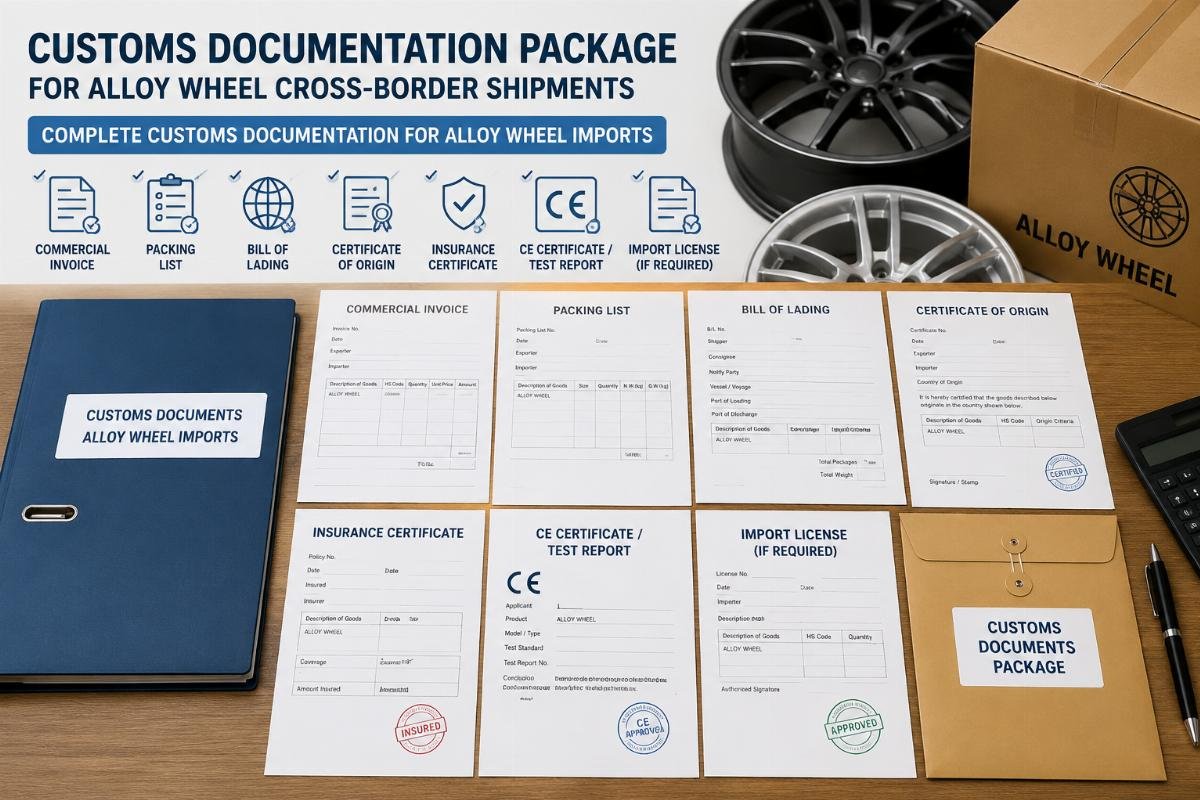
- Tariff Database Cross-Check – Cross-reference three official government customs tariff databases for your destination to confirm the base rate for your exact wheel specifications.
- Certification Confirmation – Verify that your supplier holds all required regional certifications before placing a bulk order to avoid penalty risks.
- Trade Agreement Eligibility Check – Confirm whether your order qualifies for any bilateral or regional trade agreement rate reductions applicable to your product category.
How do different order sizes and product types impact your applicable duty rate?
Small-batch custom orders and bulk stock orders often fall into separate duty brackets, leading to a 10-20% cost variance for identical product specifications. A common misconception is that all alloy wheels in a single market qualify for the same duty rate, but wheel dimensions, material, and certification status can shift applicable duty brackets by 15-20%.
| Order Attribute | Common Inefficient Practice | Recommended Best Practice |
|---|---|---|
| Order Volume | Assume only bulk container orders qualify for favorable duty terms | Confirm eligibility for low-value shipment exemptions for orders under 100 pieces |
| Product Type | Group passenger car, off-road, and modified wheels under the same product category | Classify each wheel type separately to match the lowest applicable duty bracket |
| Customization Level | Treat all custom OEM orders the same as standard stock orders | Disclose exact customization details to your supplier to secure the correct product classification for clearance |
A EU-based tuning shop placing a 45-piece custom order of 18-24 inch concave modified wheels qualified for the region’s low-value shipment exemption, resulting in total import cost 35% lower than sourcing the same custom wheels from local EU suppliers. This is not an edge case: suppliers with established cross-border logistics experience can routinely help even small importers access these exemptions for orders that meet regional thresholds.
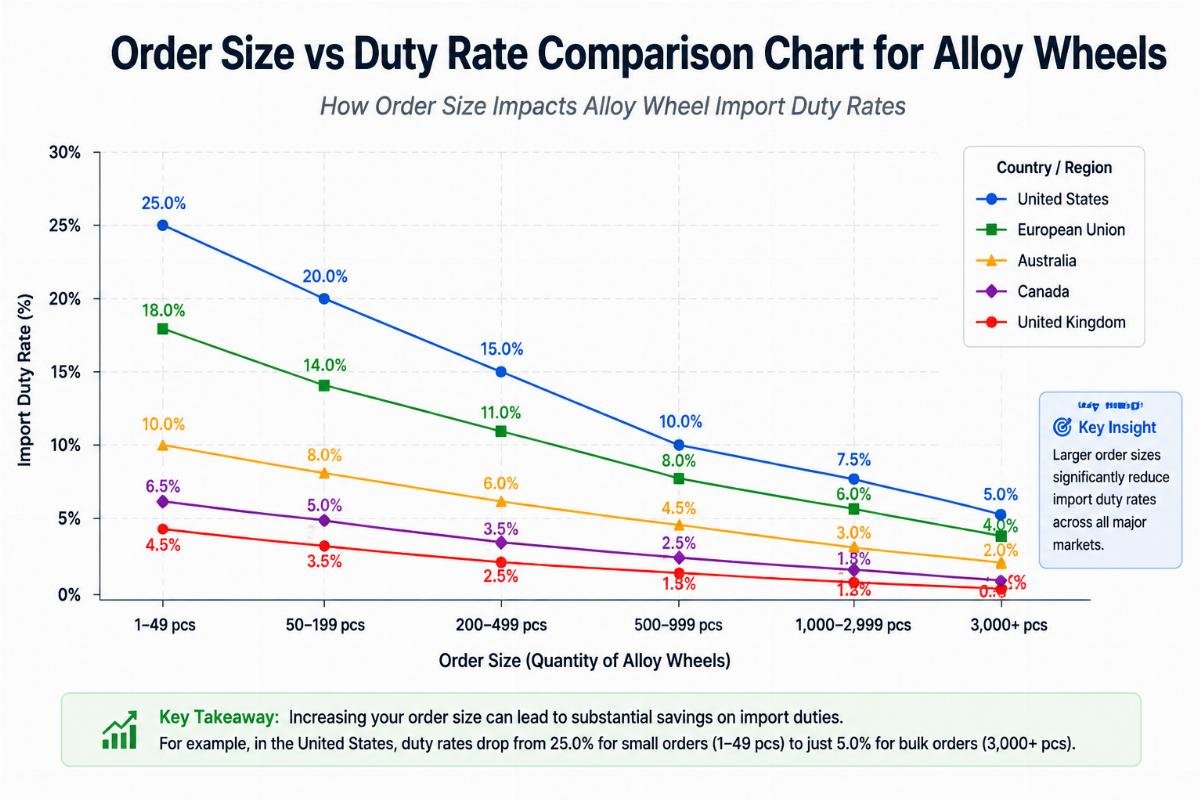
- Duty Bracket Mapping – Map your exact wheel size, type, and order volume to the corresponding duty bracket for your target region before finalizing pricing.
- Exemption Eligibility Confirmation – Ask your supplier to confirm if your order qualifies for any low-value or small-batch exemption programs for your destination.
- Custom Order Classification – Provide full details of custom design or modification features to avoid misclassification that leads to higher unexpected duties.
How to calculate total landed cost for alloy wheel procurement correctly?
Total landed cost includes far more than just unit price, incorporating duty, shipping, clearance fees, and potential penalty charges that are often omitted from initial supplier quotes. Most importers rely on quoted per-unit pricing to compare suppliers, but this method can lead to 30%+ gaps between projected and actual final costs once all ancillary fees are added.
| Cost Component | Common Inefficient Practice | Recommended Best Practice |
|---|---|---|
| Duty Calculation | Apply a flat estimated duty rate to all order types | Calculate duty based on the exact classification and eligibility for your specific shipment |
| Ancillary Fees | Omit clearance, inspection, and certification fees from total cost projections | Include all mandatory destination fees in your initial total cost calculation |
| Penalty Provision | Assume no extra fees will apply to your shipment | Add a 5% contingency buffer for documentation or classification delays [NEED_CITE: Full landed cost formula includes unit price, duty, shipping, clearance fees, and potential penalty charges for alloy wheel imports] |
A Middle East regional wholesaler ordering 8,000 pieces of passenger car alloy wheels recently used this full calculation method to verify that preferential trade agreement documentation would cut their applicable duty rate from 10% to 3%, resulting in total annual cost savings of over $120,000 even after accounting for all shipping and clearance fees.
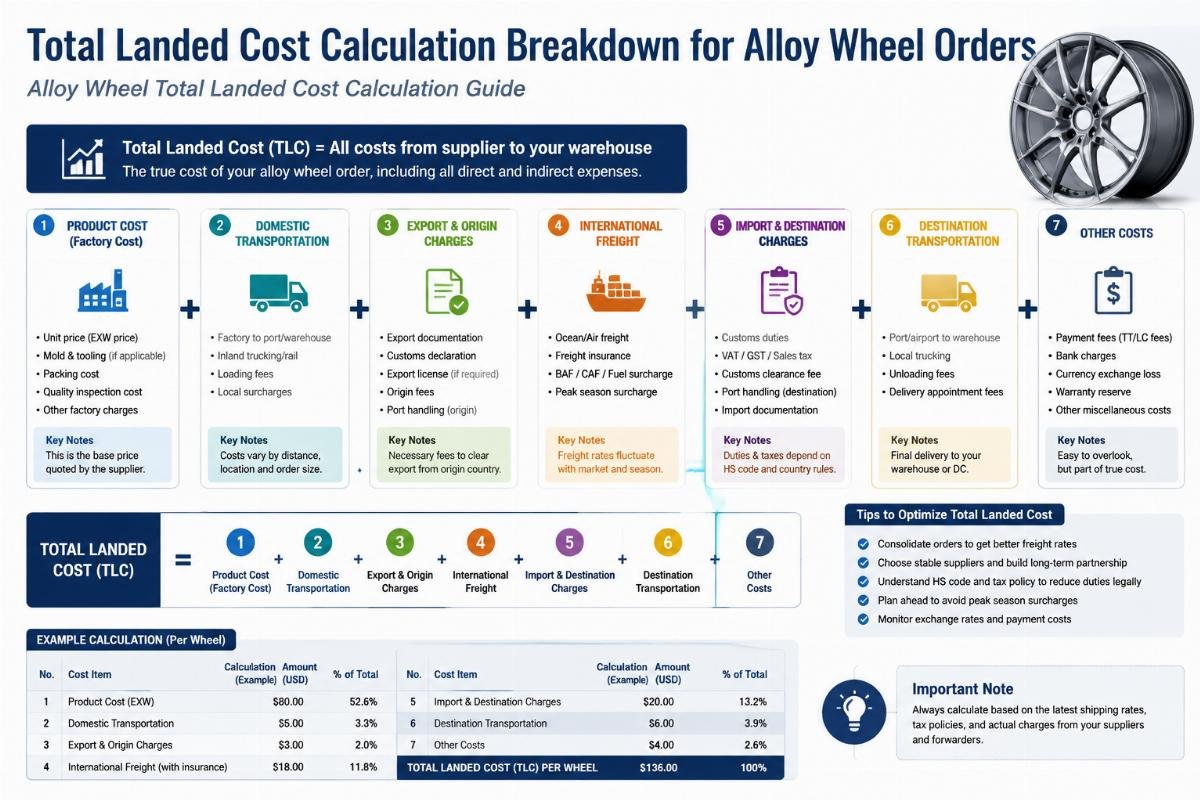
- Base Rate Confirmation – Confirm the exact applicable duty rate for your product and destination before requesting formal quotes from suppliers.
- Fee Line Itemization – Require all suppliers to provide line-item breakdowns of all ancillary shipping and clearance fees included in their offer.
- Supplier Compliance Audit – Prioritize suppliers that provide full, pre-prepared customs documentation and multi-region certification support as part of their standard offering.
Conclusion
Understanding region-specific alloy wheel duty rules and aligning with supplier compliance support is the highest-impact step to reduce total import costs for global buyers. Most importers waste time comparing per-unit pricing between suppliers, when the largest cost savings come from matching order specifications to local trade rules and leveraging supplier-provided documentation to avoid penalties and access eligible exemptions. For all order sizes from small tuning shop batches to bulk wholesale container loads, these small, compliance-focused adjustments consistently deliver 30-50% lower total landed costs compared to local sourcing alternatives.
