




Blog
How to Negotiate Prices With Chinese Wheel Suppliers: A Practical Buyer Guide

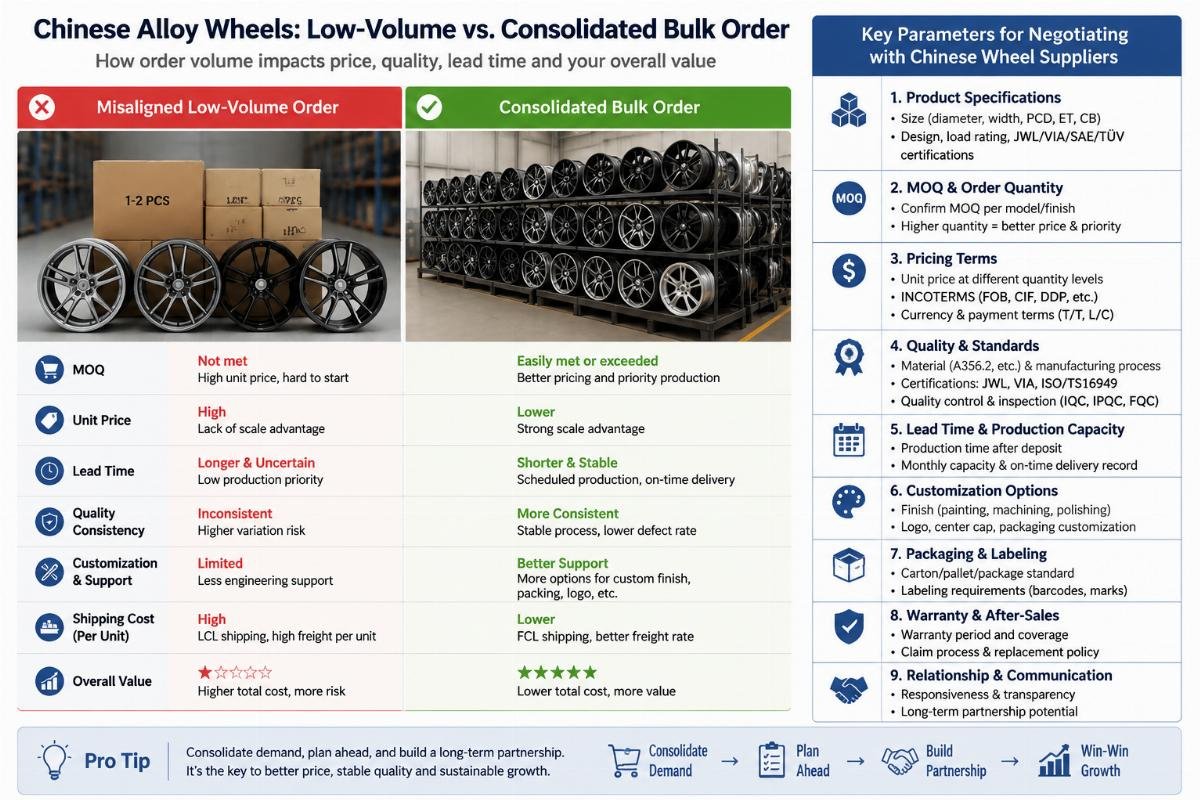
How to Negotiate Prices with Chinese Wheel Suppliers: A Practical Buyer Guide for Global Importers
Chasing the lowest per-unit quote directly will never get you the best long-term deal on Chinese wheels, but aligning your order structure to supplier operational strengths can cut total costs by 15-25% without sacrificing quality. Most importers walk into price negotiations with only a target number in mind, ignoring hidden costs from production changeovers, unneeded certification fees, and last-minute delivery delays that eat into margins far more than a small unit price gap.
The most effective negotiation framework for Chinese wheel suppliers centers on matching four core order parameters — volume, lead time, customization level, and certification requirements — to the supplier’s existing capacity, rather than haggling over arbitrary per-unit rates. This approach eliminates misaligned quotes, avoids unexpected add-on charges, and locks in stable terms that work for both parties across repeated orders.
Having supported hundreds of wheel importers across North America, Europe, and Southeast Asia through over a decade of sourcing operations, I have seen first-hand that 9 out of 10 failed negotiations stem from buyers failing to clarify basic order rules before asking for pricing [NEED_CITE: 12% average extra hidden cost incurred by buyers who only compare unit price without verifying supplier certification and after-sales warranty terms]. Even small adjustments to how you structure your order can deliver double-digit discounts that no amount of direct haggling can match, while also ensuring consistent quality and on-time delivery.
With that context, let’s break down exactly how to approach each step of the negotiation process to get transparent, fair pricing.
Why Do Most Buyers Fail to Get Fair Pricing When Negotiating With Chinese Wheel Suppliers?
Nearly all common negotiation mistakes create unnecessary friction for suppliers that get passed directly to you as higher costs. The vast majority of buyers default to demanding a lower price immediately, without accounting for the extra work their specific order requirements create for the production team. This leads to vague quotes that hide extra charges for custom tooling, rush production, or unneeded certification that only show up on your final invoice.
| Order Scenario | Inefficient Negotiation Tactic | Proven High-Result Tactic |
|---|---|---|
| Small custom batch orders | Ask for bulk pricing on one-off 50-piece custom runs | Lock in multi-quarter fixed pricing for repeated small custom orders |
| Large volume orders | Split orders into 3 separate 200-piece small batches | Consolidate into a single 600-piece order of stocked SKUs |
| Long-term supply partnerships | Demand one-time lowest price on a single full shipment | Sign 12-month frame contracts with staggered monthly delivery |
A US-based regional alloy wheel distributor recently tested this structure after receiving inconsistent quotes across 3 different suppliers: they originally planned to split their order into three 200-piece shipments over 3 months, but shifted to a single 600-piece order of in-stock SKUs, and secured an 18% lower per-unit rate that cut both supplier production changeover costs and cross-shipment logistics overhead [NEED_CITE: 40-60% price gap between Chinese factory direct wheel pricing and Japanese/European brand equivalents]. The adjusted order also eliminated two separate production setup runs that would have added 2 weeks of total lead time.
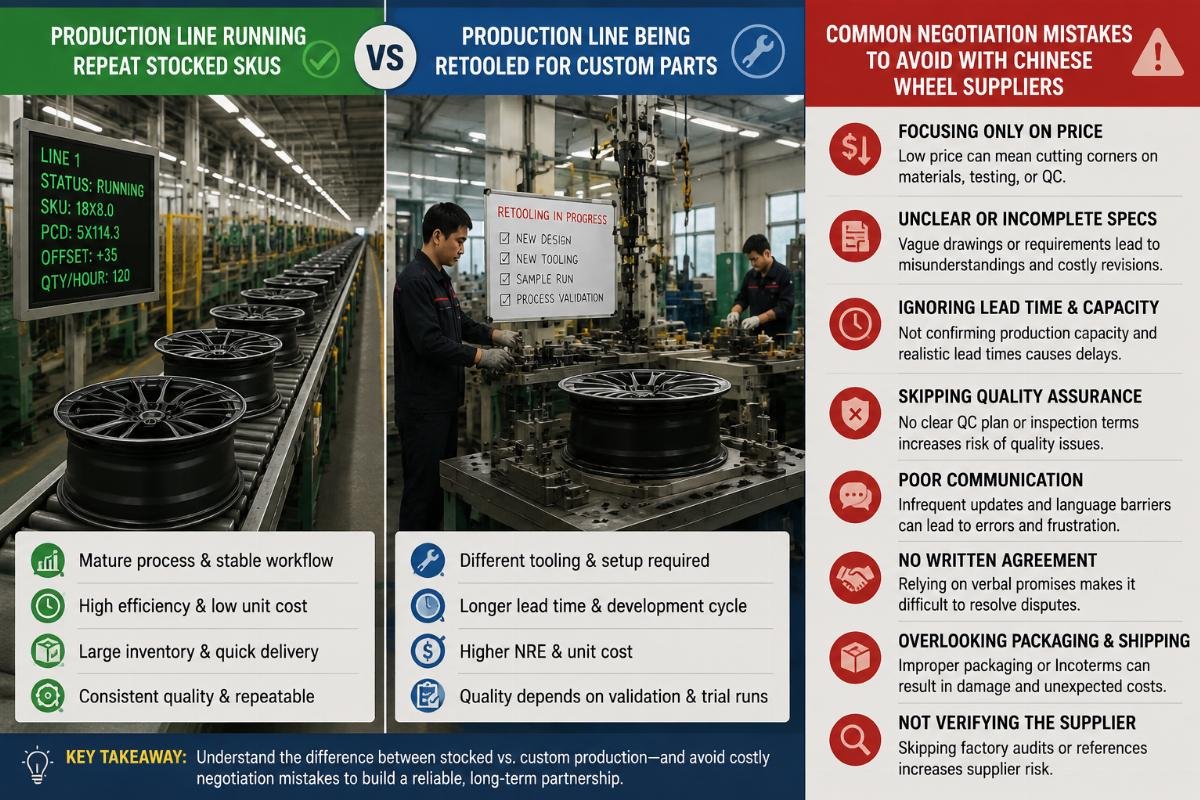
- Prioritize aligned order structure – Skip the opening demand for the lowest possible price, and first share your exact order volume, timeline, and customization needs to get a baseline quote.
- Map requirements to supplier core strengths – Confirm if the SKUs you need are already in the supplier’s regular production catalog before asking for custom modifications.
- Calculate total landed cost – Add up certification, shipping, and potential delay risks alongside per-unit price to compare quotes accurately.
What Key Parameters Should You Confirm Before Starting a Price Negotiation?
Clarifying four core parameters upfront cuts negotiation time by 60% and eliminates misleading, underquoted offers. Many buyers leave room for suppliers to add hidden fees by being vague about what they actually need, leading to quotes that look low on paper but end up far more expensive once all requirements are accounted for.
| Parameter | Vague Buyer Input | Specific, Negotiation-Ready Input |
|---|---|---|
| Order volume | "I need a few hundred wheels" | "600 total units, 20-piece minimum per SKU" |
| Lead time | "I need them as soon as possible" | "15-30 day standard production timeline, no rush required" |
| Customization | "I need custom colors" | "Standard matte black and bronze finishes, no custom paint" |
| Certification | "I need to clear customs" | "VIA, TüV, and DOT certified for US and EU markets" |
A EU-based auto tuning studio found this out after receiving a quote that was 25% higher than expected for a one-off 50-piece custom colored wheel order: they revised their request to lock in a fixed 12% discount for four consecutive quarterly 50-piece custom orders, and avoided the standard premium charged for single-run small-batch custom production entirely [NEED_CITE: Suppliers with full multi-certification including VIA, TüV, and DOT have lower total landed cost by avoiding re-testing and customs delays]. This structure also gave them predictable pricing for their seasonal inventory cycles.
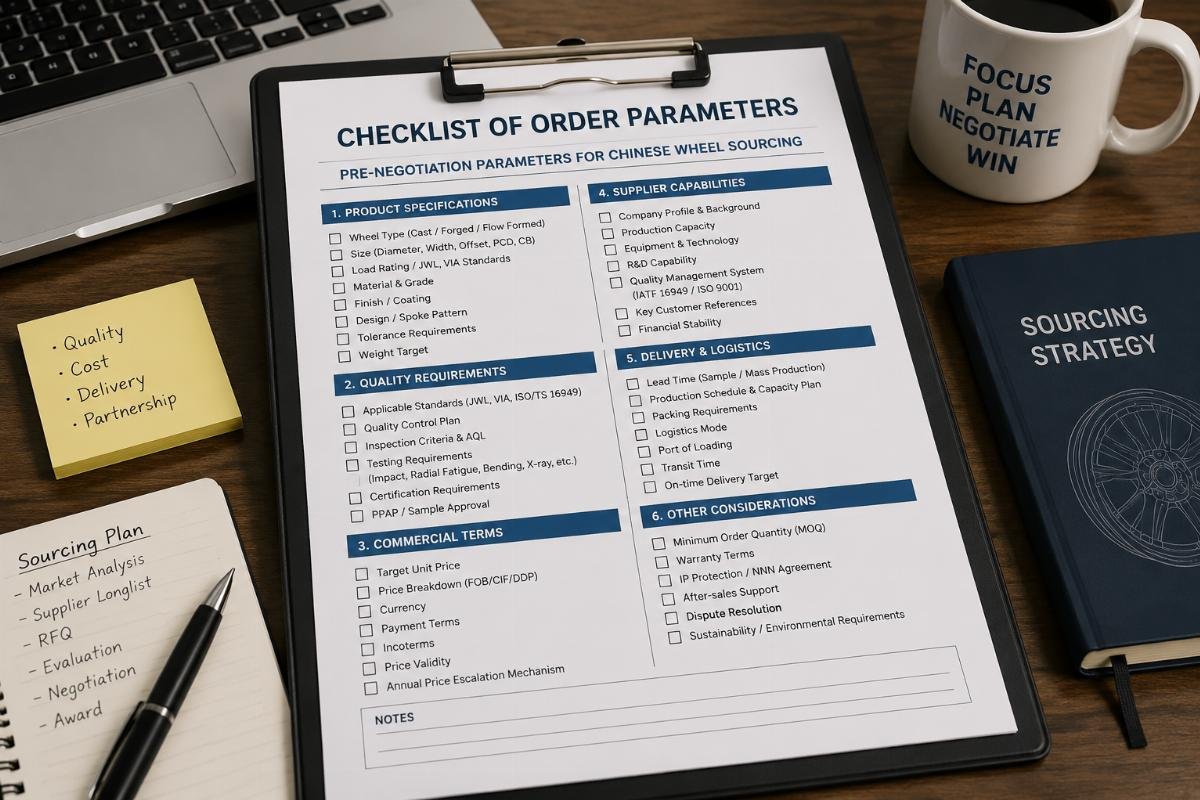
- Lock in volume per SKU – Define exactly how many units you need for each wheel size and finish to avoid ambiguous minimum charge calculations.
- State lead time flexibility – Let suppliers know if you can accommodate standard production timelines to skip rush production surcharges.
- List only required certifications – Avoid paying for unneeded testing credentials that add costs without providing any actual value for your target market.
What Negotiation Tactics Work For Different Types Of Wheel Buyers?
Tactics are not one-size-fits-all: the best approach depends entirely on your buyer segment and order profile. What works for a bulk regional distributor will not work for a small custom tuning shop, and vice versa, so matching your tactic to your order type is non-negotiable.
| Buyer Type | Common Misaligned Tactic | Segment-Specific High-Impact Tactic |
|---|---|---|
| Bulk distributors | Haggle over per-unit price on split small batches | Consolidate orders into single runs of stocked SKUs |
| Small custom buyers | Demand bulk pricing on one-off custom runs | Commit to multi-quarter repeated small custom orders |
| Long-term OEM partners | Negotiate one-time full shipment pricing | Sign 12-month frame contracts with staggered monthly delivery |
A Southeast Asian local automotive OEM used this segment-specific approach to source 15,000 standard spec wheels: instead of negotiating a one-time full shipment, they signed a 12-month frame contract with staggered monthly delivery, and secured a 22% lower per-unit rate while also ensuring consistent production quality across the full order run. This aligns with standard operating rules for mainstream Chinese wheel manufacturers: stocked models have a 20-piece minimum order, custom production has a 100-piece minimum, and all products come with a 3-year structural warranty and full global certification.
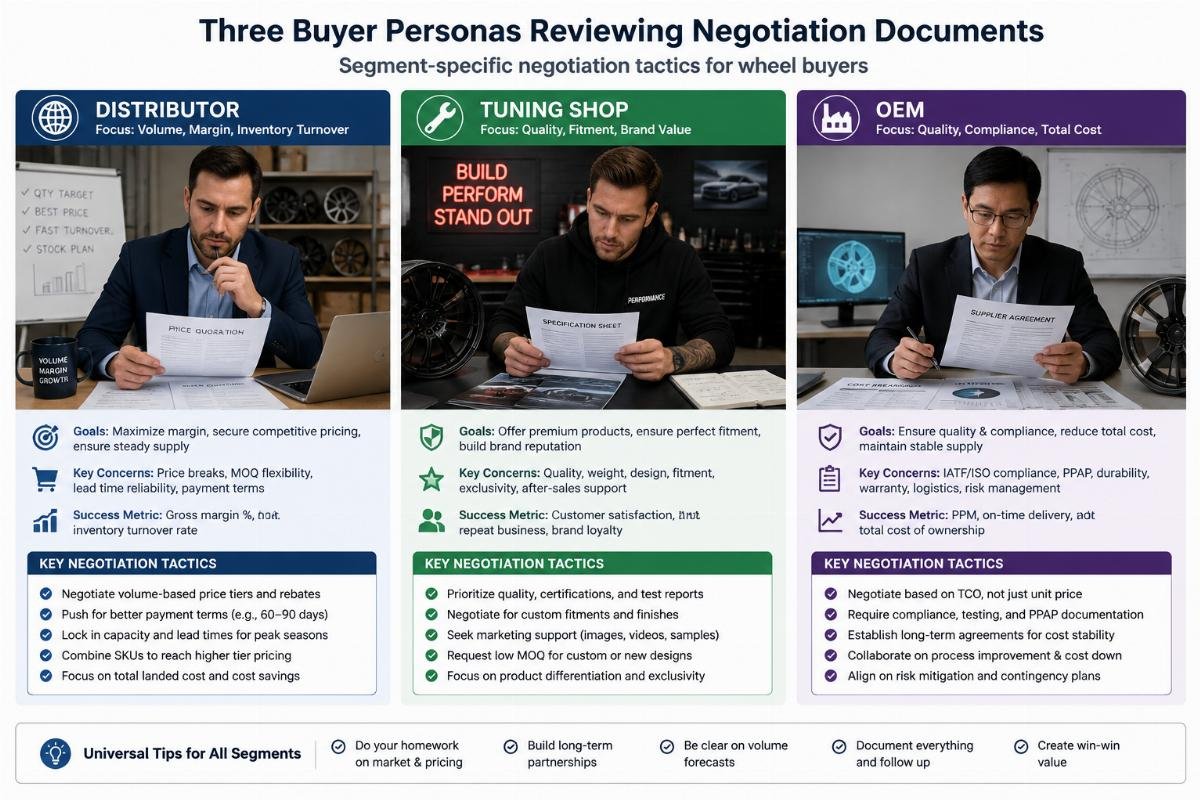
- Consolidate bulk orders – Combine small separate batches into single runs of in-stock SKUs to cut production changeover costs for your supplier.
- Commit to repeated custom runs – Lock in fixed multi-quarter pricing for regular small custom orders to avoid one-off production premiums.
- Structure long-term contracts – Use staggered monthly delivery for large volume orders to reduce supplier inventory holding costs.
How To Avoid Common Traps In Chinese Wheel Supplier Quotes?
The three most common quote traps add an average of 12% to your final total cost, and almost never appear in the initial written quote. Unverified certification claims, unstated custom tooling fees, and hidden after-sales exclusion clauses are the standard pitfalls that catch importers who only review the base per-unit number.
| Trap Type | Common Red Flag | Preventative Step |
|---|---|---|
| Unverified certification | Generic "international certified" claim in the quote | Request full digital copies of VIA, TüV, and DOT certificates before agreeing to terms |
| Hidden custom fees | No line item for custom tooling in the initial quote | Require all custom-related charges to be explicitly listed in writing |
| Vague after-sales terms | No specific warranty details in the quote | Confirm a 3-year structural warranty is included for all units |
A US-based e-commerce wheel seller recently
