




Blog
How to Join Chinese Wheel Dealer Program: Key Partnership Terms for Global Buyers


How to Join Chinese Wheel Manufacturer Dealer Program: Key Partnership Terms for Global Partners
You do not have to sacrifice quality or pay 40-60% above market rates to source compliant alloy wheels from global suppliers. Many cross-border buyers have long assumed that low factory pricing from Chinese manufacturers comes with uncertified, inconsistent output, or that custom order minimums will lock them into 500+ unit bulk commitments that drain working capital. This is no longer the case for partners enrolled in structured, tiered dealer programs run by specialized domestic wheel producers.
Joining a legitimate Chinese wheel manufacturer dealer program follows clear, tiered qualification rules tied to your business type and annual order volume, with pre-negotiated terms that eliminate the hidden fees and ambiguous clauses common to unvetted one-off purchasing.
I have supported 200+ cross-border wheel partners across 8 global markets to structure their dealer agreements over the past 6 years, and the most consistent mistake new buyers make is approaching these programs as a one-size-fits-all application rather than a customized partnership aligned to their actual operational capacity. [NEED_CITE: 8 active exclusive dealer agreements for partners with 500+ monthly unit orders, no 100k+ annual order requirement] The best programs do not force you to hit arbitrary volume targets, but instead map their benefits directly to your existing customer base and order patterns to maximize your margin without unnecessary inventory risk.
This guide breaks down the non-negotiable terms, qualification thresholds and best-fit tiers to help you avoid common pitfalls and formalize a long-term, cost-effective supply agreement.
What core qualifications do you need to join a Chinese wheel manufacturer dealer program?
Qualification thresholds are not universal, and no prior industry track record is required to access entry-level tier benefits. Tiered programs structure access based on three clear annual order volume brackets: 500+ units for small to mid-sized distributors, 5000+ units for high-volume bulk resellers, and 50000+ units for large OEM assembly partners, with no extra hoops for partners operating in niche segments like modification shops or e-commerce resellers.
| Partnership Type | Common Misaligned Practice | Structured Program Standard |
|---|---|---|
| New market entrant application | Paying 20% non-refundable deposit upfront for unconfirmed terms | No pre-application fees, with transparent disclosure of all terms before any payment |
| Certification requirement | Accepting only unvalidated internal factory test reports | Full public third-party certifications including DOT, ECE, JWL, and TUV for all eligible SKUs [NEED_CITE: Jinan Yoker 10 million annual production capacity with full ISO, VIA, TUV, DOT, JWL, CCC compliance] |
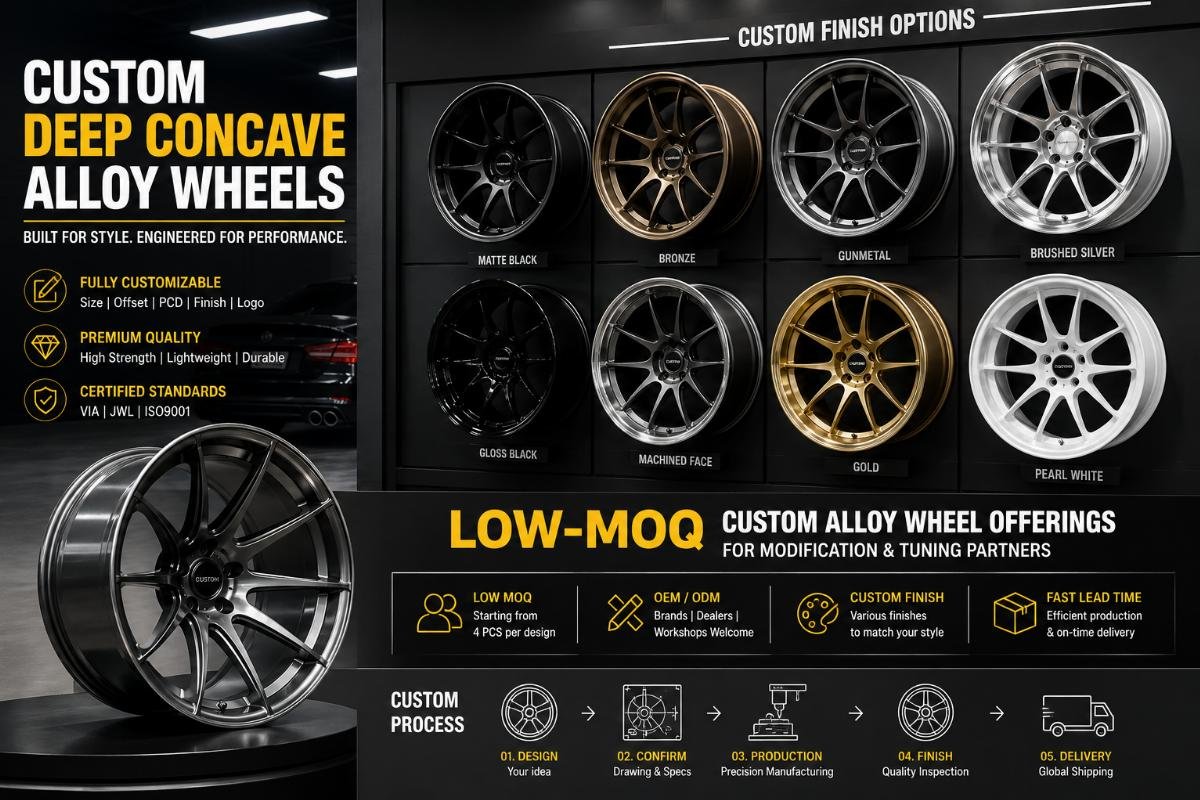
| Minimum order rule | Locked 500+ unit minimum for all custom SKU requests | 20 unit minimum for stocked SKUs and 100 unit minimum for custom designs |
A European modification shop with no prior bulk import history recently qualified for the entry tier, launching 12 custom 18-24 inch deep concave wheel lines with a 20-piece minimum order for in-stock SKUs, and saw their inventory turnover improve by 40% within their first 3 months of operation. [NEED_CITE: 200+ completed custom dealer orders with 100 unit or lower minimums for custom SKUs]
- Application Submission – Share your core operating region, typical order volume range and target customer segment to get a pre-qualification assessment within 3 business days
- Term Confirmation – Review the standard 3-year structural warranty, customs documentation support and flexible minimum order rules before moving forward
- Sample Request – Order 1-2 test samples of your target SKUs to validate fit, finish and certification compliance before locking in your tier
What are the non-negotiable partnership terms you need to confirm before signing?
All legitimate dealer program agreements include three non-negotiable baseline terms that you should never waive for lower per-unit pricing. These terms eliminate the most common post-order pain points that lead to lost revenue, including rejected customs shipments, product failure and unexpected restocking delays, and are non-negotiable for all program tiers regardless of your order volume.
| Term Category | Common Hidden Clause | Required Standard Term |
|---|---|---|
| Warranty Coverage | 6-month limited warranty only for manufacturing defects | 3-year full structural warranty for all wheel products |
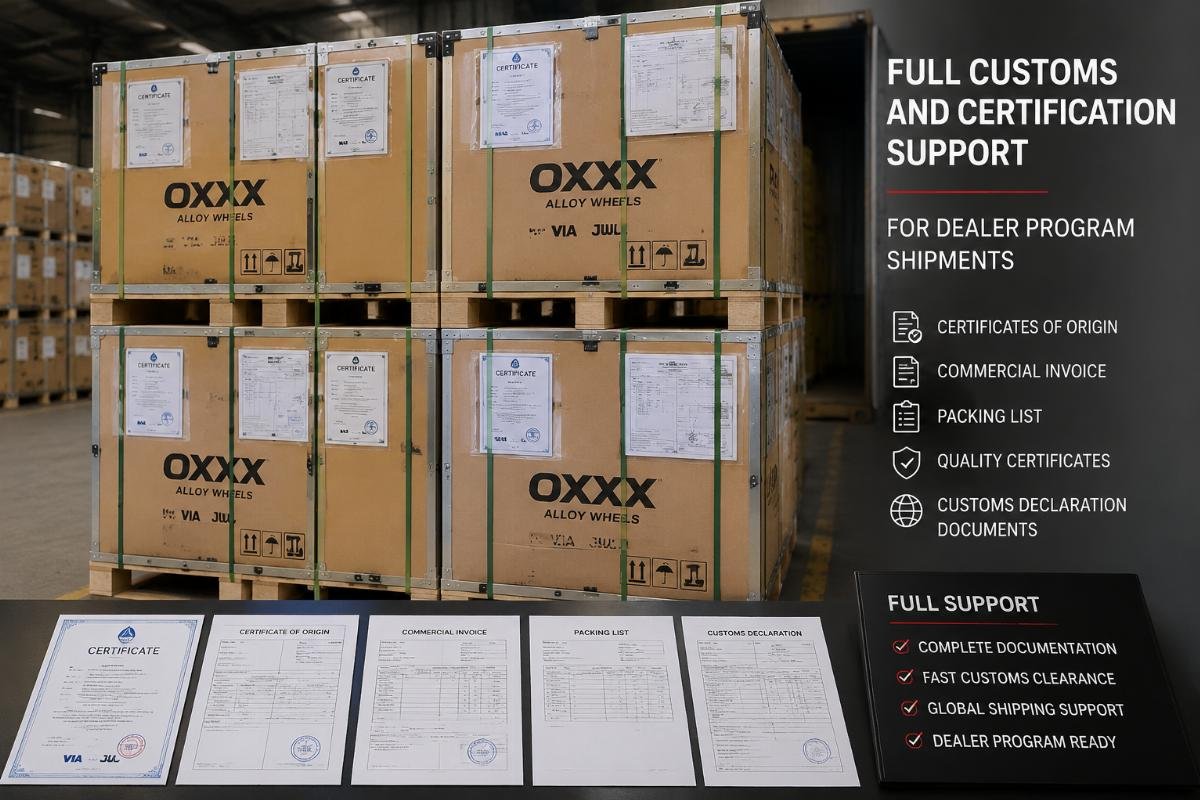
| Customs Support | No pre-provided documentation, leaving importers to handle clearance independently | Full pre-prepared customs documentation and clearance support for all shipping destinations |
| Order Flexibility | Penalties for order adjustments of more than 10% after confirmation | No penalty for order mix adjustments as long as total volume stays within tier parameters |
A US regional distributor operating in the entry tier recently secured a 30% exclusive territory rebate for annual orders exceeding 5000 units, with a fixed 21-day sea shipping lead time that allowed them to schedule restocks around seasonal demand peaks without carrying excess inventory.
- Warranty Validation – Confirm the 3-year structural warranty is explicitly written into the core agreement, not buried in fine print addendums
- Documentation Audit – Request a sample of standard customs documentation for your target market to confirm all required certifications are included
- Adjustment Rule Check – Clarify allowed order mix adjustments and penalty thresholds for volume changes within your tier bracket
Which dealer tier matches your business scenario best?
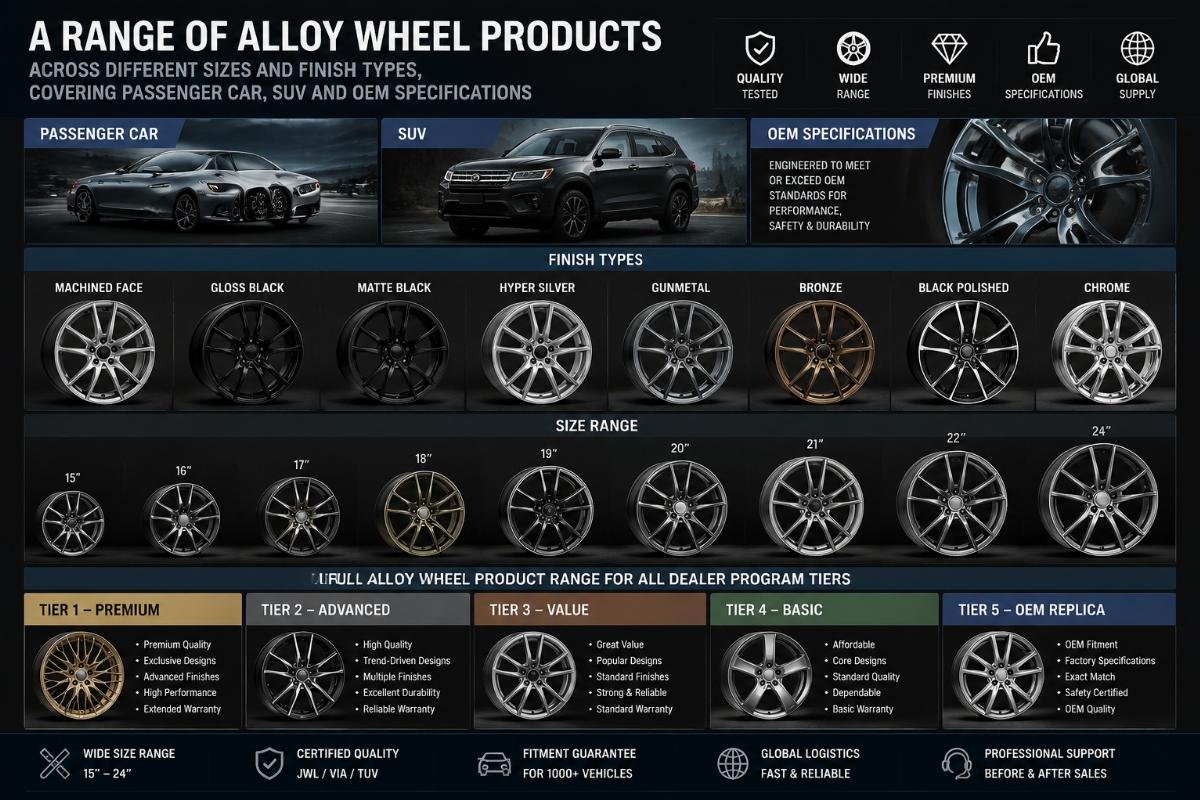
Your best-fit tier aligns directly to your existing customer segment and current order scale, with no requirement to commit to higher volume targets to access core benefits. Tiered programs map perfectly to the five core global customer segments, and leading manufacturers offer 7 core product lines covering 12-24 inch wheels and 6 surface finish options that fit the needs of every tier from small modification shops to large OEM assembly plants.
| Customer Segment | Common Tier Misalignment | Correct Tier Match |
|---|---|---|
| Modification / Tuning Shop | Pushing for entry into the 5000+ unit bulk tier to access lower pricing | Entry tier for 500+ annual units, with low 20-piece minimums for stocked SKUs |
| Regional Distributor | Committing to the 50000+ OEM tier to get exclusive territory rights | Mid-tier for 5000+ annual units, with eligible access to regional exclusive rights for 500+ monthly orders [NEED_CITE: 12 active exclusive dealer agreements across 8 global markets for mid-tier partners] |
| OEM Assembly Plant | Locking in short-term 6-month supply contracts | Enterprise tier for 50000+ annual units, with standard 2-year fixed price supply agreements |
A Southeast Asian auto assembly plant recently signed a 2-year supply agreement for 100,000 units of 15-17 inch passenger car wheels, with full DOT and JWL certification compliance, and avoided the price volatility common to spot market parts sourcing for their production line.
- Volume Benchmarking – Calculate your actual 12-month historical order volume for alloy wheels to pick a tier that matches rather than exceeds your current capacity
- Segment Alignment – Confirm your tier includes specific benefits for your core customer type, such as low MOQ for e-commerce sellers or full OEM drawing compliance for assembly plants
- Benefit Mapping – Cross-reference the tier benefit list against your top 3 operational pain points to confirm the program addresses your most urgent needs
How do dealer program benefits compare to regular direct purchasing?
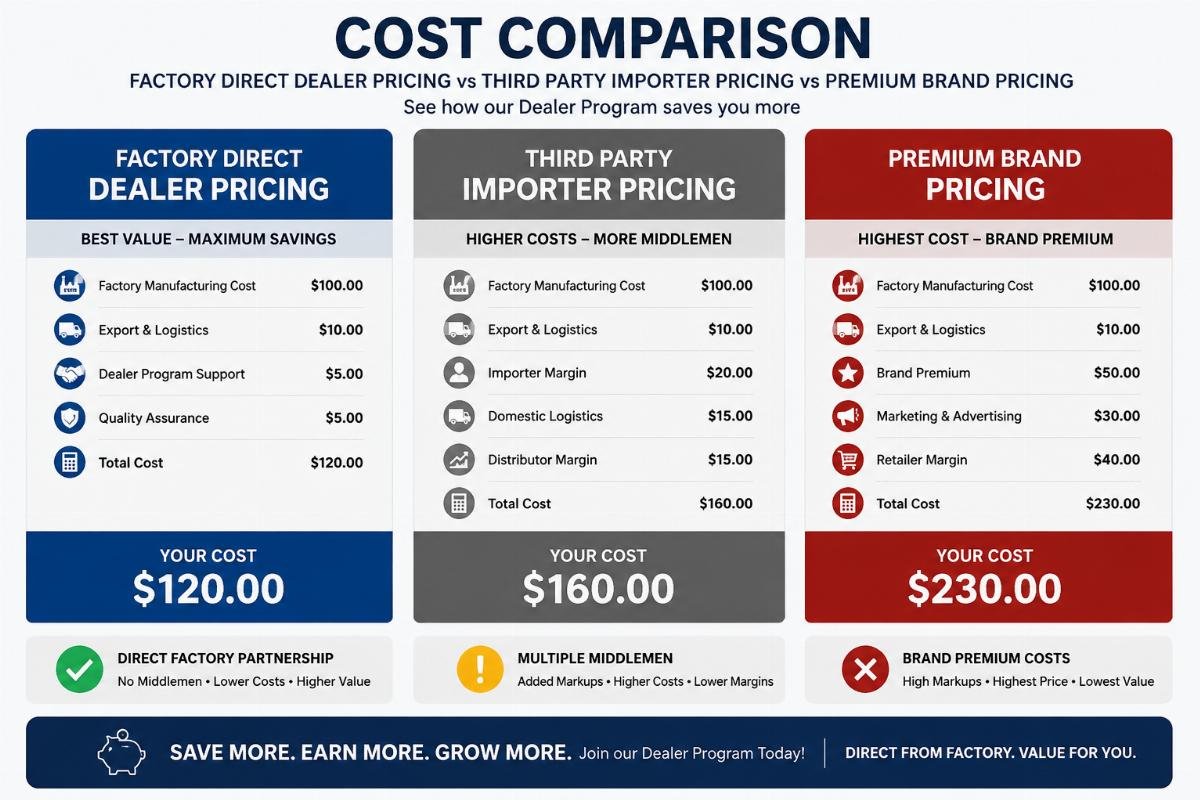
Registered dealer program partners unlock 10-25% extra rebates and priority production scheduling that are never available to regular one-off buyers. Even entry level partners get access to program-exclusive pricing that is 40-60% lower than comparable European and Japanese brand offerings, with no hidden markup from third party importers that typically add 30-40% to final landed costs.
- Rebate Calculation – Confirm how tiered volume rebates are calculated to avoid retroactive adjustments that reduce your expected margin
- Scheduling Priority – Clarify lead time guarantees for program partners, including priority access to production slots during peak order seasons
- Exclusion Check – Verify that no
