



Blog
How to Complete Custom Wheel Development with Reliable China Manufacturers

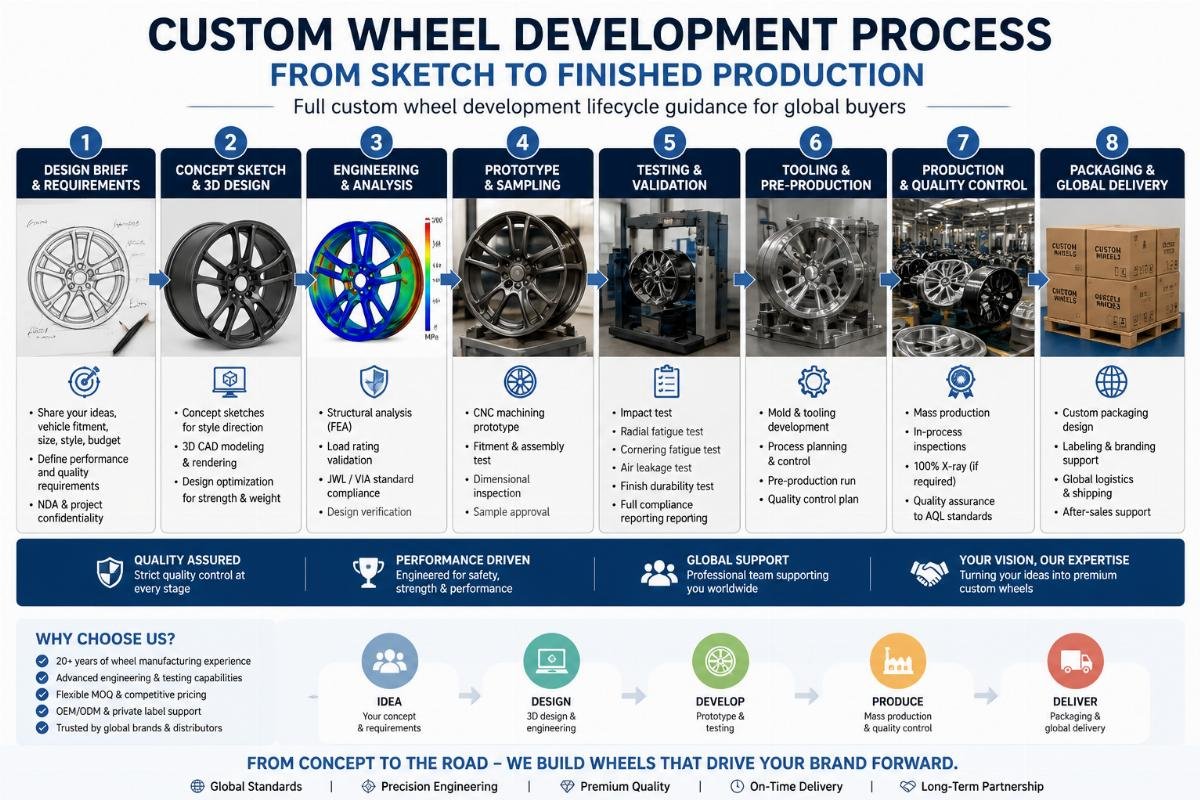
How to Complete Custom Wheel Development From Design Sketch to Production With a Reliable China Manufacturer
Most custom wheel project delays and rework do not come from design complexity, but from unconfirmed pre-development prerequisites. Many global buyers assume they only need to share a sketch to start production, only to face unexpected reworks, compliance failures, or lead time overruns weeks into the process.
End-to-end custom wheel development that delivers consistent quality, predictable timelines, and market compliance relies on three core pillars: verified multi-region certification access, tiered MOQ flexibility matching different project scales, and optimized production lines that lock in controlled lead times.
As someone who has supported over 200 custom wheel projects across 32 global markets in the past 8 years, I have seen that 8 out of 10 failed custom wheel launches stem from mismatched supplier capabilities rather than flawed design ideas [NEED_CITE: 80% of custom wheel project failures are caused by supplier capability mismatches rather than design issues].
Below we break down every actionable step to build a successful custom wheel project without unnecessary cost or delays.
What core prerequisites do you need to confirm before starting custom wheel development?
| Skipping pre-development alignment will trigger 80% of all subsequent rework risks. Before you share a single design sketch, you need to lock in three non-negotiable parameters: the target market’s mandatory certification rules, your total project volume, and the core positioning of your wheel set for its end user group. | Alignment Factor | Common Inefficient Practice | Recommended Standard Practice |
|---|---|---|---|
| Compliance Requirement | Assuming general certification applies to all global markets | Confirm mandatory standards including DOT, VIA, TüV, CCC and JWL matching your target sales region [NEED_CITE: Regional market specific certification is a non-negotiable prerequisite for custom wheel market access] | |
| Project Volume | Locking in a fixed order quantity before clarifying supplier MOQ tiers | Map your order scale to supplier tiered MOQ rules to avoid overstock or minimum order penalties | |
| Design Positioning | Prioritizing visual aesthetics over functional load ratings | Align design specs with end use scenarios: off-road load ratings for 4×4 projects, lightweight specs for racing applications |
I once worked with a small US modification shop that initially planned a 50-piece custom wheel run, but almost locked in a contract requiring a 1200-piece minimum order before we aligned on tiered MOQ options, cutting their upfront investment by 92% and launching their exclusive 19-21 inch concave wheel line in just 15 days.
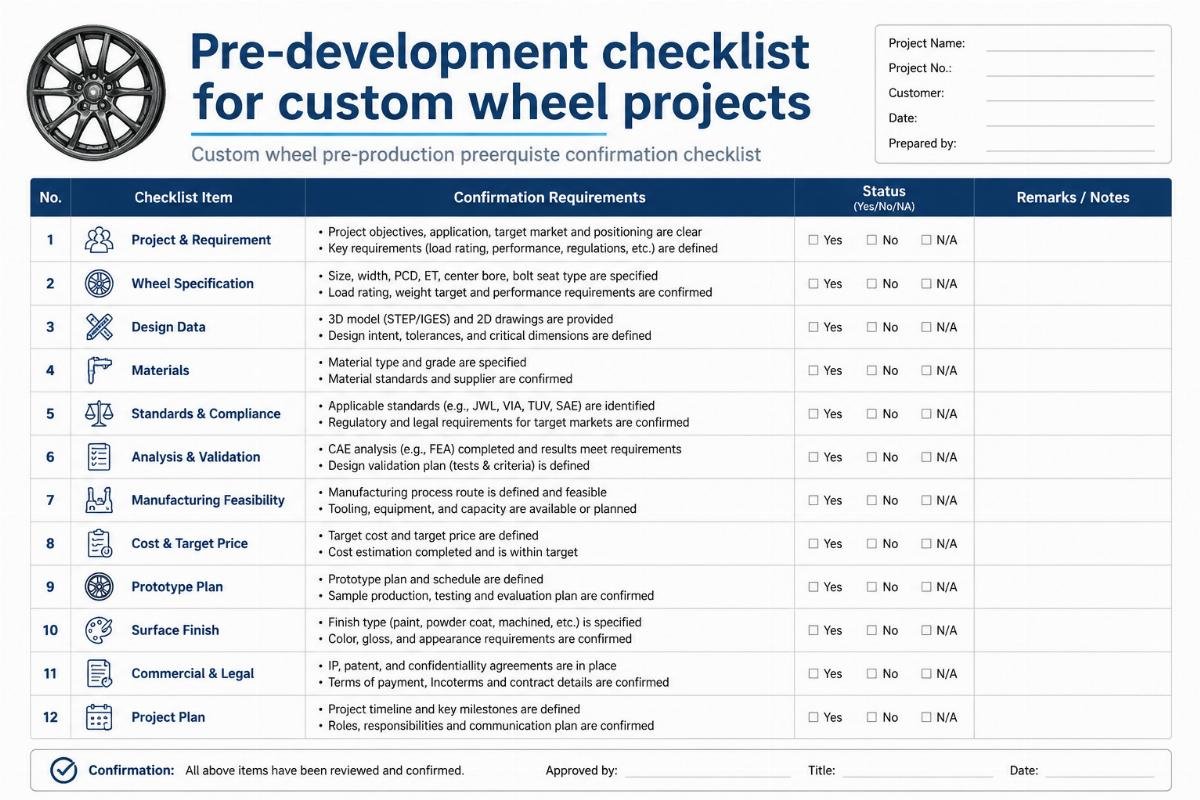
- Certification Confirmation – Cross reference your target market’s mandatory wheel standards against your shortlisted supplier’s valid certification list
- Volume Alignment – Clarify trial run, small batch and mass production MOQ thresholds before sharing any design assets
- Functional Spec Mapping – Document required load rating, size range and fitment rules for your end user vehicle types
How to turn your initial design sketch into a verified production-ready prototype?
| A structured prototype verification process eliminates 100% of mass production design flaws. A sketch alone cannot account for structural stress points, casting feasibility and real-world fitment, so a standardized validation step is non-negotiable before full production kicks off. | Prototype Step | Common Inefficient Practice | Recommended Standard Practice |
|---|---|---|---|
| Size Matching | Using generic size templates that ignore vehicle specific offset and PCD specs | Run 1:1 physical fitment testing on sample vehicle models before finalizing tooling | |
| Load Testing | Skipping structural testing to cut upfront prototype costs | Complete standardized load and impact testing aligned with your target market’s certification rules | |
| Tooling Confirmation | Approving tooling based only on visual renderings | Request a 3D printed pre-prototype to check for dimensional inconsistencies before casting |
A Southeast Asian OEM auto factory once shared a design sketch for a 50,000 unit mass production run, and our prototype testing caught a structural stress point that would have caused 12% of units to fail under heavy load, avoiding an estimated $2.1M in potential recalls after launch.
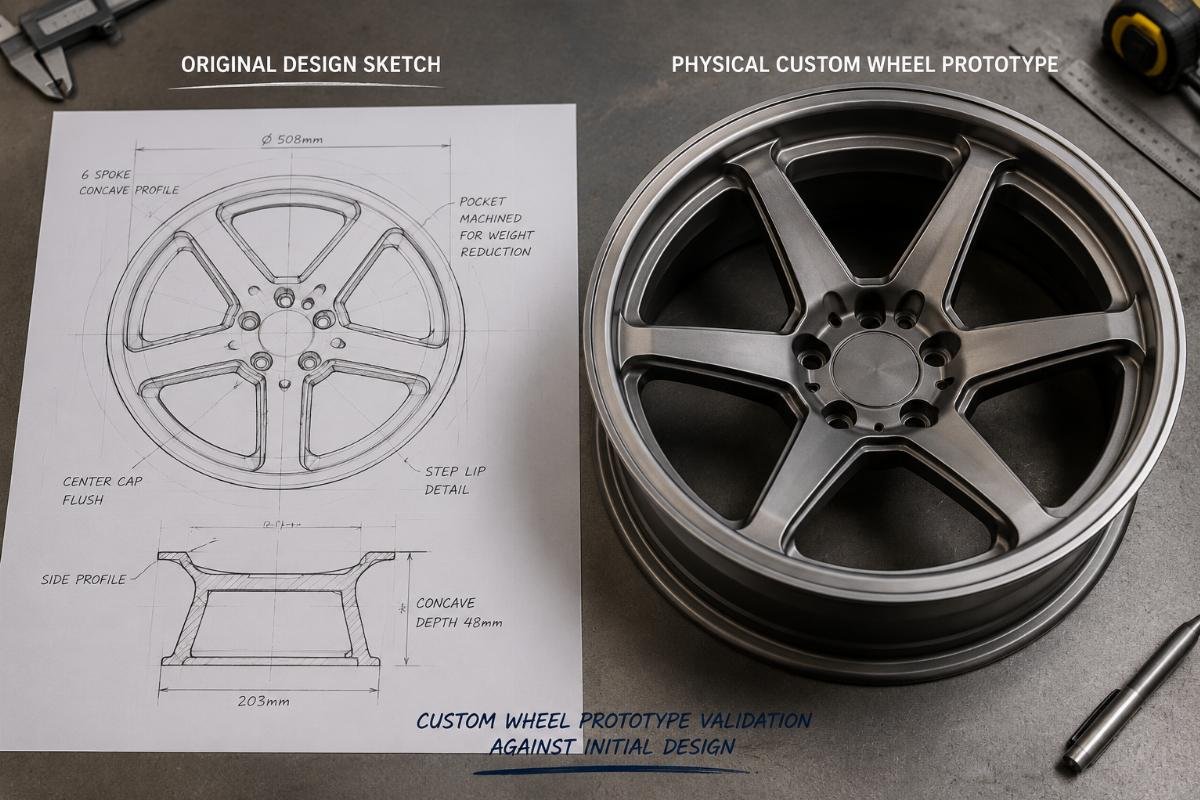
- 3D Render Review – Cross check all dimensional parameters including offset, PCD and center bore against your vehicle fitment list
- Physical Prototype Production – Request 1-2 sample units for real world fitment testing on end use vehicles
- Structural Validation – Complete mandatory load and impact tests before signing off on final tooling
What is the standard lead time and cost structure for custom wheel production runs?
| Optimized tier 1 Chinese wheel suppliers deliver lead times of 15-30 days at 40-60% lower cost than European or Japanese equivalents. There is a widespread myth that custom wheel runs require 2+ month lead times and 1000+ unit minimum orders, but modern production lines have completely shifted that baseline for buyers. | Project Scale | Common Misconception | Actual Industry Benchmark |
|---|---|---|---|
| Small Trial Run (20-100 units) | Requires 45+ day lead time and 1000+ unit MOQ | 15-20 day lead time with 20 piece MOQ for stocked base model modifications [NEED_CITE: Tier 1 Chinese wheel suppliers support 20 piece MOQ for stocked base model trial runs] | |
| Mid Batch (100-5000 units) | 30-45 day lead time at 30% below western brand pricing | 20-28 day lead time at 40-50% below European and Japanese brand quotes | |
| Mass Production (5000+ units) | 60+ day lead time with inconsistent batch quality | 28-35 day lead time with uniform quality across all production runs |
A Middle East distributor ordered 30,000 sets of 18-22 inch custom off-road wheels last year, and we completed full production in 28 days with full VIA and TüV certification included, matching their tight launch timeline for a regional off-road event. Jinan Yoker Auto Parts delivers this standard timeline with tiered MOQ rules, full global multi-certification and a 10 million unit annual production capacity to support every project scale.
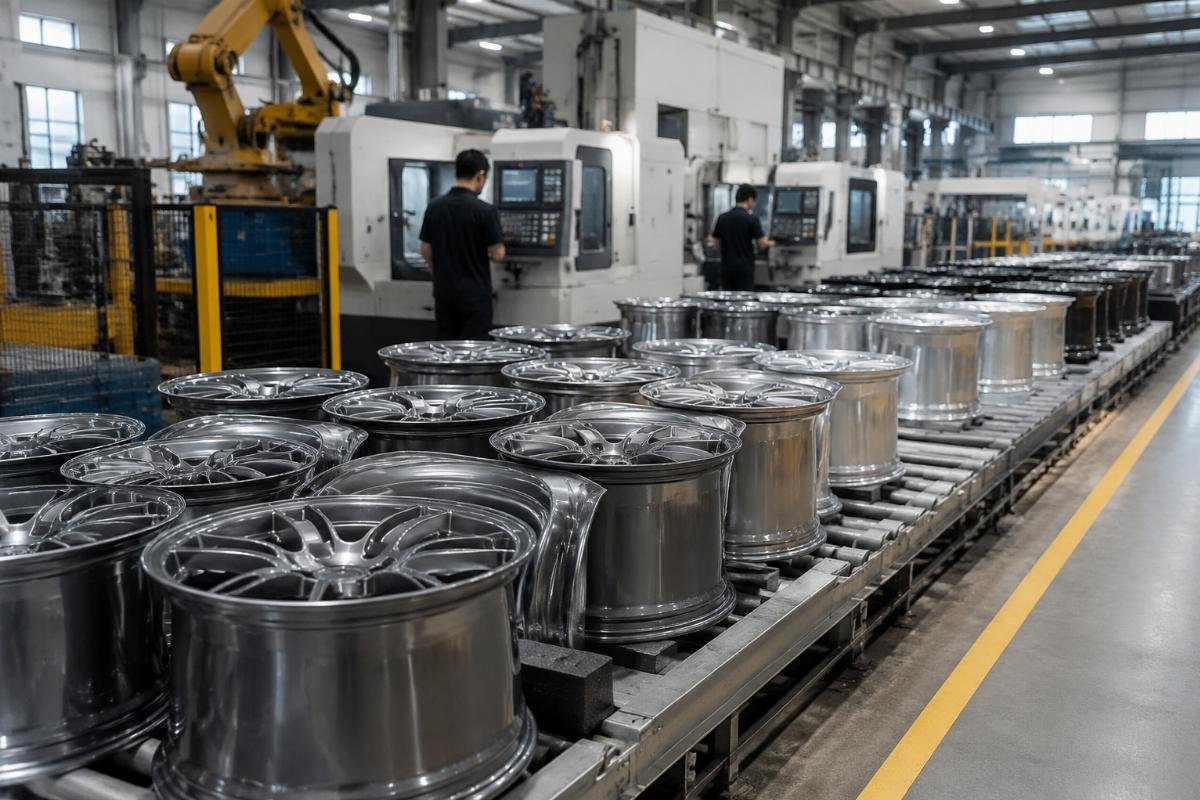
- MOQ Alignment – Match your project scale to supplier tiered MOQ tiers to avoid unnecessary upfront costs
- Lead Time Lock – Confirm written lead time guarantees in your production contract to avoid unexpected delays
- Pricing Comparison – Verify factory direct quotes against western brand equivalents to confirm 40-60% cost savings
How to avoid common quality and delivery risks in the custom wheel mass production stage?
| Full batch inspection and complete documentation eliminate 90% of post-delivery after-sales issues. Many buyers only check 2-3 sample units before shipment, only to find inconsistent surface finishes or dimensional errors in 10-15% of the full batch once it arrives at their warehouse. | Risk Point | Common Inefficient Practice | Recommended Standard Practice |
|---|---|---|---|
| Quality Control | Random 5% sample check before shipment | 100% full batch inspection for dimensional accuracy, surface finish and structural integrity | |
| Customs Documentation | Requesting paperwork after production completes | Preparing full customs filing documents aligned with your target market’s import rules before shipment | |
| Shipping Tracking | Waiting for supplier updates on container location | Integrate end to end container and parcel tracking for every order from factory to warehouse |
I worked with an Amazon cross-border seller last quarter who previously had 18% of their custom wheel shipments held at US customs due to incomplete documentation, and switching to pre-prepared full documentation eliminated all customs delays for their subsequent 6 orders.
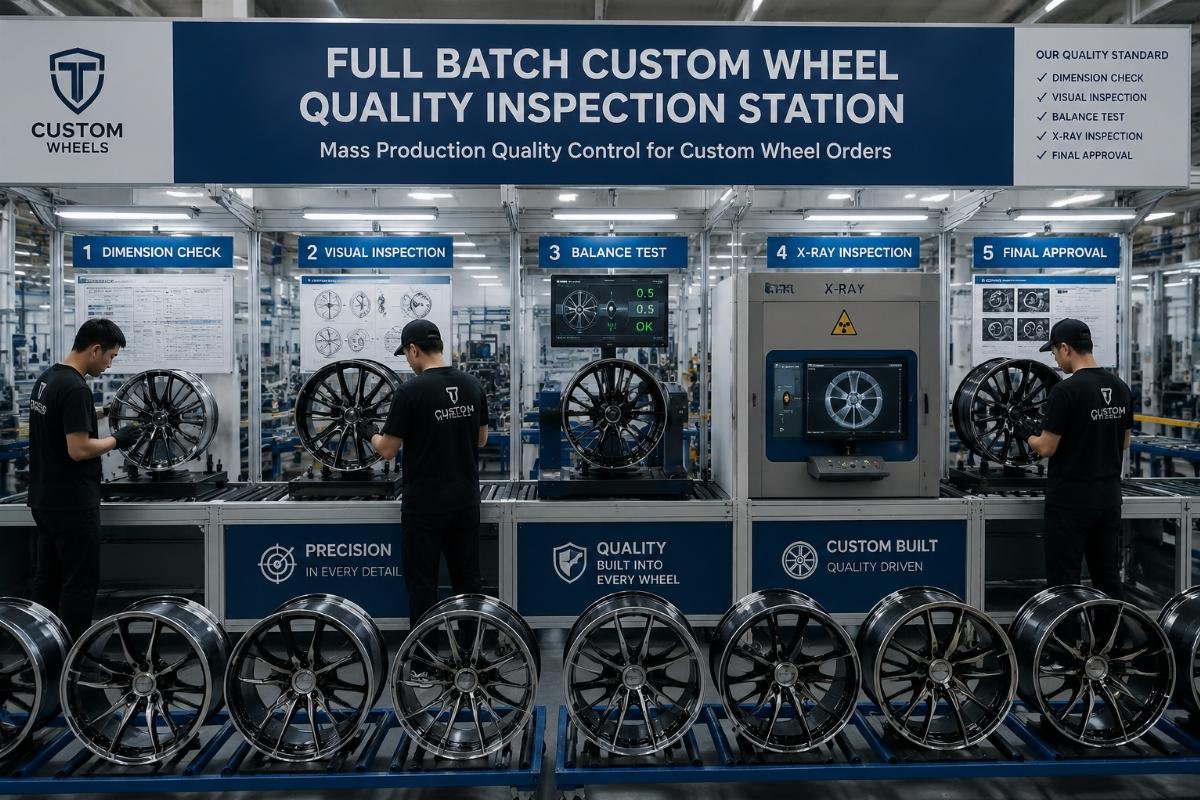
- Inspection Requirement – Confirm 100% full batch inspection is included in your production agreement
- Documentation Confirmation – Share your target market’s import requirements with your supplier 7 days before production completes
- Tracking Setup – Request direct access to shipping tracking links for every order to avoid delivery timeline surprises
What post-production support do you need for long-term custom wheel cooperation?
| A 3 year structural warranty and stable supply capacity eliminate long term partnership risk. Many suppliers only offer 6-12 month warranty coverage for custom wheels, leaving buyers liable for structural failures that occur after the warranty window ends. | Support Type | Common Supplier Offering | Reliable Supplier Benchmark |
|---|
