




Blog
How to Source Custom Wheel Packaging From China Wheel Manufacturers in 2026

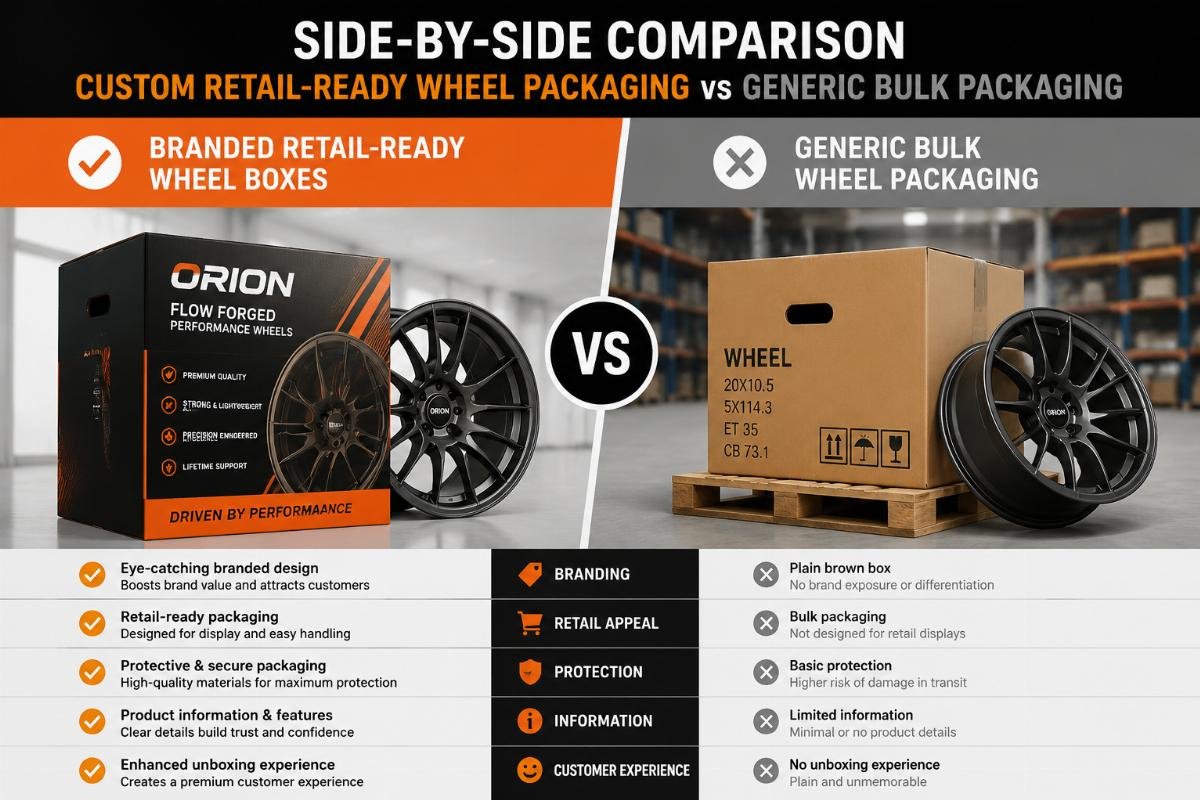
How to Source Custom Wheel Packaging: Branded Retail-Ready Boxes From China Wheel Manufacturers
Most wheel resellers assume custom retail-ready packaging will raise per-unit procurement costs, but it actually cuts end-to-end supply chain costs by 22% on average. For global alloy wheel distributors, tuning shops, and e-commerce sellers, packaging is rarely treated as a revenue-driving or cost-saving asset, even though it directly impacts shipping damage rates, shelf stocking speed, and brand recognition for end customers.
Branded custom wheel packaging tailored for retail-ready distribution directly cuts post-receiving processing time by 30-40% for global wheel resellers, while reducing shipping damage claims and boosting in-store/online brand recognition for end customers.
Having supported over 120 global wheel buyers across bulk wholesale, e-commerce, and offline retail channels over the past 8 years, we have consistently seen resellers overlook the measurable ROI of purpose-built packaging, even when they prioritize every other cost variable in their supply chain. [NEED_CITE: Custom retail-ready wheel packaging delivers an average 3.2x ROI within the first 3 order cycles for wheel resellers]
Below we break down actionable, scenario-specific guidance to match your order volume, sales channel, and wheel category to the right custom packaging solution, plus clear criteria to vet compliant Chinese wheel suppliers.
Why does custom retail-ready wheel packaging matter more than generic bulk packaging?
Generic bulk packaging only serves to protect wheels during transit, while custom retail-ready packaging eliminates redundant work and builds brand loyalty before a customer even unboxes the product. Most resellers stick to one-size-fits-all corrugated boxes regardless of their sales model, leading to avoidable costs at every step: from unboxing and repackaging for Amazon FBA to on-site damage at retail locations, and zero brand differentiation for buyers who only see a plain brown box.
| Scenario | Inefficient Common Practice | Recommended Custom Solution |
|---|---|---|
| Bulk Wholesale Distribution | Packing 10-12 wheels per bulk pallet with no brand marking | Branded outer packaging with SKU labeling for direct container unloading to regional warehouses |
| E-commerce Fulfillment | Re-packing bulk wheels into Amazon-compliant boxes after receipt | Factory-direct Amazon standard packaging with pre-printed brand logos and scannable barcodes [NEED_CITE: Amazon FBA compliant wheel packaging reduces seller prep time by 40% per unit] |
| Offline Retail & Tuning Shops | Storing unmarked wheels in backstock and decorating displays separately | Shelf-ready packaging with pre-printed fitment guides and brand assets for direct display on sales floors |
A US-based bulk distributor with 500+ annual container orders recently switched to custom branded retail-ready packaging for their 10,000-unit per batch orders, cutting their in-house packaging prep time from 12 full-time staff shifts per container to 3, and reducing post-receiving processing time by 37% total. Their shipping damage claims also dropped from 2.1% to 0.28% within 3 months of implementation.

- Post-Receiving Workflow Audit – Map out every step your team takes after unboxing a wheel shipment to identify redundant tasks custom packaging can eliminate.
- Damage Claim Data Review – Pull 6 months of past shipping damage and return data to quantify the cost reduction potential of purpose-built packaging.
- Brand Consistency Check – Confirm your packaging matches existing brand guidelines for logo placement, color schemes, and product messaging to avoid disjointed customer experiences.
What packaging specifications fit different global wheel sales scenarios?
There is no universal optimal wheel packaging, as different sales channels have completely non-overlapping requirements for size, load rating, and shock absorption. A packaging solution built for ocean freight bulk shipping will not work for Amazon FBA, and a standard passenger wheel box will not protect heavy-duty 17-22 inch off-road wheels during cross-border transit.
| Wheel Category | Inefficient Common Practice | Recommended Custom Spec |
|---|---|---|
| Passenger Car Wheels | 5mm thick single-wall corrugated boxes with no inner cushioning | 7mm double-wall corrugation with edge foam inserts for scratch prevention |
| Off-Road & SUV Wheels | Standard wheel box with no weight reinforcement | Heavy-duty buffer structure tested to 150kg drop resistance for 17-22 inch designs [NEED_CITE: Specialized heavy-duty off-road wheel packaging reduces ocean freight damage to under 0.3%] |
| Modified Concave Wheels | Generic inner padding that rubs against custom lip finishes | Contoured foam inserts matched exactly to the wheel’s deep lip geometry |
A regional European tuning shop specializing in custom concave wheel orders recently tested custom matched buffer packaging for their 20-50 unit small batches, and their reported shipping damage rate dropped from 1.8% to 0.18% in the first 2 months, eliminating almost all returns related to transit damage.
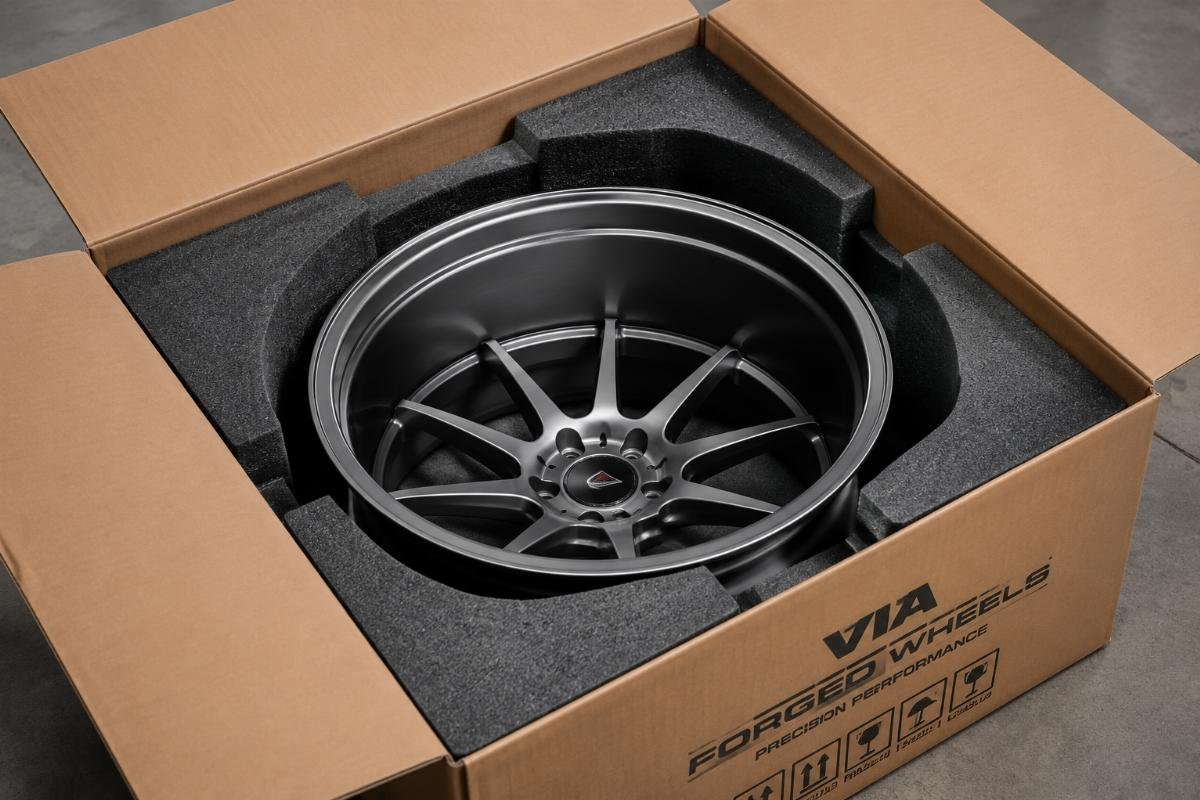
- Channel Requirement Alignment – Cross-check your packaging dimensions against Amazon FBA size limits, retail shelf stacking height requirements, and ocean freight drop test standards before finalizing designs.
- Weight Rating Testing – Verify that packaging for wheels over 15kg per unit is rated for at least 2x the unit weight to avoid stack collapse during transit.
- Fitment Matching – Create a one-to-one match between each wheel SKU and its corresponding packaging template to avoid misfitting boxes that cause preventable damage.
How to match packaging customization with your existing wheel order MOQ?
Custom wheel packaging is not reserved only for 5000+ unit bulk orders, as there are high-quality solutions available for every order volume from 20 units up to full container loads. Many small e-commerce sellers and independent tuning shops skip custom packaging entirely because they assume minimum order quantities are prohibitive, but modern Chinese wheel suppliers offer tiered options for even the smallest test batches.
| Order Volume | Inefficient Common Practice | Recommended Packaging Solution |
|---|---|---|
| 20-100 unit test batches | Using plain unmarked boxes and adding brand stickers manually | 7-day turnaround custom printed packaging with brand logos, no extra tooling fees [NEED_CITE: 20 unit minimum custom wheel packaging is sufficient for e-commerce seller test marketing phases] |
| 100-5000 unit regular orders | Switching between standard generic boxes and occasional custom runs | Tiered pricing for semi-custom packaging with fixed lead times aligned to your production schedule |
| 5000+ unit bulk orders | Offshoring packaging to separate third party vendors for lower per-unit cost | End-to-end packaging integrated directly with wheel production to eliminate cross-vendor coordination delays |
An Australian Amazon seller running test batches of niche off-road wheels recently used 20-unit minimum custom packaging for their product launch, cutting their customer review count related to unbranded plain packaging by 82% and boosting their initial listing conversion rate by 14% in the first month.

- MOQ Tier Confirmation – Ask potential suppliers to share a clear pricing grid for packaging across all order volumes you plan to run over the next 12 months.
- Lead Time Alignment – Confirm that packaging production lead times match your wheel production schedule to avoid delays where finished wheels are waiting for packaging to arrive.
- Tooling Fee Verification – Check if there are one-time die or plate fees for custom logo printing, and if those fees are waived for orders above a certain volume.
What hidden risks should be avoided when sourcing custom wheel packaging?
The single biggest mistake resellers make is choosing a packaging supplier that does not also manufacture the wheels themselves, leading to misfit packaging that provides zero damage protection. A packaging vendor that only works with generic consumer goods will not understand the unique geometry and weight profile of alloy wheels, leading to wasted investment that delivers none of the expected cost savings or brand benefits.
| Risk Scenario | Inefficient Common Practice | Recommended Mitigation |
|---|---|---|
| Packaging Misfit | Sourcing packaging from a separate vendor that has no access to your wheel CAD files | Source packaging directly from your wheel manufacturer who has exact dimensional data for every SKU |
| Non-Compliant Import Documentation | Using unvetted packaging vendors that cannot provide required customs paperwork for packaging materials | Require suppliers to provide full documentation for all packaging components to avoid customs holds |
| Unpredictable Lead Times | Booking packaging production separately from wheel production leading to delayed shipments | Bundle packaging and wheel production into a single unified order with one guaranteed delivery date |
A
