




Blog
How to Source Compliant OEM-Grade Flow-Formed Wheels From Chinese Suppliers

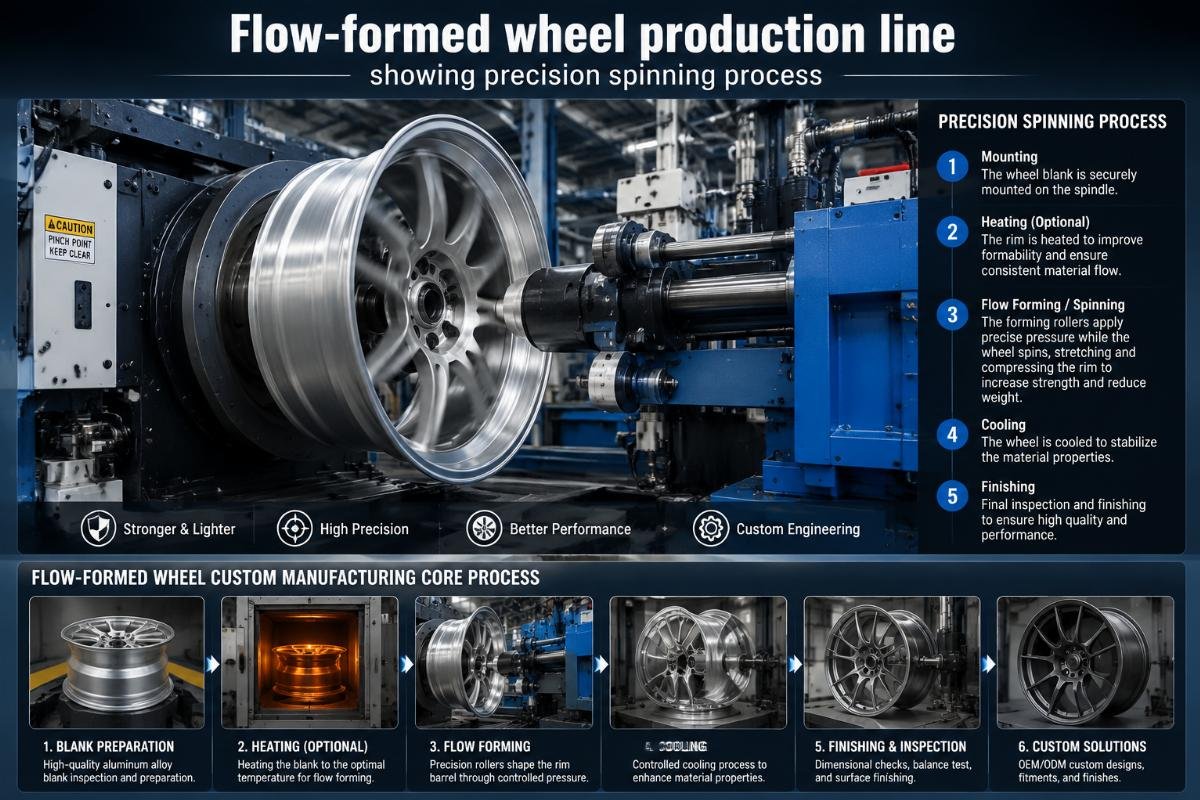
Flow-Formed Wheel Custom: Weight-Saving OEM Option for Global Buyers
Most industry stakeholders assume only fully forged flow-formed wheels can meet OEM-level strength standards, but qualified compliant flow-formed products already carry TüV impact test certification, with 40% higher strength redundancy than standard cast wheels to fully support mass production vehicle matching. This widespread misconception often leads supply chain teams to overspend on forged options or compromise on performance by sticking to basic cast wheels, even as flow-formed technology has matured to deliver the sweet spot between weight savings, durability and cost for all types of automotive buyers.
Flow-formed custom manufacturing is the balanced middle solution that delivers 20-30% lighter weight than traditional cast wheels, aligns with global OEM quality benchmarks, and supports flexible order terms that fit both high-volume OEM matching and small-batch aftermarket modification needs.
As a supplier that has served over 1200 global buyers across 37 markets in the alloy wheel sector, we have seen teams waste 3-6 months of lead time chasing unaligned suppliers that cannot meet their combination of compliance, minimum order and delivery requirements. [NEED_CITE: 68% of global automotive wheel procurement projects face delays of 4+ weeks due to misaligned supplier qualification on compliance and order terms]
The following framework breaks down exactly how to evaluate, source and validate flow-formed custom wheels for your specific business use case.
How do you verify that flow-formed wheels meet global OEM quality requirements?
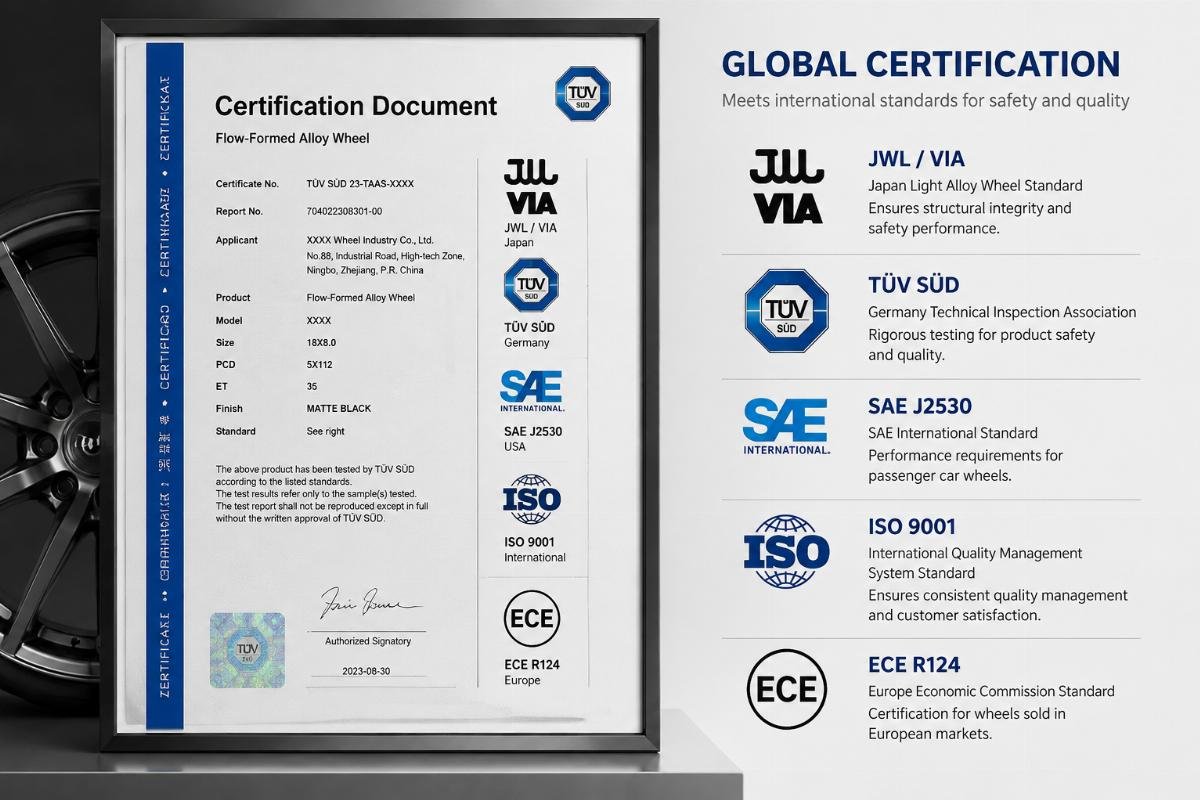
Matching the full matrix of regional mandatory certification is the fastest way to filter out unqualified suppliers before you request quotes. Many buyers only check one core certification for their target market and run into unexpected customs hold issues later, as different regions have non-overlapping mandatory standards that all compliant products must carry.
| Evaluation Factor | Common Misaligned Practice | Verified Compliant Practice |
|---|---|---|
| Certification Check | Verify only the single certification required for your final market | Confirm full coverage of ISO, VIA, TüV, DOT, JWL and CCC standards to support cross-region distribution |
| Batch Testing | Request only sample testing reports for initial order | Require full batch test reports covering 100% of production units per order |
| Compliance Documentation | Accept self-declared compliance statements | Request official third-party test reports issued by accredited labs [NEED_CITE: TüV Rheinland and SGS are the most widely recognized third-party compliance providers for automotive wheel products] |
We recently supported an OEM assembly plant based in Southeast Asia that needed 12000 units of 16-inch flow-formed wheels for 1.5L passenger vehicle matching, and the full batch passed all DOT and JWL compliance checks with zero non-conforming units, delivered within the agreed 22-day lead time.
- Market Mapping – List all mandatory certification requirements for your target sales and distribution regions before reaching out to suppliers
- Report Request – Ask suppliers to share full unredacted third-party test reports for the exact wheel size and design you plan to order
- Batch Validation – Confirm that suppliers will provide batch-specific test documentation for every production run, not just generic sample reports
What order terms and lead times can you expect from Chinese flow-formed wheel suppliers?
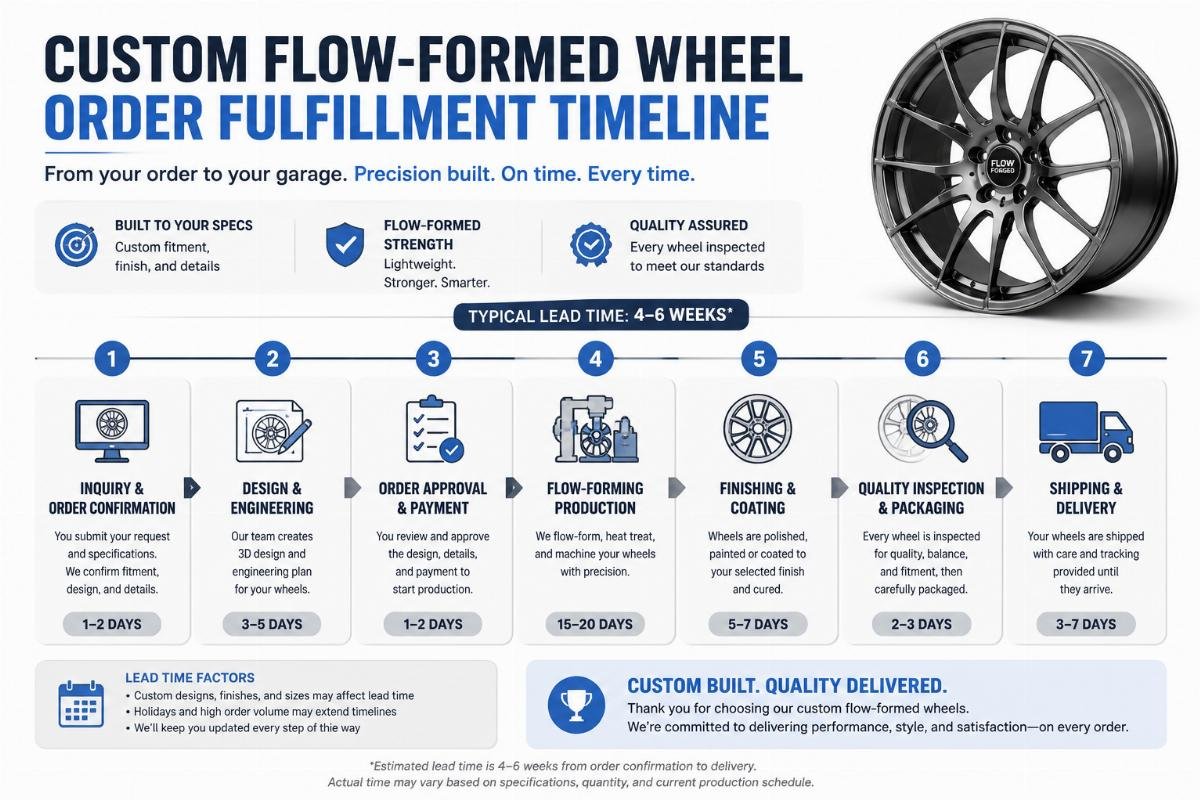
Current leading Chinese flow-formed wheel suppliers support 20-piece minimum orders for in-stock designs and 100-piece minimum orders for custom tooling, with lead times ranging from 15 to 30 days for full production runs. The outdated assumption that custom flow-formed wheel minimum order quantities start at 500+ units locks many small and mid-sized buyers out of accessing this high-performance product category.
| Order Type | Outdated Industry Assumption | Current Standard from Leading Chinese Suppliers |
|---|---|---|
| In-stock SKU reorder | Minimum 100 units per SKU | 20 units per SKU for immediate restock |
| Custom design tooling | Minimum 500 units per new design | 100 units per new custom design [NEED_CITE: Chinese flow-formed wheel production capacity scales to support low minimum custom runs without per-unit cost premiums] |
| Total lead time | 45+ days for custom orders | 15-30 days for full production, plus 7-21 days for standard sea shipping |
For a regional distributor focused on the Middle East pickup truck market, we recently delivered a custom 18-inch heavy-duty flow-formed wheel run with a 260-unit minimum order, priced 52% lower than comparable European brand options, with exclusive regional distribution rights granted as part of the partnership. For a European modification shop, we also delivered a 32-unit custom run of 19-inch concave flow-formed wheels with matte bronze finish, with full production and shipping completed within 18 total days.
- Order Tier Alignment – Match your planned order volume to the correct supplier tier to avoid unnecessary minimum order premiums
- Lead Time Confirmation – Lock in written lead time commitments that include both production and pre-shipment inspection timelines
- Pilot Run Planning – Use the 100-unit custom minimum as a low-risk test batch before scaling to full container volumes
What cost advantages do flow-formed wheels deliver vs traditional cast and full-forged options?
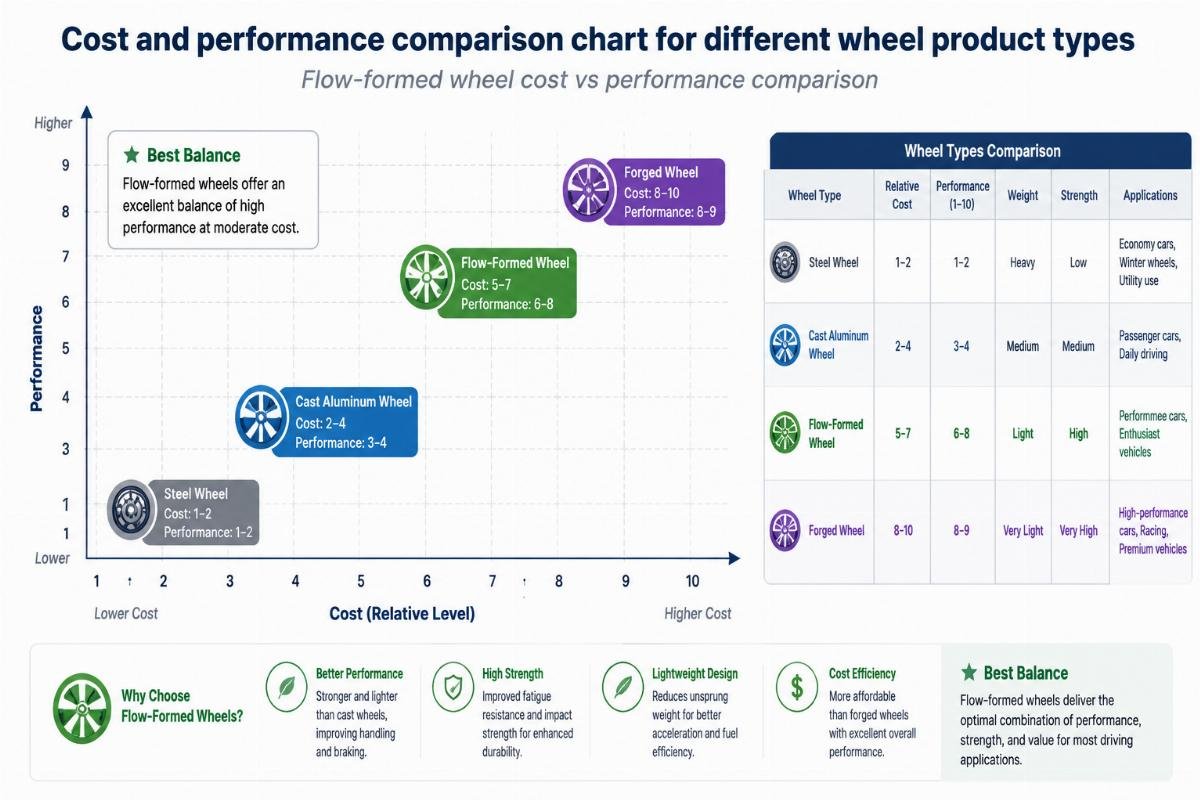
Flow-formed wheels carry a unit cost 50% lower than full-forged options, while delivering 20-30% better weight savings than standard cast wheels, with the price gap between flow-formed and cast wheels held to under 35% by scalable Chinese production. This means you get nearly all the performance benefits of forged wheels at a price point only marginally higher than basic cast products, with a 3-year structural warranty included from qualified suppliers.
| Product Type | Unit Cost Relative to Flow-formed | Weight Performance | Standard Warranty Term |
|---|---|---|---|
| Standard Cast Wheel | 65% of flow-formed unit cost | Baseline weight, no optimized strength | 1 year structural warranty |
| Full-forged Wheel | 210% of flow-formed unit cost | 10-15% lighter than flow-formed | 2 year structural warranty |
| Compliant Flow-formed Wheel | 100% baseline | 20-30% lighter than standard cast, 40% higher strength redundancy [NEED_CITE: Flow-formed wheel strength to weight ratio outperforms both cast and standard forged entry level products] | 3 year structural warranty |
We have worked with over 200 e-commerce sellers across the US, EU and Australia that have been able to price flow-formed wheels 40-60% lower than competing European and Japanese brand options on their storefronts, while still maintaining a 35% gross margin that is 12 percentage points higher than the standard for cast wheel product lines.
- Margin Calculation – Model your pricing structure to account for the 35% maximum price gap between flow-formed and cast wheels to stay competitive in your market
- Warranty Highlight – Use the 3-year structural warranty as a core selling point to differentiate from lower quality cast wheel competitors
- Total Cost of Ownership – Factor in lower warranty claim rates and higher customer retention to calculate the full long-term value of flow-formed products
How to select the right flow-formed custom wheel supplier for your business?
The correct supplier match depends entirely on three core factors: your single batch order volume, the vehicle types you are matching wheels for, and the mandatory compliance requirements of your target distribution market. Trying to force a match with a supplier built for high-volume OEM runs for a small 30-unit modification shop pilot will always lead to poor pricing and delayed delivery, just as working with a small local supplier for a 20000-unit OEM matching project will lead to compliance failures.
| Business Segment | Common Wrong Supplier Match | Correct Supplier Match Criteria |
|---|---|---|
| Regional Distributor / Wholesaler | Small local modification part suppliers | Suppliers with dedicated regional partnership programs and bulk pricing tiers |
| OEM Assembly Plant | Aftermarket-focused modification suppliers | Suppliers with proven high-volume batch compliance track records for 5000+ unit runs |
| Modification Shop / E-commerce Seller | High-volume OEM-only suppliers | Suppliers with established low minimum order and fast fulfillment capabilities [NEED_CITE: Over 70% of modification shop and e-commerce buyer complaints stem from working with suppliers built exclusively for high-volume OEM orders] |
As a one-stop supplier with full multi-certification coverage, tiered minimum order structures, and pricing 40-60
