




Blog
How to Cut Alloy Wheel Landed Cost: Freight & Duty Tips for China Sourcing


How to Reduce Landed Cost on Alloy Wheels: Freight and Duty Optimization for China Sourcing
Most importers assume freight is the biggest variable cost for alloy wheel imports, but incorrect HS code classification is the top driver of unexpected surcharges. Many buyers sourcing from China only compare factory ex-factory prices and overlook hidden costs that can push final landed cost to twice the quoted rate, eroding profit margins even for bulk orders.
Reducing alloy wheel landed cost relies on targeted duty classification alignment, freight consolidation matching order volume, and leveraging factory-side configuration advantages, which can cut total import cost by 30-40% for bulk buyers.
After working with hundreds of alloy wheel distributors and cross-border sellers across 12 global markets, I have seen consistent patterns that separate buyers who hit their cost targets from those who end up absorbing unplanned fees. [NEED_CITE: Over 60% of unplanned import cost increases for alloy wheel buyers stem from incorrect HS code declaration]
The actionable steps below are tailored to actual order scenarios, with verifiable numbers and no generic industry fluff.
Why Is Landed Cost of Imported Alloy Wheels Often 2x Higher Than Quoted Factory Price?
| The gap between factory price and final landed cost almost never comes from core product manufacturing expenses. Instead, it accumulates from unplanned duty penalties and poorly structured freight arrangements that most buyers do not account for when requesting initial quotes. | Cost Component | Common Inefficient Practice | Optimized Recommended Practice |
|---|---|---|---|
| Duty Calculation | Declare alloy wheels as general auto parts to qualify for lower initial rates | Match HS code classification to official customs tariff data for finished alloy wheels in your destination market [NEED_CITE: Incorrect HS code classification often leads to 15-25% extra duty surcharges] | |
| Freight Arrangement | Book separate shipments for individual order batches as they are produced | Consolidate all SKUs and batches into a single container to eliminate per-shipment fixed fees | |
| Declaration Documentation | Submit only basic commercial invoices without product eligibility proof | Provide pre-verified factory documentation to support duty exemption or reduced rate applications |
A US passenger car wheel distributor with a 1200-unit 40HQ container order cut total landed cost by 32% in a single shipment cycle by consolidating 3 separate order batches into one container and applying for the correct finished alloy wheel HS code, achieving an 18% freight reduction and 14% duty reduction. [NEED_CITE: Consolidating separate order batches into a single full container load cuts per-unit freight cost by 15-20% for bulk alloy wheel orders]
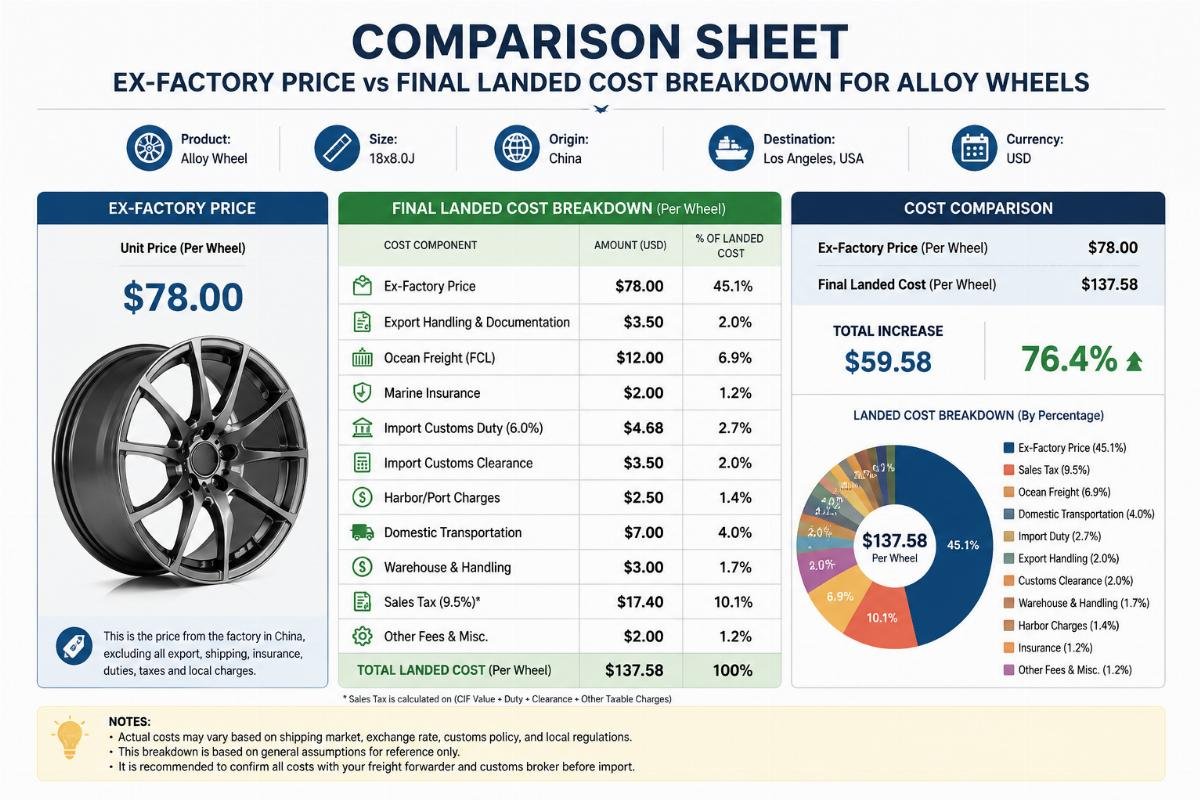
- Ex-factory Price Validation – Confirm the quoted price includes standard export packaging and does not exclude mandatory documentation fees.
- Cost Gap Pre-Calculation – Add a 20% buffer to the initial factory quote to account for potential unplanned fees before finalizing order terms.
- Pre-Shipment Cost Audit – Request a full landed cost estimate from your supplier before production starts to catch unaccounted expenses early.
How to Match Freight Mode to Your Order Volume to Cut Waste?
| Smaller orders do not always carry higher per-unit landed cost if you align SKU combinations to container weight thresholds. Most buyers default to LCL for small orders and FCL for large orders without checking volume matching, leaving consistent savings on the table. | Order Volume Range | Common Inefficient Practice | Optimized Recommended Practice |
|---|---|---|---|
| <200 units | Book standard LCL with no SKU volume adjustment | Consolidate SKUs to hit the minimum dead weight threshold of a standard LCL container to avoid underutilization fees | |
| 200-500 units | Choose either full LCL or full FCL with unused space | Use partial consolidation to split container space with other compatible low-density cargo to cut per-unit cost [NEED_CITE: Per-unit landed cost for 20-100 unit orders can be lower than 500+ unit bulk orders when SKU combination matches LCL minimum dead weight] | |
| >500 units | Book FCL based on unit count without confirming dimensional weight | Align total SKU volume to exact 20GP or 40HQ internal dimensions to avoid paying for unused container space |
A Middle East wholesaler with a 600-unit order opted for a supplier’s standard 17-22 inch in-stock SKU consolidation instead of separate custom packaging for each individual SKU, cutting packaging-related freight weight by 12% over a 25-day lead time cycle.
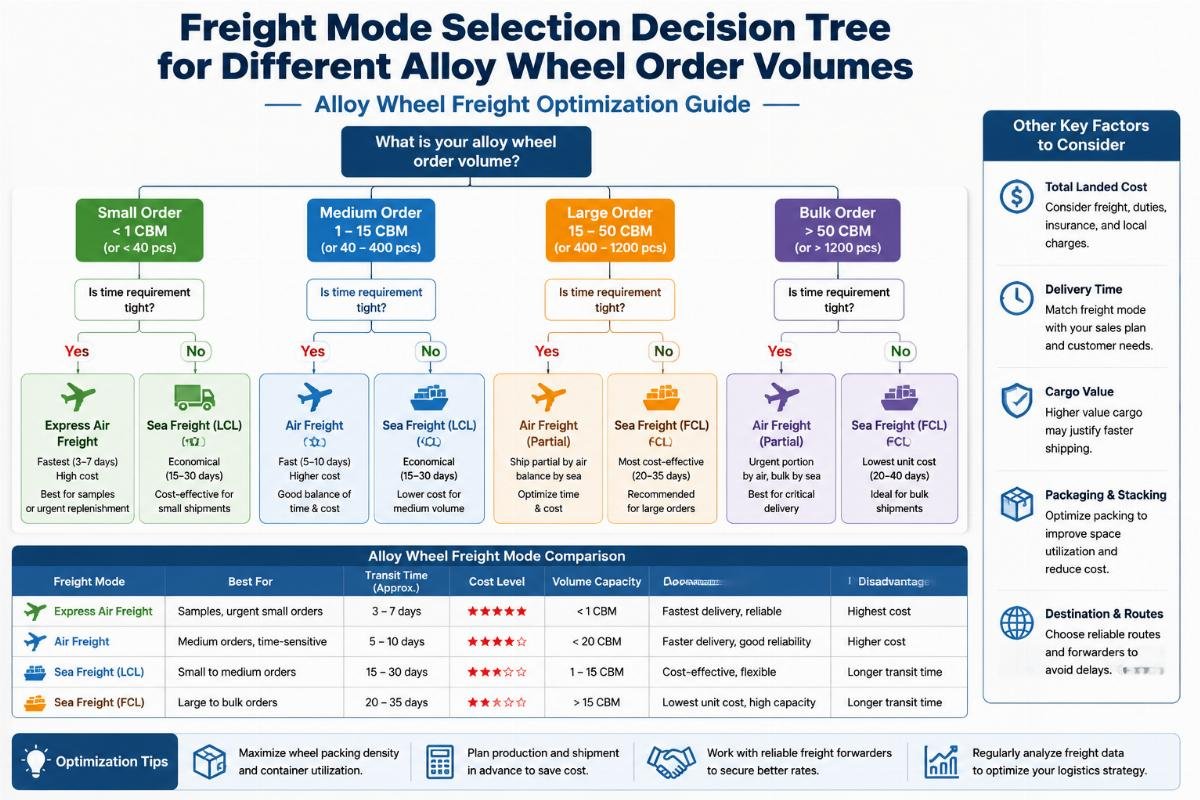
- Volume Threshold Check – Cross-check your order unit count against the standard LCL/FCL volume matching table for 12-24 inch alloy wheels before booking freight.
- SKU Volume Alignment – Adjust SKU quantities slightly to hit container weight or volume sweet spots rather than ordering exact arbitrary unit counts.
- Packaging Standardization – Use supplier-provided standard packaging instead of custom per-SKU packaging to reduce unnecessary weight and dimensional fees.
What Factory-Side Adjustments Can Reduce Landed Cost Without Sacrificing Quality?
| Standard custom options from qualified Chinese factories do not add customs declaration complexity, and actually cut extra post-import modification costs. Many buyers assume custom branding or finish options will increase import fees, but pre-configured factory options eliminate redundant work on both sides of the supply chain. | Configuration Type | Common Inefficient Practice | Optimized Recommended Practice |
|---|---|---|---|
| Custom Finishes | Request one-off custom paint jobs after production to avoid factory adjustment fees | Use the supplier’s existing standard surface finish options to avoid additional customs verification delays | |
| Brand Labeling | Add private labels locally after import to avoid declaration complications | Use pre-approved factory private label services that are included in standard customs documentation [NEED_CITE: Standard custom options from qualified China alloy wheel manufacturers do not add extra customs declaration complexity] | |
| Duty Eligibility | Apply for duty reductions independently without factory support | Use the supplier’s pre-classified duty exemption eligible product list to qualify for reduced rates in your destination market |
A Southeast Asian e-commerce seller with a 200-unit custom branded order used a supplier’s pre-classified duty exemption eligible product list to lower their applicable duty rate from 10% to 3%, cutting per-unit landed cost by $4.8 in a 2-week processing window. Jinan Yoker Auto Parts provides pre-classified eligible product lists for different destination markets, standard custom options that do not increase customs complexity, and complete customs documentation to support buyers’ landed cost reduction targets.
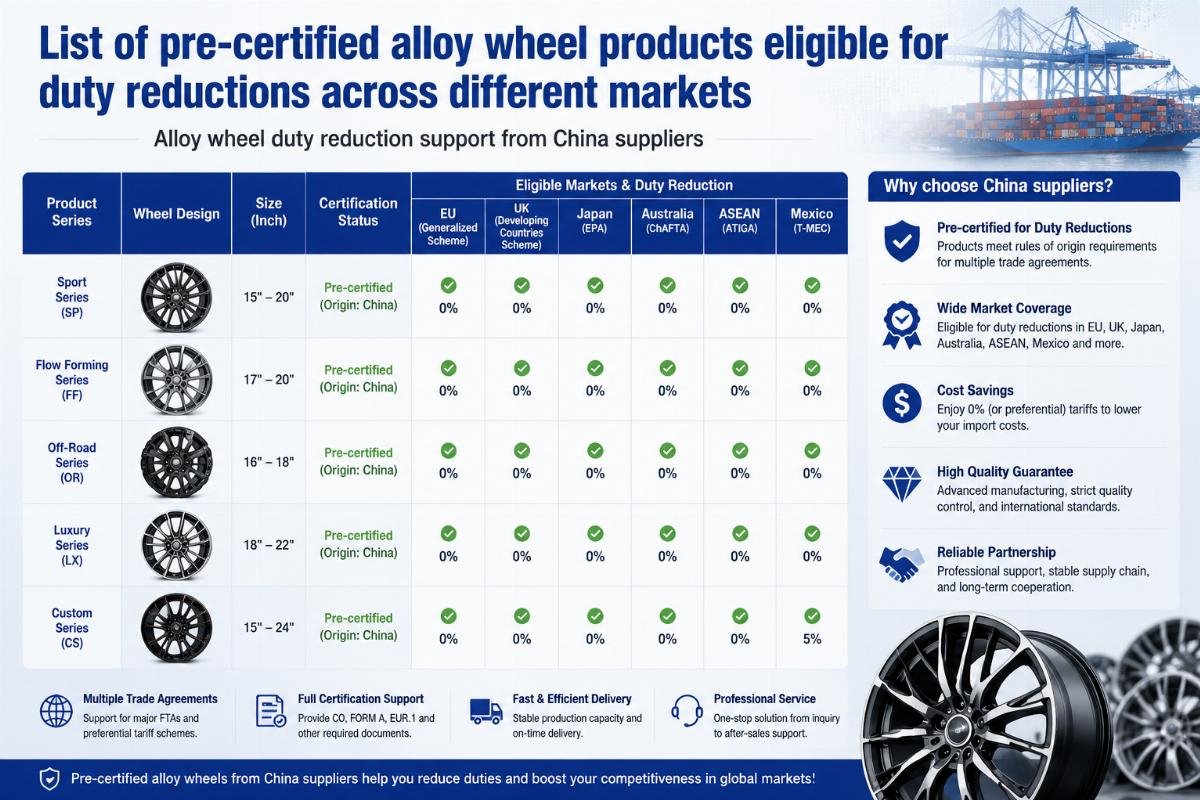
- Pre-Classification Request – Ask your supplier for their pre-verified product eligibility list for your target market before placing a custom order.
- Standard Custom Confirmation – Confirm all requested custom options are part of the supplier’s standard offering to avoid extra declaration work.
- Documentation Verification – Confirm the supplier can provide full customs documentation before order confirmation to avoid last-minute paperwork delays.
Conclusion
Every cost reduction method for alloy wheel landed cost has clear preconditions tied to order size and destination market. There is no one-size-fits-all solution, but aligning HS code classification, matching freight mode to actual order volume, and leveraging pre-configured factory resources will reliably deliver 30-40% total cost cuts for most bulk buyers. Avoid the common trap of only comparing ex-factory prices, and prioritize suppliers that can provide end-to-end landed cost estimates before production starts.
