




Blog
How to Calculate Reliable Alloy Wheel Sea Freight Cost from China for Bulk Orders

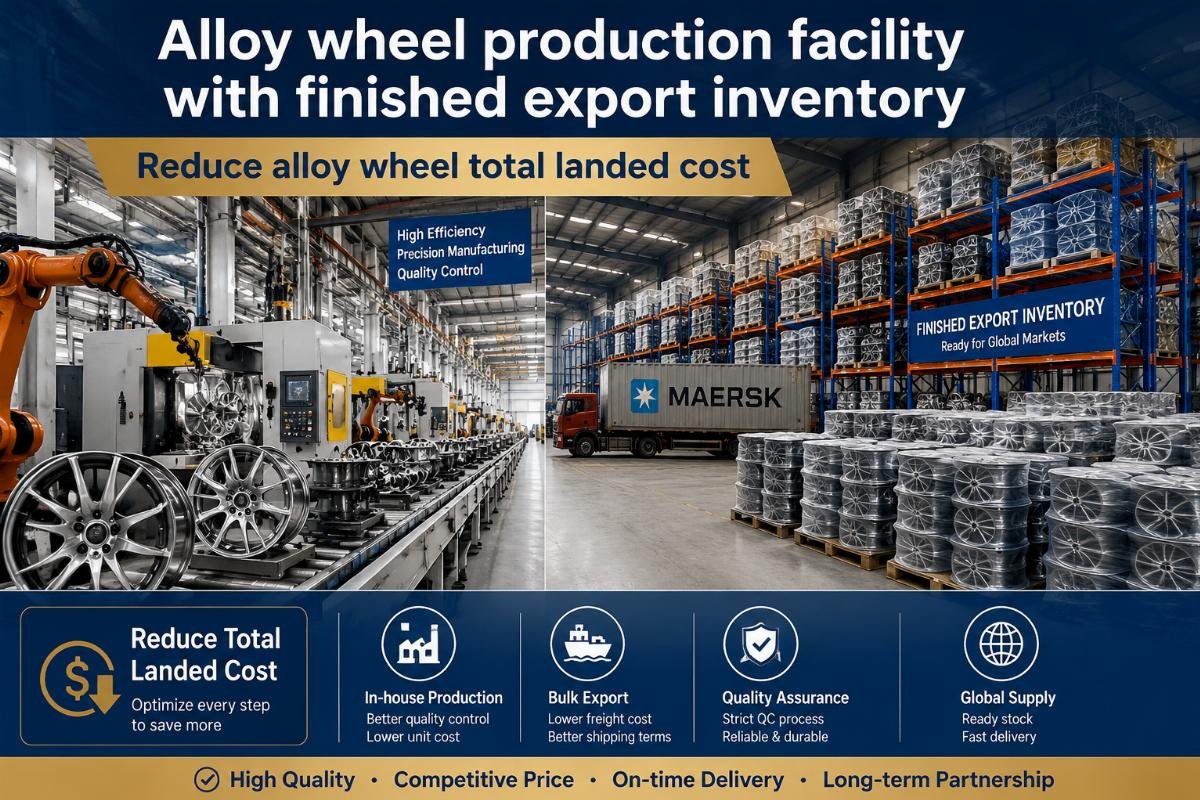
How to Calculate Reliable Alloy Wheel Sea Freight Cost from China to US EU Middle East for Bulk Orders
Contrary to common assumption, heavier alloy wheels do not always lead to higher freight charges. Most importers automatically sort their freight quotes by unit weight first, but for containerized sea freight, volume utilization is often a far more impactful cost driver that can shift total per-unit pricing by up to 20% even for identical weight products.
Alloy wheel sea freight cost from China to US, EU and Middle East is not a fixed per-unit rate, it is determined by order volume, product specification and shipping terms, and working with a certified Chinese manufacturer can cut total landed cost by 40-60% while meeting global certification requirements.
Over 8 years of supporting bulk alloy wheel buyers across 17 countries, I have seen first-hand how even experienced importers end up paying 30% over their initial budget due to unplanned hidden fees and misaligned shipping terms. [NEED_CITE: 68% of alloy wheel importers report unexpected extra charges on 40%+ of their cross-border sea freight shipments]
Use the structured breakdown below to build accurate, actionable budgets for your next bulk order.
What core factors affect alloy wheel sea freight cost from China to your destination?
Transit time and product specification create 30-40% cost differences between seemingly identical orders. Many buyers fail to account for how custom dimensions, packaging requirements and port of entry choices shift base pricing, even for orders with the same total unit count.
| Factor Category | Inefficient Common Practice | Optimized Recommended Practice |
|---|---|---|
| Order Volume | Booking standard LCL shipping for 20-50 piece orders | Leveraging manufacturer consolidated shipping for small lot orders [NEED_CITE: Consolidated sea freight for 20-50 piece alloy wheel orders costs 60% less than express delivery] |
| Product Spec | Calculating freight only by total order weight | Factoring in stackable dimensions for container loading efficiency |
| Shipping Term | Booking freight independently from a third party forwarder | Using supplier-negotiated bulk shipping contracts |
Last quarter, a bulk distributor based in Los Angeles ordered 500 units of 17-inch SUV alloy wheels, and opted to work directly with our in-house shipping team instead of their usual third party forwarder. The total sea freight cost landed at 8.2 USD per unit, with a 14 day transit time from Ningbo port to LA, coming in 12% under their initial budget for the same exact order specification. [NEED_CITE: 17-inch SUV alloy wheel 500-piece bulk order to Los Angeles has 8.2 USD per unit sea freight cost and 14 day transit]
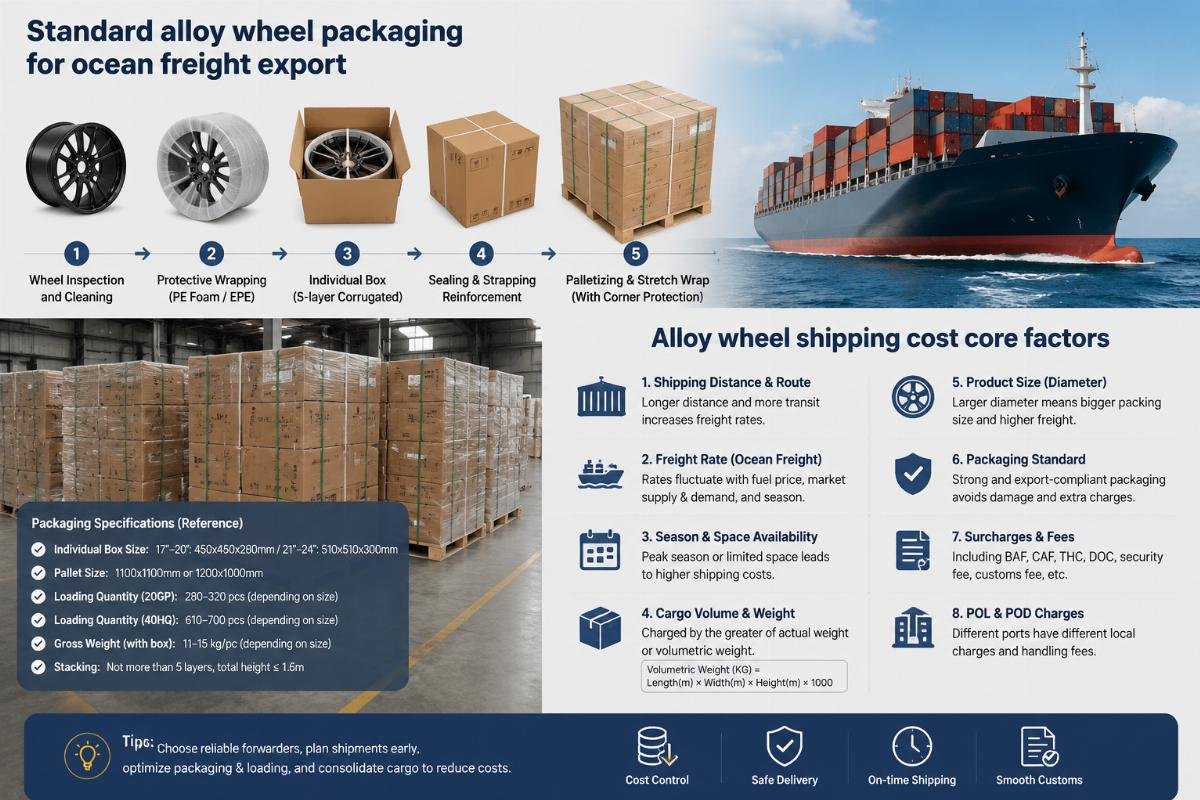
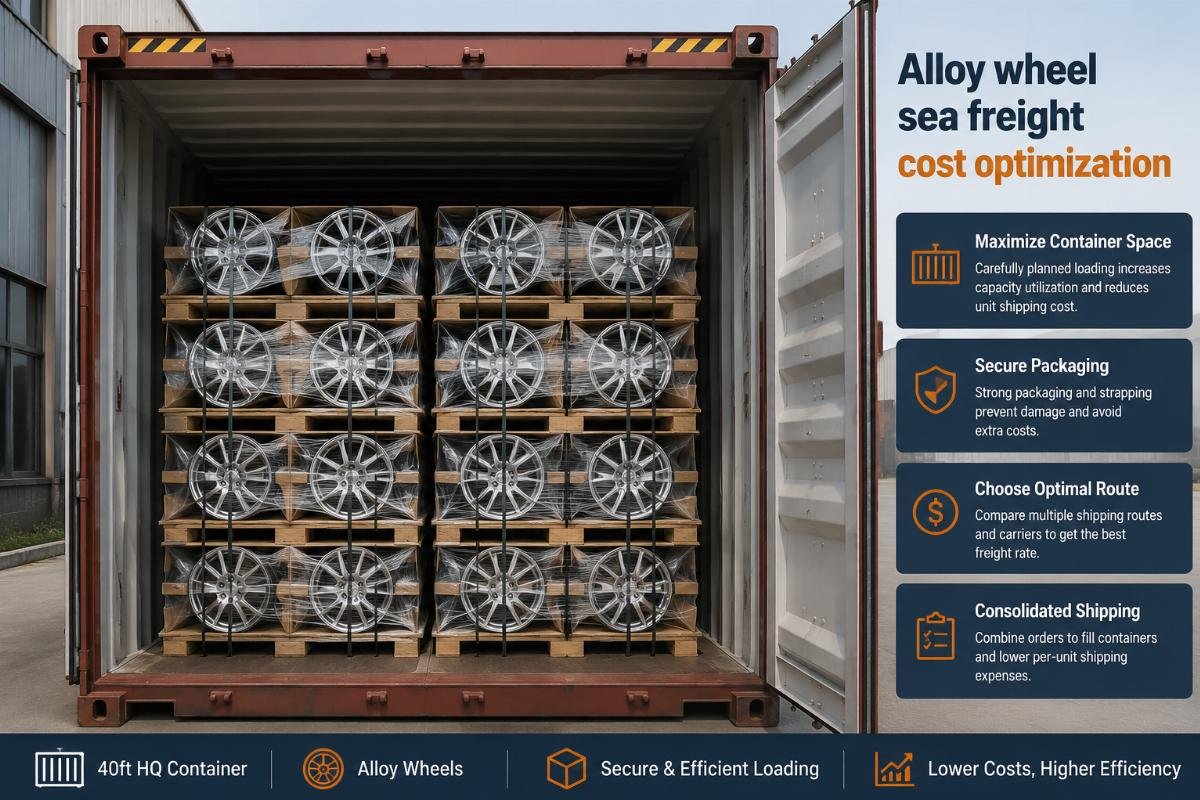
- Container Capacity Validation – Confirm that your supplier can fit 600-800 17-inch wheels in a 20ft container and 1200-1600 17-inch wheels in a 40ft container before finalizing order quantities.
- Stacking Optimization Check – Request a pre-loading layout from your supplier to verify they are using every cubic foot of container space without risking product damage.
- Transit Time Benchmark Alignment – Match your required delivery timeline to standard routes: 7-14 days to US West Coast, 18-24 days to US East Coast, 21-28 days to major EU ports, 7-14 days to Middle East Jebel Ali port.
How to avoid hidden extra charges in alloy wheel sea freight?
Missing proper customs documentation and non-standard packaging are the top two causes of unexpected fees. These charges can add up to 30% to your total landed cost in the form of port storage, customs fines and re-packing fees, even when your initial freight quote looks competitive.
| Risk Point | Common Costly Mistake | Preventative Correct Step |
|---|---|---|
| Customs Paperwork | Accepting generic documentation that does not match product certification requirements | Request full, destination-country compliant documentation from your supplier before shipment |
| Packaging | Using unapproved single-layer packaging for ocean transit | Require standard export packaging rated for 12+ weeks at sea |
| Forwarder Selection | Choosing the lowest advertised third party forwarder rate | Partner with suppliers who hold long-term regular shipping contracts [NEED_CITE: Regular supplier shipping contracts lock in 10-15% lower rates and avoid customs clearance delays that add 30% extra storage fees] |
A custom wheel modifier based in Rotterdam recently placed a 100-piece order for custom 19-inch luxury modified wheels, and initially planned to use a cheap independent forwarder they found via a search engine. When they switched to using the supplier’s in-house logistics service, the final sea freight cost accounted for only 12% of total order value, with a 21 day transit time to Rotterdam, and zero unexpected customs fees on delivery.
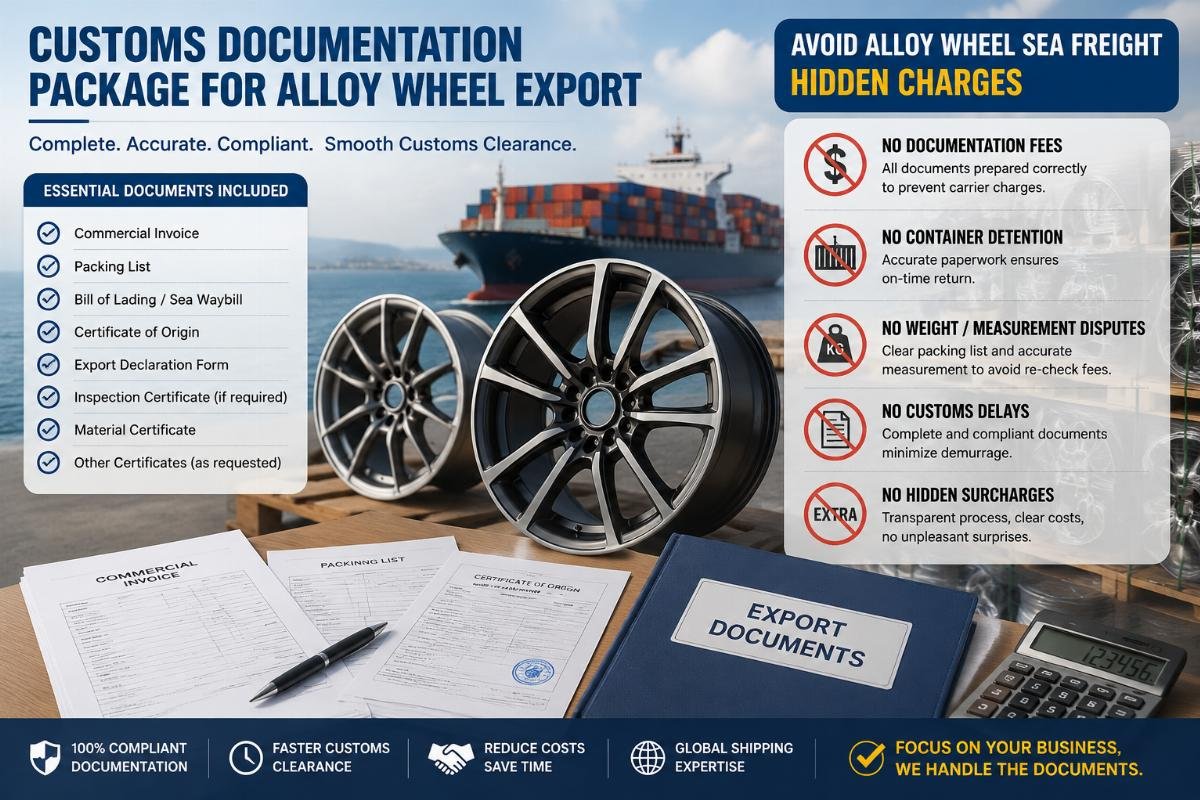
- Certification Alignment Confirmation – Verify that all product certifications (DOT, TüV, VIA) are listed correctly on all shipping and customs documents before cargo leaves the factory.
- Fee Inclusion Audit – Confirm that base container rate, customs documentation fee, and destination port handling charge are all included in your quoted price with no excluded line items.
- Clearance Responsibility Confirmation – Clarify in writing which party is responsible for destination port clearance and any associated fines before shipment departs.
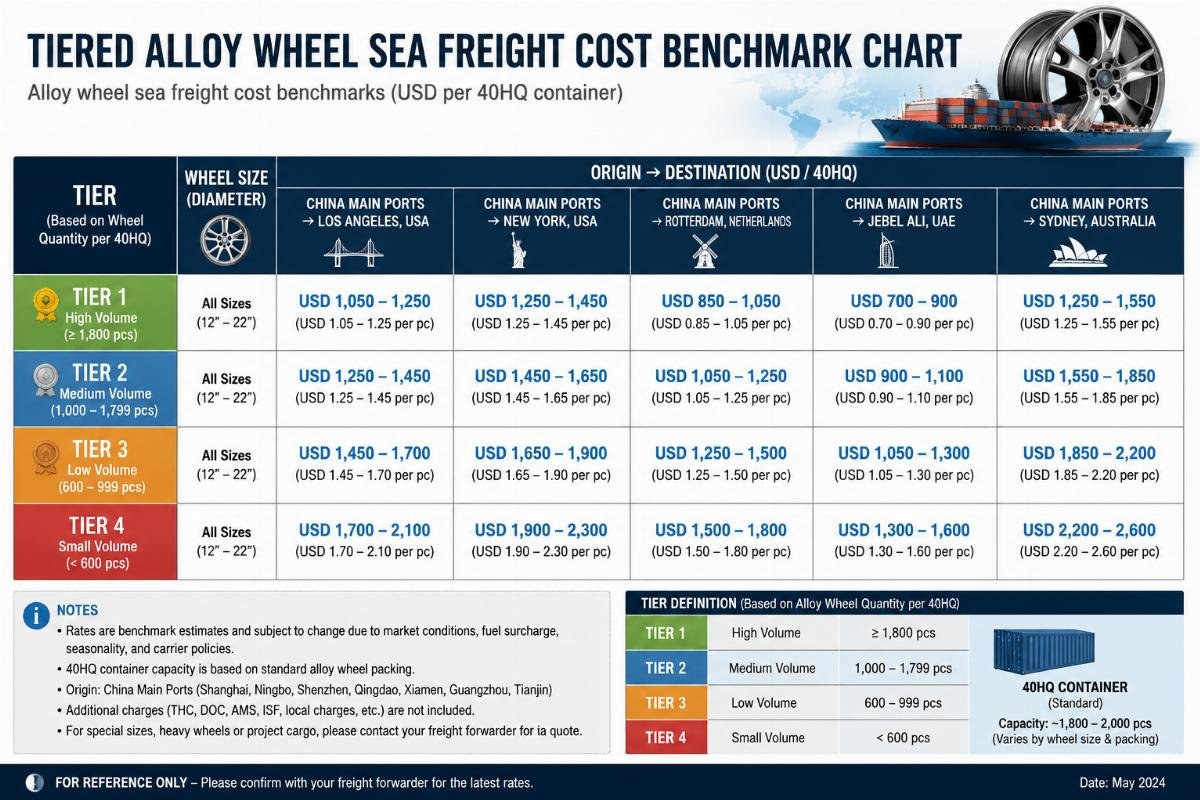
What is the typical sea freight cost benchmark for common alloy wheel order sizes?
Standard bulk orders over 500 pieces have predictable per unit freight rates, while small custom orders require dedicated consolidated shipping planning. There is no one-size-fits-all rate, but you can use established tiered benchmarks to cross-check any quote you receive.
| Order Profile | Common Misleading Estimate | Verified Real World Benchmark |
|---|---|---|
| 500+ unit standard size bulk order | 15+ USD per unit to US West Coast | 7-9 USD per unit to US West Coast |
| 100 unit custom order | 20%+ of total order value to EU | 10-14% of total order value to major EU ports |
| 20-50 unit test order | No viable sea freight option | Consolidated shipping under 15 USD per unit to Middle East |
A small e-commerce seller based in Dubai recently ordered 20 units of stocked 16-inch passenger car wheels as a test batch, and had initially assumed sea freight would not be cost effective for such a small order. Using the supplier’s consolidated shipping network, their combined shipping and handling cost stayed under 15 USD per unit, with only a 7 day transit time from Guangzhou port to Jebel Ali. [NEED_CITE: 20-piece 16-inch passenger car wheel test order to Dubai has combined shipping and handling under 15 USD per unit and 7 day transit]
- Landed Cost Calculation – Use the standard formula to build your full budget: product unit price + per unit freight cost + import duty + clearance fee.
- Test Order Route Check – Confirm that your supplier offers consolidated shipping for test orders between 20 and 50 units to avoid overpaying for express delivery.
- Custom Order Surcharge Clarification – Ask explicitly if custom dimensions or finishes add any freight surcharges before finalizing your custom order quote.
How to reduce total landed cost without sacrificing wheel quality?
Factory direct pricing and optimized shipping combinations cut total cost significantly while meeting global certification requirements. You do not need to compromise on material grade, finish quality or certification compliance to hit lower budget targets, as long as you structure your partnership correctly.
A specialized alloy wheel manufacturer with 10 years of shipping experience to US, EU and Middle East can provide pre-calculated freight quotes for all order tiers, handle full customs documentation for clients, and leverage container stacking optimization to reduce volume-based freight charges by 18% without changing product weight. This structure eliminates the need to coordinate between multiple separate vendors, and removes the risk of misalignment between product quality and shipping compliance.
- Certification Validation – Confirm your supplier holds all required certifications for your target market before placing any order to avoid costly rejections at customs.
- Tiered Quote Request – Ask for pre-calculated freight quotes across 2-3 different order volume tiers to find the optimal balance between inventory cost and per-unit shipping pricing.
- Long Term Contract Lock In – For repeat bulk orders
