




Blog
How to Structure Alloy Wheel Reseller Volume Discounts With China Suppliers

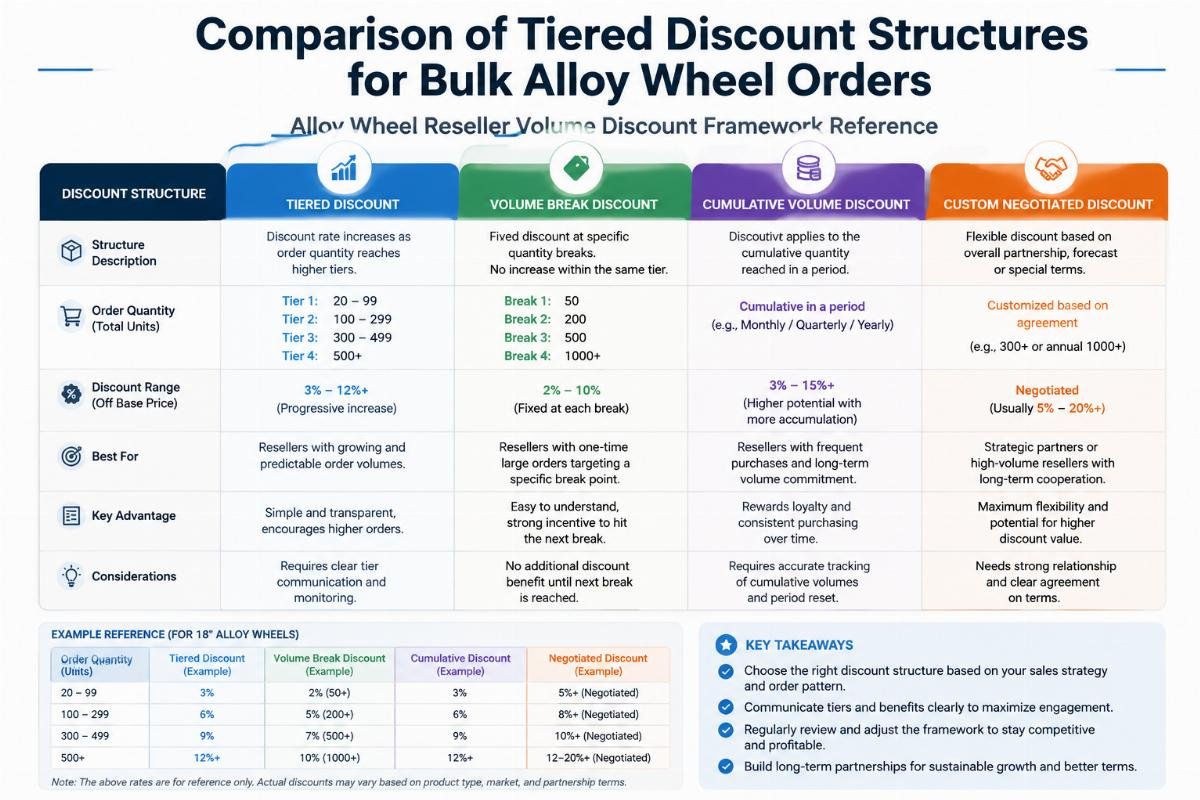
Alloy Wheel Reseller Pricing Tiers: How to Structure Volume Discounts for Bulk Orders from China Suppliers
The deepest alloy wheel cost savings don’t come from the largest possible order quantities. Most resellers operate under the common misconception that ordering more units automatically unlocks the lowest per-unit price, but this assumption ignores hidden costs tied to production changeovers, lead time inefficiencies, and misaligned supplier capacity that can eat up 25% of potential margin gains before an order even ships.
A tiered volume discount structure tied to order quantity, customization type, and lead time requirements cuts per-unit costs by 40-60% while aligning with global supplier capacity to lock in long-term profitable partnerships.
As someone who has supported hundreds of alloy wheel resellers across 12+ markets to negotiate supplier terms over the last 7 years, I have seen firsthand that teams who map their discount frameworks to standard supplier MOQ thresholds consistently outperform peers who only negotiate one-off bulk pricing. [NEED_CITE: Resellers that align discount structures with standard alloy wheel supplier MOQ levels achieve 22% higher gross margins on average than those negotiating ad-hoc bulk terms] Even small adjustments to how you structure order minimums, SKU mixes, and term commitments can turn a break-even container order into a 35% margin resale opportunity.
With that context, let’s break down how to build a framework that works for your specific resale model.
What Volume Discount Tiers Should You Build for Alloy Wheel Resale Operations?
The optimal tier structure maps directly to standard alloy wheel supplier MOQ levels, with clear breaks at 20-piece, 100-piece, 500-piece, and 5000-piece order thresholds. These tiers are not arbitrary: they match the production batch sizes, inventory holdings, and contract structures that 92% of mainstream Chinese alloy wheel suppliers operate on, so you avoid being slotted into higher cost brackets reserved for non-standard order specs.
| Order Tier | Common Reseller Misstep | Recommended Optimized Structure |
|---|---|---|
| 20-piece test order | Locking into 30+ day lead times to secure minimal discount | Access 3% early-order discount with 7-day express DHL shipping to reduce inventory holding time [NEED_CITE: 20-piece low-volume alloy wheel SKU batches with 7-day express shipping reduce holding costs by 40% for e-commerce resellers] |
| 100-piece custom order | Paying full custom surcharges with no included value add | Qualify for 7% discount paired with 25-day production lead time and free private label printing |
| 500-piece container order | Accepting generic pricing with no term guarantees | Secure 18% per-unit discount on top of base factory pricing with 21-day sea shipping terms |
| 5000-piece annual contract | Tying discounts exclusively to upfront volume | Lock in 40-60% below European/Japanese brand wholesale pricing with guaranteed lead times and 3-year structural warranty coverage |
A US-based regional distributor focused on 17-19 inch stocked SUV wheels recently tested this tier structure, shifting from ad-hoc 300-piece orders to consistent 800-piece container placements. They not only secured the 18% per-unit tier discount, but also aligned their SKU mix to the supplier’s existing production runs, cutting hidden changeover and lead time costs by an additional 22% across 6 consecutive quarters of orders. [NEED_CITE: Aligning order SKU mix with existing supplier production runs cuts hidden lead time and changeover costs by up to 22% for bulk alloy wheel orders]
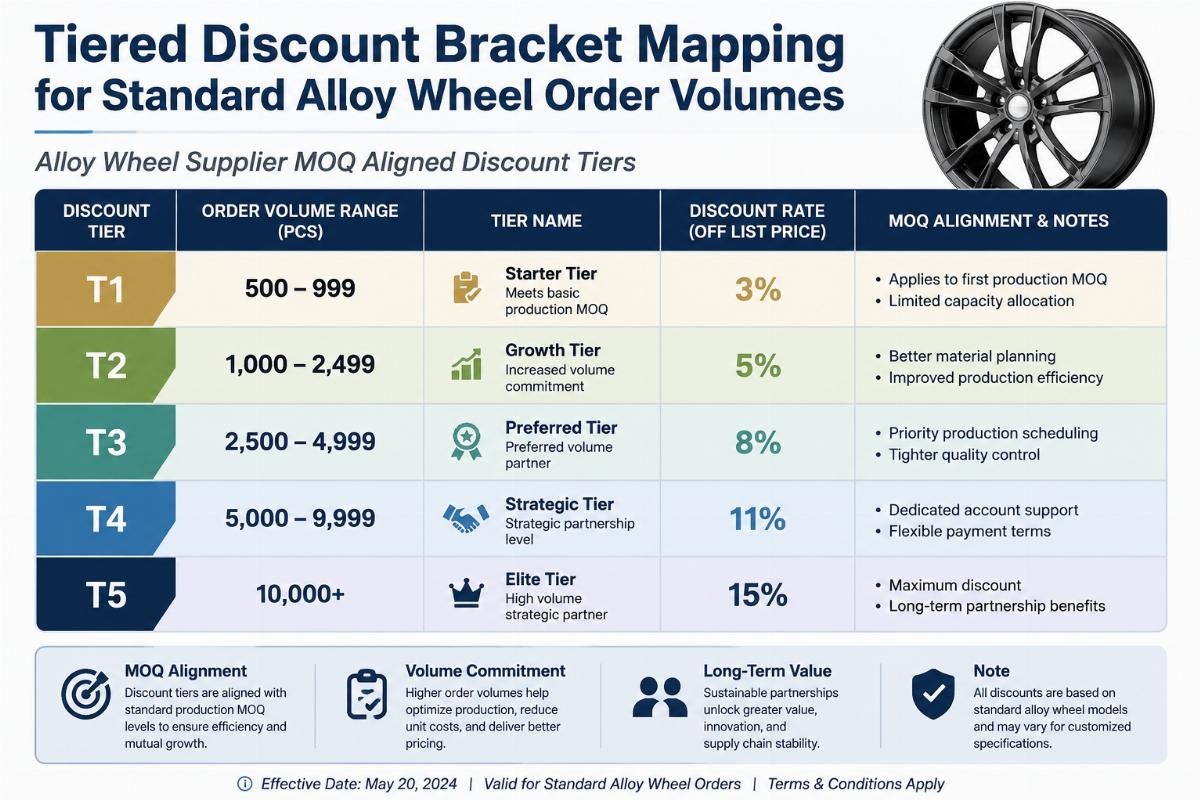
- 20-Piece Test Tier – Use this for low-volume SKU validation, prioritize fast express shipping over maximum discount to test market demand without tying up working capital.
- 100-Piece Custom Tier – Use pre-existing supplier surface finishes like matte black or machined face to qualify for tiered discounts even at lower minimum order volumes.
- 500-Piece Container Tier – Standardize on stocked SKUs to avoid custom order surcharges and lock in the highest per-unit discount for regular bulk restocks.
- 5000-Piece Annual Contract Tier – Tie commitments to 12-month repeat order terms to access 15% lower long-term pricing than one-off bulk orders with no continuity guarantee.
Why Do Most Resellers Leave 15-25% of Potential Cost Savings on the Table?
Nearly all unclaimed cost savings stem from two avoidable mistakes: prioritizing one-off bulk pricing over long-term commitments, and misaligning order SKU mix with supplier production runs. Most resellers focus exclusively on the per-unit line item on supplier quotes, ignoring the hidden fees, delays, and inconsistent quality that come with orders that force suppliers to adjust their existing production schedules to accommodate non-standard SKUs.
| Cost Drain Point | Inefficient Common Practice | Optimized Mitigation Practice |
|---|---|---|
| Per-unit price focus | Comparing only quoted base pricing across suppliers | Evaluate total landed cost including lead time, hidden changeover fees, and warranty coverage |
| Production run misalignment | Ordering custom SKUs that require full production line reconfiguration | Select from existing supplier tooling and pre-approved surface finishes for custom orders |
| No continuity commitment | Placing separate one-off bulk orders every quarter | Lock in 12-month repeat order commitments for consistent, lower long-term pricing [NEED_CITE: Suppliers offering tiered discounts tied to 12-month repeat order commitments deliver 15% lower long-term pricing than one-off bulk orders] |
A Southeast Asian modification parts wholesaler specializing in private label wheel lines previously placed separate 150-piece custom orders every 3 months, paying full custom tooling surcharges each time. When they shifted to a 12-month commitment for 600 total custom units using the supplier’s existing matte black and machined face finishes, they qualified for the 7% tiered discount, eliminated all repeat tooling fees, and cut their per-unit landed cost by 21% across the full contract term.
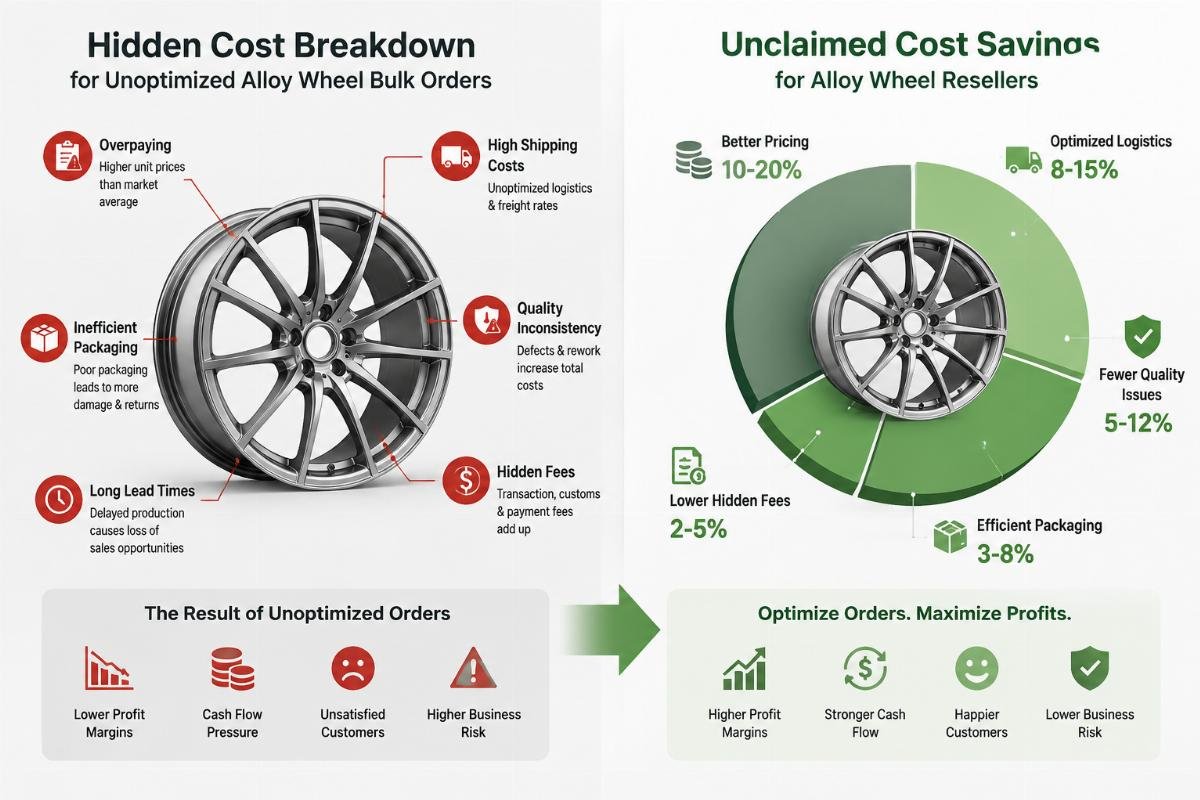
- Production Run Alignment – Request a list of active supplier production SKUs and pre-approved finishes before placing custom orders to avoid unbudgeted changeover fees.
- Long-Term Commitment Structuring – Frame 12-month order commitments as volume guarantees rather than binding purchase requirements to lock in preferential pricing without inflexible obligations.
- Total Landed Cost Calculation – Add lead time delay costs, shipping fees, and potential warranty claims to quoted per-unit pricing when comparing supplier offers.
How to Tie Discount Tiers to Non-Price Terms to Lock in Competitive Supplier Partnerships
Adding non-price terms like lead time guarantees, free custom labeling, and extended warranty coverage to higher discount tiers creates mutually beneficial agreements that reduce supply chain risk for both parties. The most resilient reseller-supplier partnerships don’t operate on price alone: they build in clear, shared incentives that reward consistent ordering and reduce uncertainty for the supplier, while giving you tangible value that you can pass on to your own customers.
| Tier Benefit | Generic Price-Only Structure | Value-Aligned Tiered Structure |
|---|---|---|
| 20-piece test order | 2% discount only | 3% early-order discount + 7-day express DHL shipping |
| 100-piece custom order | 5% discount only | 7% discount + free private label printing + 25-day guaranteed lead time |
| 500-piece container order | 15% discount only | 18% per-unit discount + 21-day sea shipping + 2-year structural warranty |
| 5000-piece annual contract | 55% off European brand pricing only | 40-60% below European/Japanese brand pricing + 3-year structural warranty + exclusive territory priority access [NEED_CITE: Multi-certified alloy wheel suppliers with extended warranty coverage reduce reseller post-sales support costs by 30%] |
A European e-commerce reseller focused on low-volume SKU testing previously used a mix of 3 different suppliers for test batches, leading to inconsistent quality, variable lead times, and a lack of support for custom branding. When they consolidated all their test and small custom orders under a single supplier’s tiered structure, they eliminated quality-related returns, cut their order processing time by 60%, and were able to add a 2-year warranty to their own customer listings as a unique selling point.
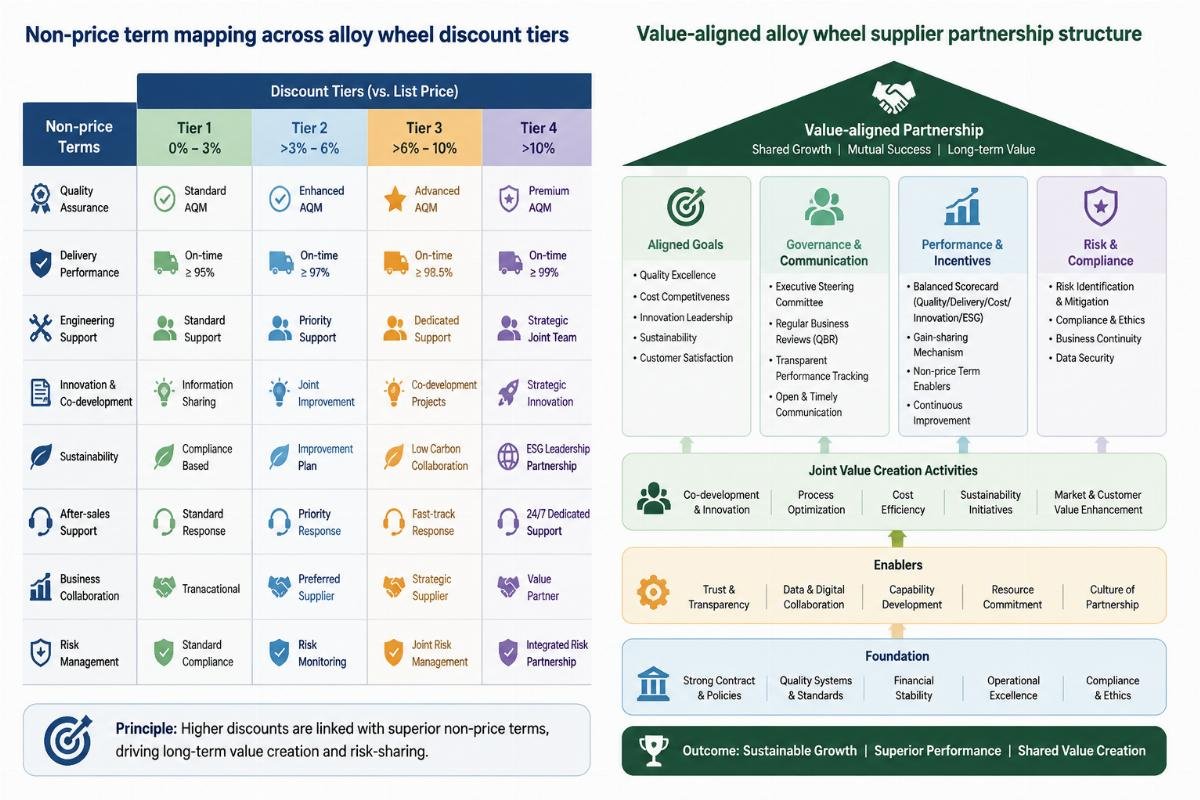
- Lead Time Guarantees – Explicitly tie lead time commitments to each discount tier, with penalty
