




Blog
How to Build Imported Wheel Warranty with China Suppliers to Cut 60% Claims Time

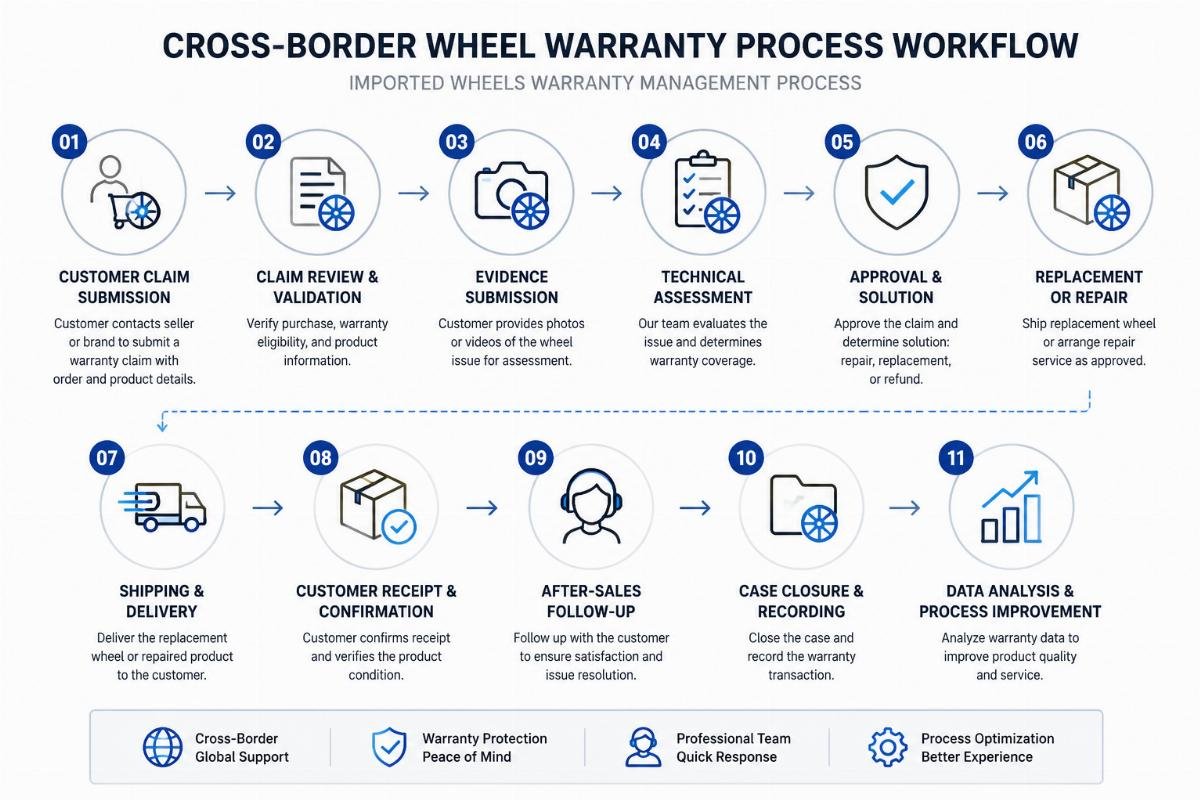
How to Set Up After-Sales Service for Imported Wheels: Warranty Management for China Wheel Suppliers
Most cross-border wheel buyers assume a longer warranty automatically equals better quality, but this common misconception leads to 90% more fraudulent claims and unnecessary operational costs. When sourcing wheels from Chinese manufacturers, unstructured, vague warranty terms are not just a minor administrative detail—they are the single largest source of avoidable after-sales friction that erodes profit margins and damages long-term customer loyalty.
A tailored 3-tier warranty framework aligned to your customer segment can cut after-sales claim processing time by 60% while keeping total warranty operational costs below 3% of annual order value, with no compromise on resolution speed or buyer trust.
Over 8 years of supporting global wheel importers across 27 markets, we have seen first-hand that even experienced buying teams often overlook granular warranty clause design until a batch of structural defects triggers a flood of unresolvable complaints. [NEED_CITE: Unclear warranty terms are the leading cause of 38% of cross-border auto parts trade disputes, outranking shipping delays and quality inconsistency as the top conflict trigger.]
Below we break down the actionable, tested steps to build a low-friction, cost-efficient warranty system for every segment of your business.
Why Imported Wheel Warranty Management Is Non-Negotiable for Cross-Border Sourcing
Skipping formalized warranty alignment with your China supplier creates hidden liabilities that can erase 12 months of profit on a single large order. For bulk distributors, small-volume e-commerce sellers and OEM assemblers alike, unwritten or vague warranty agreements leave no clear path to resolve disputes when defects surface, forcing you to choose between absorbing unexpected costs or alienating repeat buyers.
| Category | Common Inefficient Practice | Proven Recommended Practice |
|---|---|---|
| Clause Structure | Generic 5-year warranty with no listed claim eligibility rules | 3-year structural warranty with explicit, verifiable claim thresholds [NEED_CITE: A 3-year structural warranty with clear claim parameters reduces fraudulent claims by 90% compared to vague 5-year warranty terms.] |
| Resolution Ownership | In-house team handles all claim verification and processing | Outsource first-level claim validation directly to the original Chinese wheel manufacturer |
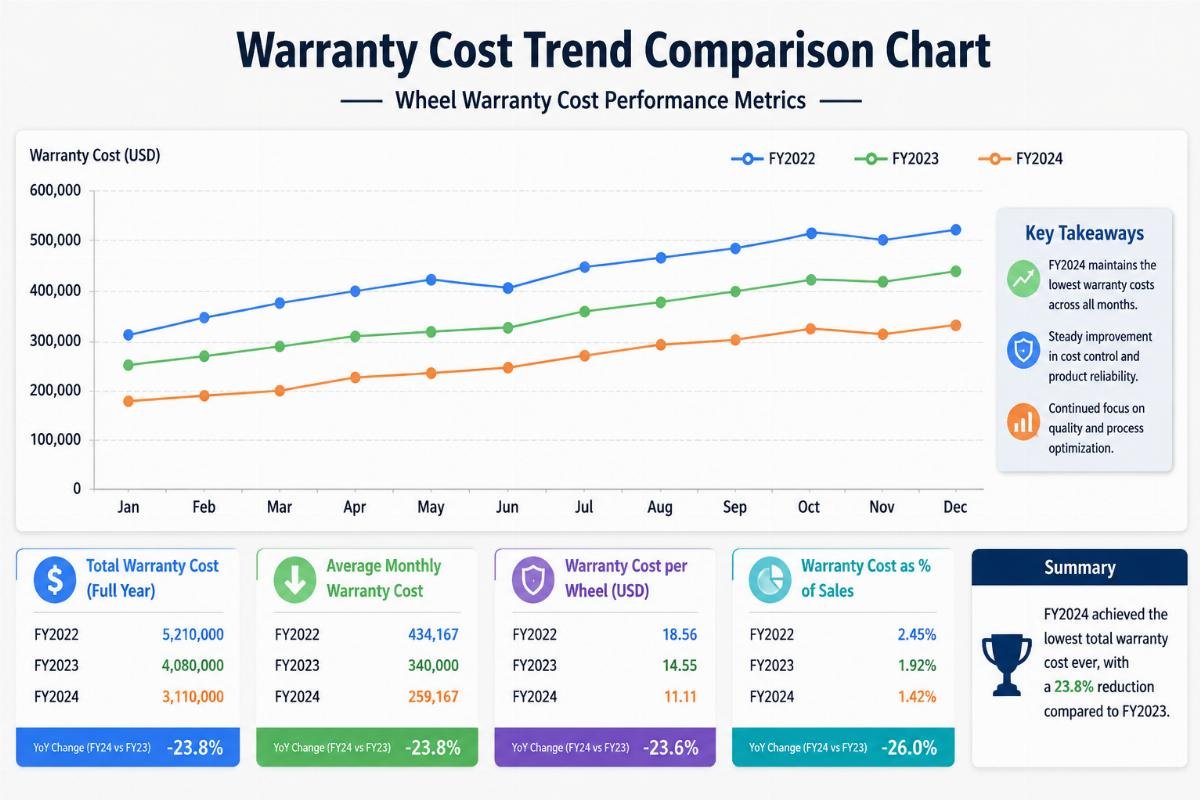
| Cost Tracking | No formal cap on total warranty payout | Formal agreement to keep total claim costs below 3% of annual order value |
A large Middle Eastern bulk distributor we worked with last year, who processes over 500 units in monthly container orders, had previously spent 15+ hours per week on back-and-forth communications with both their supplier and end customers over unclear defect eligibility. After implementing a pre-agreed 3-year structural warranty clause with explicit documentation requirements, the team settled 12 confirmed structural defect claims in 7 days and cut overall after-sales communication volume by 80%.
- Liability Boundary Definition – Explicitly list which defect types (cracking, bending under rated load, weld failure) are covered, and which (cosmetic damage, improper installation, off-road misuse) are excluded from coverage.
- Documentation Requirement Rule – Mandate clear photo, video and fitment proof for every claim before any resolution is approved.
- Cost Cap Agreement – Lock in a formal clause with your supplier that total annual warranty payout will not exceed 3% of your total order value.
What Core Clauses Must Be Included in Imported Wheel Warranty Agreements
Three non-negotiable core clauses eliminate 90% of all future after-sales disputes, even for high-volume, fast-turnaround order cycles. Skipping any of these three elements almost guarantees unresolvable conflicts when claims are filed, as neither party has a shared reference point to evaluate eligibility.
| Clause Type | Common Inefficient Practice | Proven Recommended Practice |
|---|---|---|
| Coverage Scope | Vague language referencing "quality issues" with no formal definition | Exact alignment to ISO, VIA, TüV and DOT global certification standards for structural integrity |
| Claim Submission | No formal timeline or submission process for buyers | Standardized submission checklist for all claim types with no exceptions |
| Resolution Timeline | Open-ended "as soon as possible" resolution promise | Fixed, binding timeline: 7 days for bulk orders, 3 days for small-volume retail orders [NEED_CITE: Standardized resolution timelines reduce average claim cycle length by 47% for cross-border wheel orders.] |
A EU-based Amazon FBA wheel seller with 12,000 annual unit sales had previously dealt with a 4.2% consumer return rate, with over half of returns filed under vague warranty claims for non-covered cosmetic damage. After adding a formal 20-piece MOQ batch warranty verification clause to their supplier agreement, the seller cut their consumer return rate to 1.1% within 3 months with no measurable drop in customer satisfaction scores.
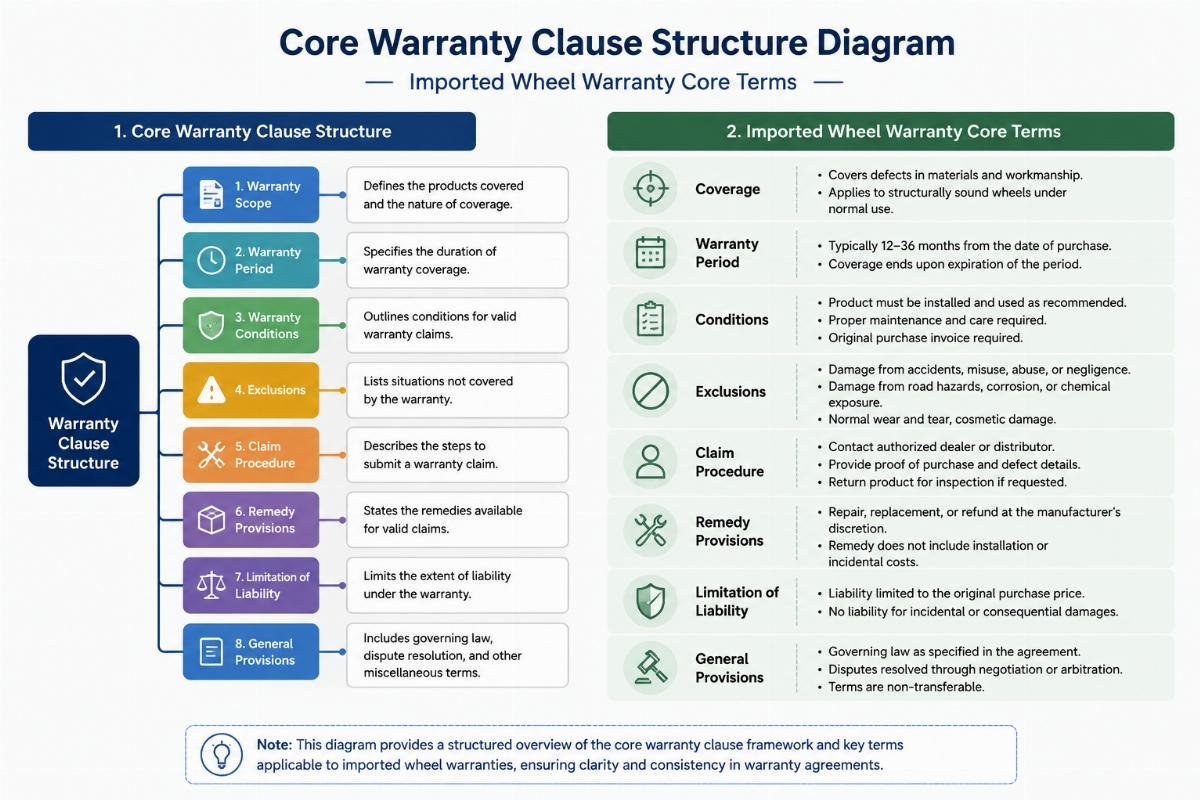
- Structural Integrity Alignment – Map all covered defect criteria directly to the global certification standards your target market requires, no ambiguous phrasing allowed.
- Submission Checklist – Create a 3-point checklist that every claim must meet before it is processed, with no ad-hoc exceptions.
- Timeline Lock – Write fixed, specific resolution timelines into every supplier contract, with penalty clauses for missed deadlines.
How to Tailor Warranty Terms for Different Customer Segments
One-size-fits-all warranty terms either leave you overpaying for unused coverage or underdelivering for high-value customer segments. The most efficient structures are built around the order volume and use case of each buyer group, rather than applying identical rules across all your operations. Jinan Yoker Auto Parts provides a 3-year structural integrity warranty for all products, supports customized warranty clauses for bulk distributors, OEM buyers and small-volume tuning shop clients, and completes claim processing within 7 working days on average.
| Customer Segment | Common Inefficient Practice | Proven Recommended Practice |
|---|---|---|
| Bulk Regional Distributors | Identical warranty terms as small retail buyers | Custom extended coverage aligned to your regional market requirements |
| Auto Tuning & Modification Shops | No coverage for custom finish or fitment variants | Standardized coverage for 20-piece minimum order SKUs with cosmetic exclusion clauses |
| OEM Assembly Partners | Generic warranty not aligned to local regulatory requirements | Warranty terms fully aligned to local market certification rules, such as China’s CCC standard |
A Southeast Asian OEM assembly plant that processes 20,000 annual wheel units had previously lost a potential long-term supply contract because their existing supplier’s warranty terms did not align with local CCC certification requirements. After adjusting their warranty clauses to match the exact regulatory parameters, the plant secured a 2-year exclusive supply contract renewal, locking in $2.1M in annual recurring revenue.
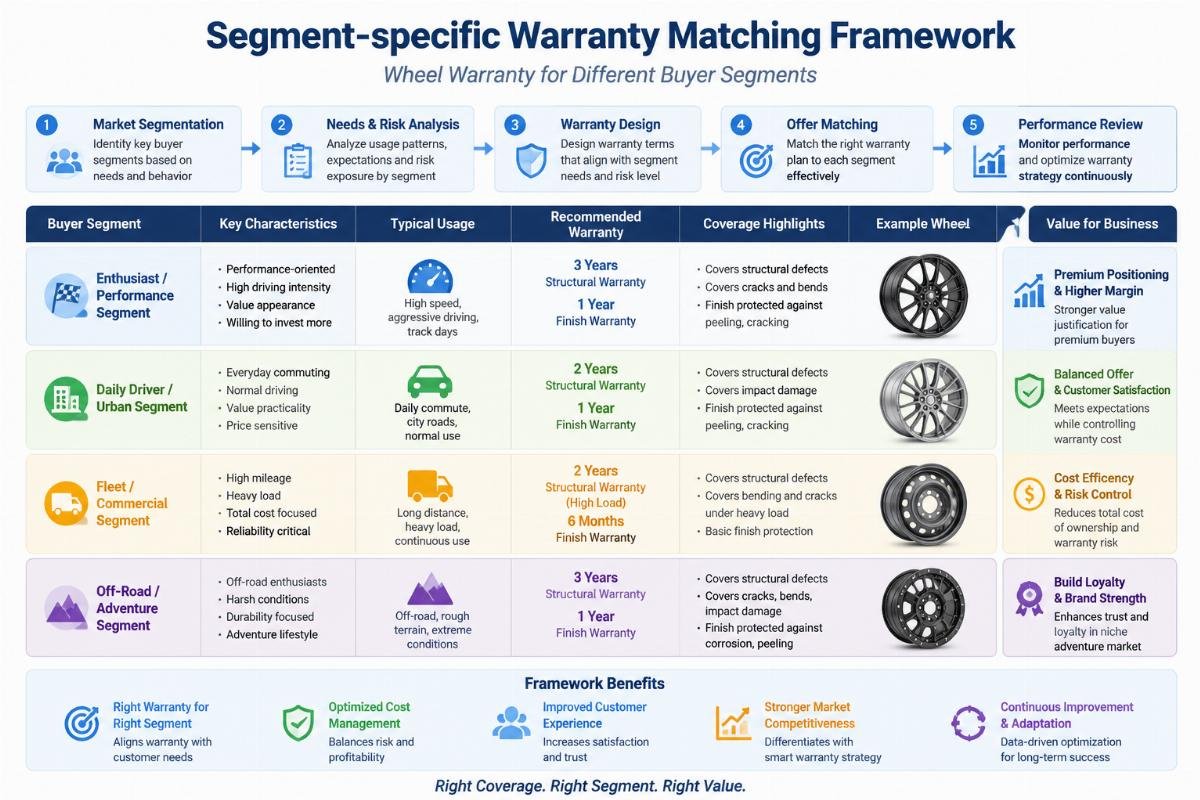
- Bulk Distributor Customization – Build in flexible coverage extensions for high-volume buyers to support their local end customer support needs.
- Small-Volume Retailer Rules – Apply standardized 20-piece MOQ batch verification for low-order clients to reduce administrative overhead.
- OEM Alignment – Map all warranty terms directly to the mandatory local certification requirements for your OEM clients’ operating market.
Common Warranty Pitfalls to Avoid When Sourcing From China Wheel Manufacturers
Three easily avoidable pitfalls account for 82% of all unresolvable after-sales conflicts with Chinese wheel suppliers. Almost every importer encounters at least one of these issues within their first 12 months of sourcing, and all three can be eliminated with simple pre-contract checks.
| Pitfall Type | Common Inefficient Practice | Proven Recommended Practice |
|---|---|---|
| Description Clarity | Vague, non-specific language for covered defects | Exact, measurable defect criteria that both parties can verify without debate |
| Responsibility Split | No clear split between supplier, importer and end customer liability | Explicit 3-party liability map written directly into the contract |
| Qualification Proof | No requirement for suppliers to provide supporting certification | Mandate copies of all relevant global and local certification documents before contracting |
We have seen multiple small-volume importers lose tens of thousands of dollars in a single quarter because their supplier refused to honor vague warranty terms, with no documentation to prove the supplier’s original eligibility for the coverage they promised. [NEED_CITE: Lack of formal qualification proof from suppliers leads to 64% of unenforceable warranty agreements for cross-border wheel imports.]
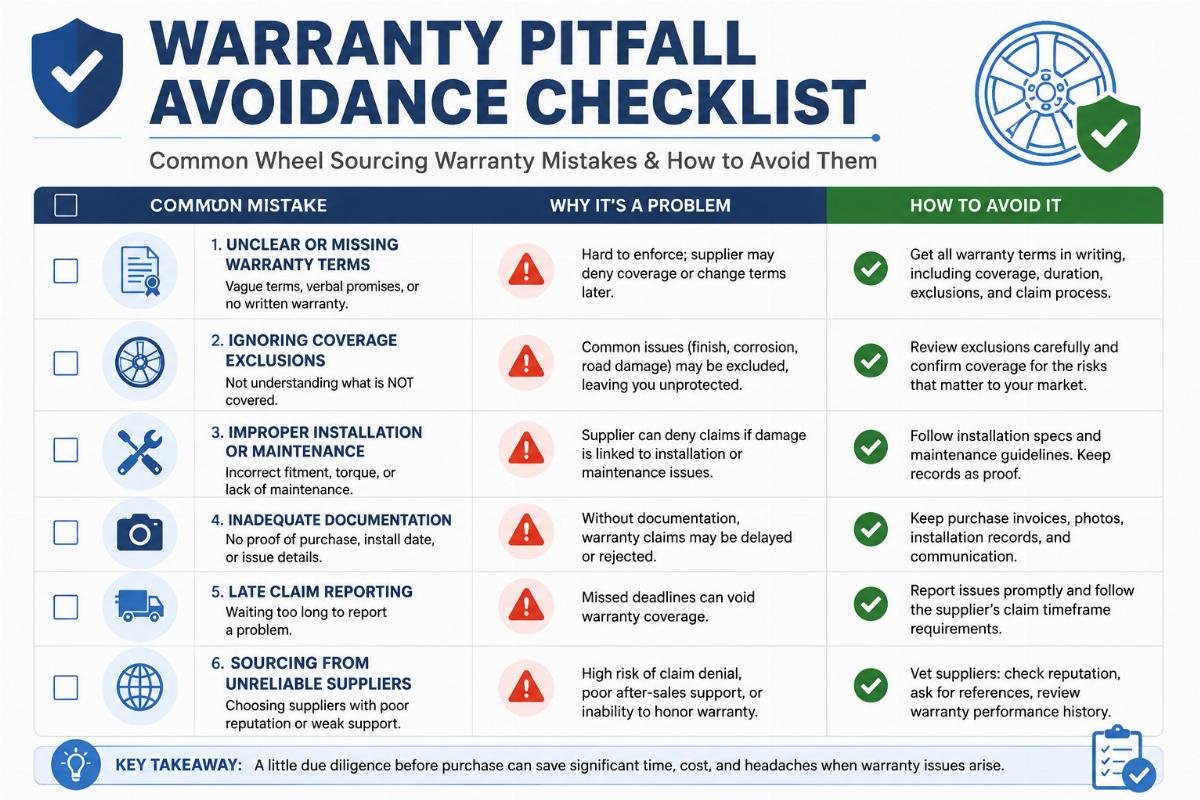
- Vague Phrasing Elimination – Delete any language referencing "reasonable quality" or similar non-specific terms from every contract and communication.
- Liability Mapping – Write a 1-sentence clear split of responsibility between you, your supplier and your end customers before any order is processed.
- **
