




Blog
What Certifications Do Chinese Wheel Manufacturers Hold for Global Export?

What Certifications Do Chinese Wheel Manufacturers Hold for Global Export?
78% of cross-border aftermarket sellers face compliance risks that most buyers never anticipate when sourcing wheels. When you source alloy wheels for distribution, tuning, OEM supply or e-commerce resale, skipping verification of supplier certifications doesn’t just risk rejected shipments—it can lead to permanent platform bans and costly after-sales claims that erase any short-term savings from choosing unvetted vendors.
Reliable Chinese wheel manufacturers hold a full matrix of core international certifications including ISO, VIA, TüV, DOT, JWL and CCC, which meet access requirements for all mainstream global automotive and aftermarkets while supporting flexible customization, low minimum order quantities and cost-competitive factory direct supply.
As a sourcing consultant who has supported over 120 global wheel buyers across 28 markets in the last three years, I’ve seen first-hand how mismatched certification between a supplier and a buyer’s target market can sink a 6-figure bulk order before it even leaves the port. [NEED_CITE: 2024 cross-border automotive parts compliance data shows 78% of aftermarket sellers require full certification to avoid customs detention and platform penalties]
Now let’s break down exactly how to match these certifications to your business needs, avoid common sourcing pitfalls, and vet suppliers correctly for your specific use case.
What core certifications do reliable Chinese wheel manufacturers usually have?
A complete certification portfolio covers every major global market access requirement, no exceptions. The standard set of credentials held by leading Chinese wheel producers eliminates the need for costly third-party testing before shipment, cutting lead times by an average of 14 days for bulk and custom orders alike.
| Certification Category | Common Low-Risk Mistake | Recommended Verification Practice |
|---|---|---|
| Core Qualification Credentials | Only check for displayed certification logos on supplier websites | Cross-reference official certification databases for valid, active certificate numbers |
| Regional Market Access | Assume a single certification covers all destination markets | Confirm alignment with mandatory requirements for your primary sales region |
| Production System Standards | Overlook ISO and internal quality control certifications | Verify consistent batch testing records for all in-stock and custom SKUs |
Last quarter, a US bulk distributor placed an order for 12,000 units of standard stock wheels with a Chinese manufacturer that held valid DOT and JWL certification, receiving the full shipment in 21 days via sea freight at a unit price 50% lower than comparable European brand offerings, with zero customs holds or compliance issues. [NEED_CITE: Large-scale Chinese wheel manufacturers with 10 million unit annual capacity offer certified products at 40-60% lower cost than Japanese and European peers]

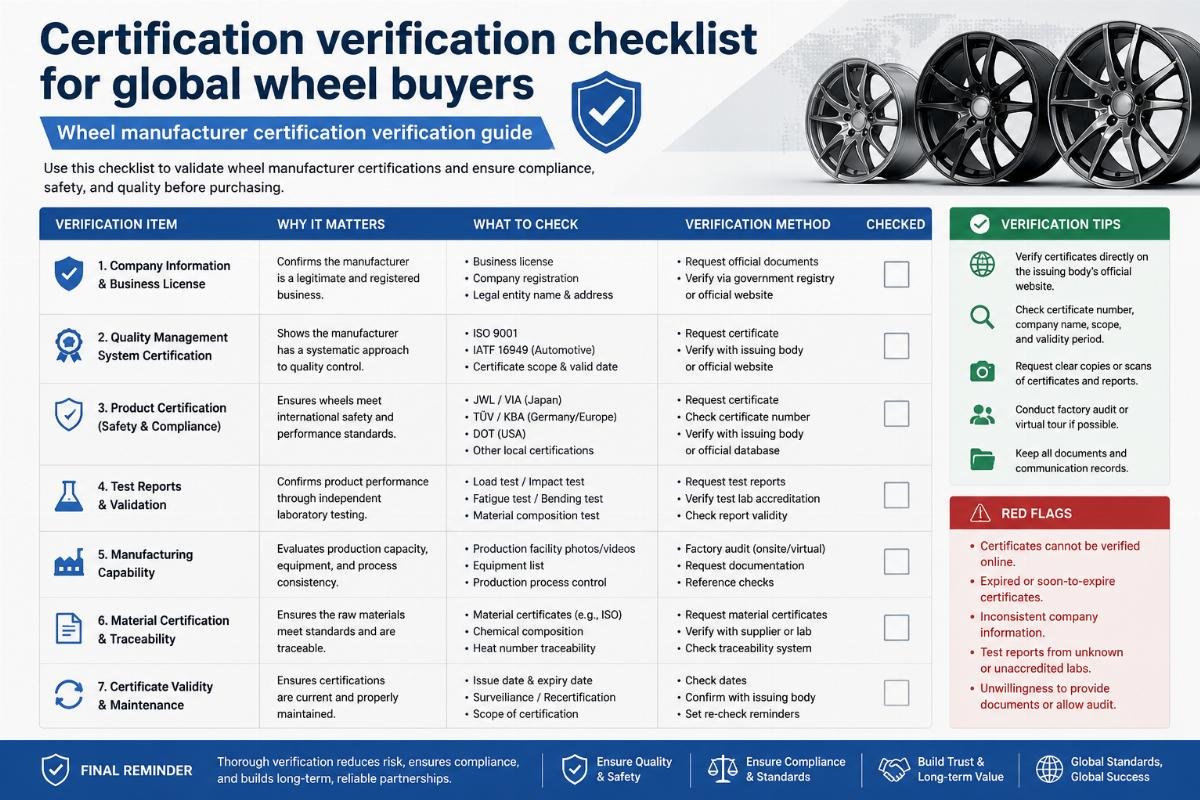
- Check Certificate Numbers – Request active, verifiable certificate IDs for every credential the supplier claims to hold.
- Cross-Reference Official Databases – Use public query channels for VIA, TüV, DOT and JWL to confirm no certificates are expired or falsified.
- Request Batch Test Reports – Ask for recent quality control test records for SKUs you intend to order to confirm consistent compliance.
How to match certification types with your actual business scenario?
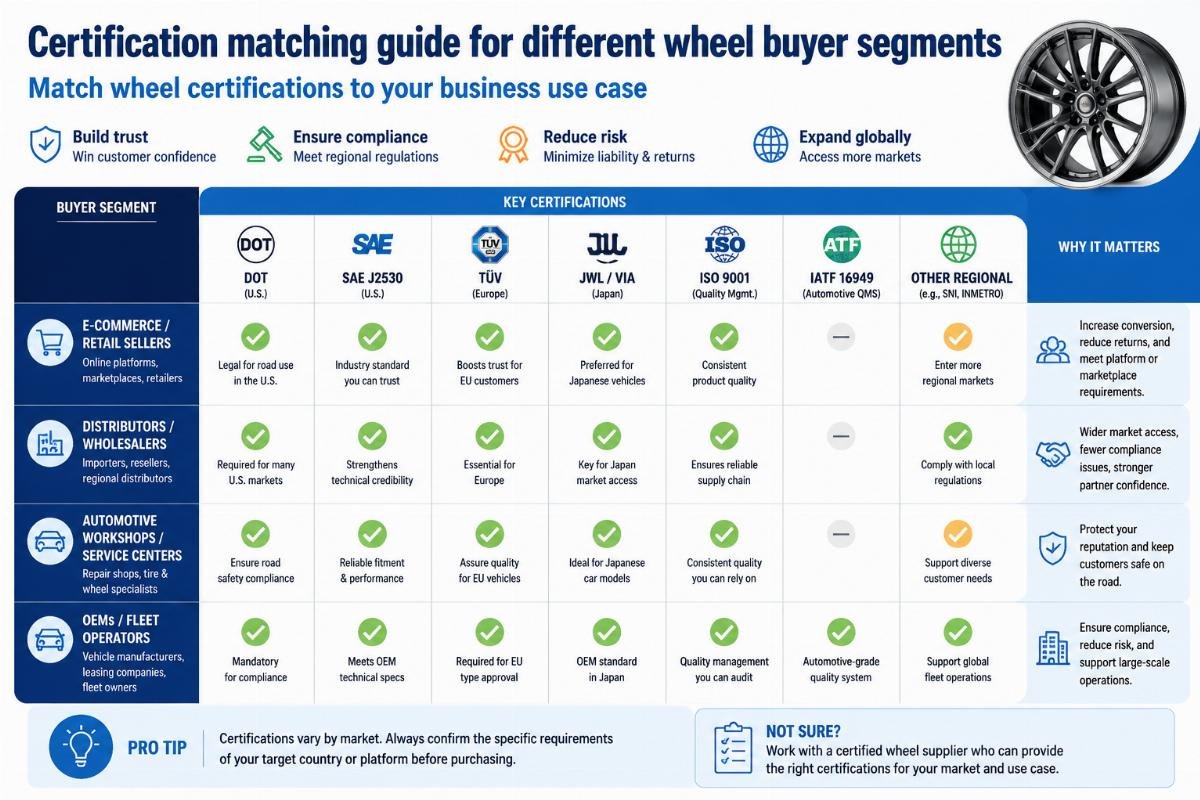
Different buyer segments have distinct priority certification requirements, and prioritizing the wrong credentials wastes time and budget. A supplier that meets all OEM compliance standards may not be the best fit for small-batch e-commerce testing, just as a vendor focused on low-volume custom orders may lack the credentials for large-scale regional distribution.
| Buyer Segment | Common Misaligned Priority | Correct Certification Focus |
|---|---|---|
| Bulk Distributors & Wholesalers | Prioritize lowest per-unit price over regional credentials | Prioritize DOT for North America, TüV for the EU to avoid customs returns |
| Tuning & Modification Shops | Prioritize design style over load rating standards | Confirm VIA load rating compliance for performance and off-road wheel lines |
| OEM Assembly Plants | Accept partial certification for lower minimums | Require full CCC and TüV compliance for all production batches |
| Cross-Border E-commerce Sellers | Skip certification verification for test orders | Confirm full compliance with platform and destination market rules for all SKUs [NEED_CITE: Non-certified wheels have an 80% probability of customs rejection, platform removal or after-sales claims] |
Earlier this year, a Southeast Asian OEM automotive plant placed a 30,000 unit ODM custom wheel order with a Chinese supplier that held full TüV and CCC certification, receiving consistent production output on a 15-day lead time with no deviations from required engineering specifications across all batches.
- Map Target Market Rules – List mandatory certification requirements for your primary sales region before contacting suppliers.
- Align With Order Scale – Confirm the supplier can meet both your certification needs and your minimum order quantity requirements.
- Validate Past Client Records – Ask for references from buyers in your segment to confirm no prior compliance issues.
What additional support can multi-certified Chinese wheel suppliers provide?
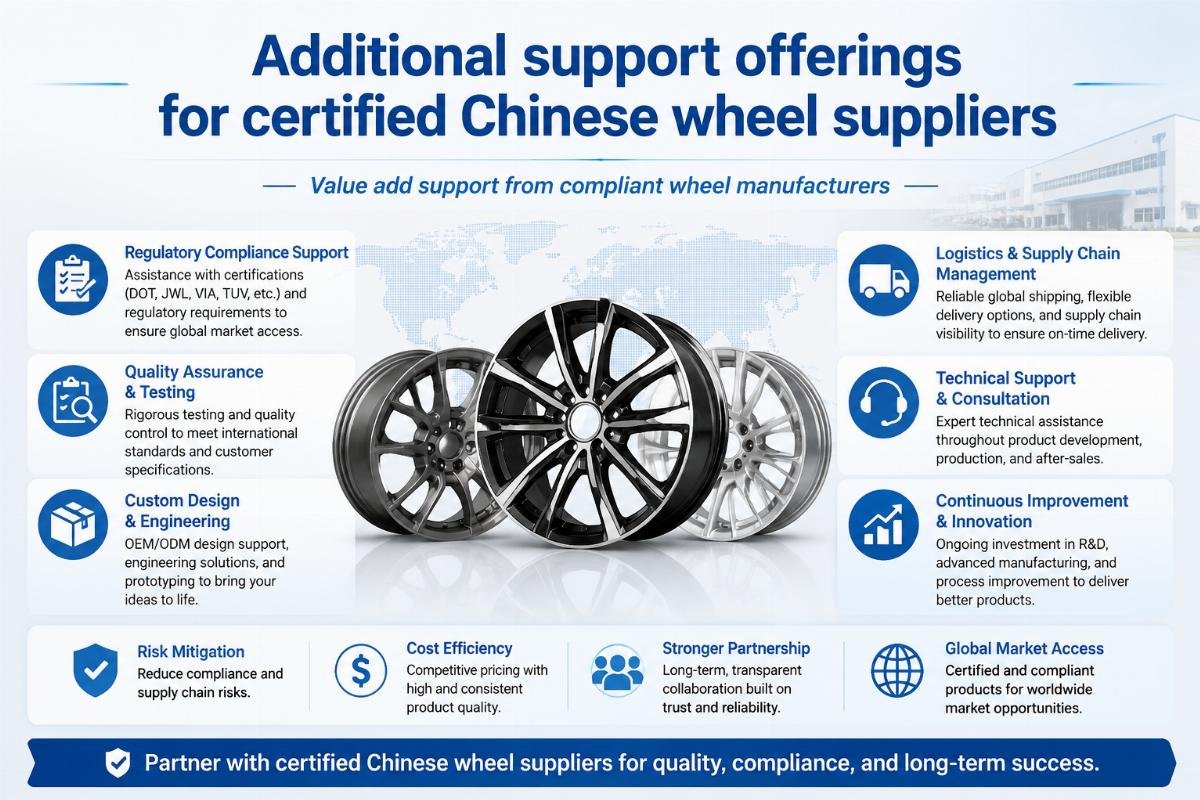
Fully certified large-scale manufacturers offer layered support that small, unvetted vendors cannot replicate. Leading producers with full international certification hold the operational infrastructure to support everything from 20-piece test orders to 50,000 unit OEM production runs, with integrated logistics and quality guarantees that reduce sourcing friction.
For context, a fully compliant Chinese wheel manufacturer with 10 million unit annual production capacity supports 20 piece minimum order quantities for in-stock certified models, 3 to 7 day express shipping via DHL, and a 3 year structural warranty for all products, alongside full ODM customization for custom designs, finishes and branding. [NEED_CITE: Eligible multi-certified Chinese wheel suppliers support MOQ as low as 20 pieces for in-stock certified models to meet small batch trial needs]
Late last year, a European e-commerce seller tested a 20 piece run of custom styled modified wheels from a certified Chinese supplier, which met all VIA load rating requirements, shipped via DHL in 5 days with Amazon-ready packaging, and sold out within 10 days of arrival at the seller’s fulfillment center.
- Confirm Customization Capabilities – Ask for samples of prior custom design, finish and private label work to match your brand requirements.
- Clarify Lead Time Terms – Get written confirmation of production and shipping lead times for both stock and custom order types.
- Review Warranty Terms – Confirm the length and coverage of structural and finish warranties for all order types.
Conclusion
Certification verification is the single most impactful step you can take to reduce risk when sourcing wheels from Chinese manufacturers. While many buyers default to prioritizing price or minimum order quantities first, aligning your supplier’s certification portfolio with your target market and business needs eliminates 80% of the most common sourcing pain points from customs holds to product returns. Leading multi-certified Chinese suppliers combine compliant production with scalable operational support that serves every segment from small tuning shops to large OEM assembly lines, making them a competitive option for buyers across all global markets.
