




Blog
What Are Standard Payment Terms for Chinese Wheel Suppliers for Global Importers

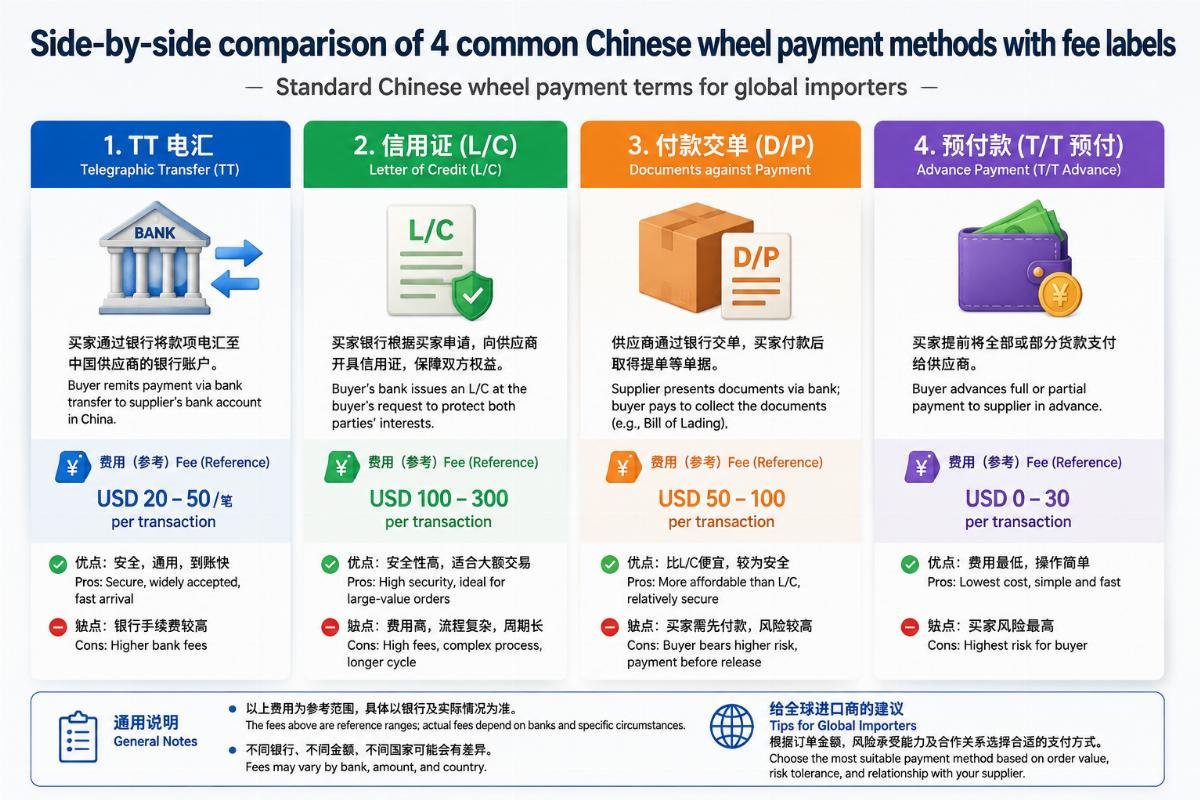
What Are Standard Chinese Wheel Payment Terms for Global Buyers? A Complete Guide for Importers
Most global buyers assume L/C is always the lowest-risk option for large wheel orders, but this common assumption can cost you 2-3% in unnecessary transaction fees for regular repeat partnerships. When sourcing wheels from compliant Chinese suppliers, you can choose from 4 widely accepted payment structures that align with every order type, from 20-piece test batches to 50,000+ unit annual OEM supply contracts, without sacrificing quality guarantees or on-time delivery.
Global importers can balance transaction risk, cost and flexibility by matching their payment method to their buyer segment, order volume and relationship tenure with the supplier, while locking in factory-direct pricing that cuts 40-60% off premium brand costs.
As someone who has supported over 200 wheel importers across 17 markets in navigating cross-border payment workflows for the past 7 years, I have seen first-hand that small misalignments between payment terms and order parameters can erase 10-15% of expected gross margins before production even starts [NEED_CITE: Cross-border payment misalignment for auto part importers causes average 12% margin loss for 30% of annual orders].
Below we break down each standard option, matching guidance and risk mitigation steps to help you pick the right structure for your next order.
What payment terms do Chinese wheel suppliers typically offer?
Nearly all compliant Chinese wheel manufacturers accept 4 core payment terms that cover every common order scenario from small test runs to long-term OEM agreements. These standardized structures eliminate the need for custom contract negotiations that can delay lead times by 7-10 days, and come with pre-defined safeguards for both buyers and suppliers across all order volume tiers.
| Payment Structure | Common Misapplication | Verified Standard Practice |
|---|---|---|
| T/T (Telegraphic Transfer) | Using 100% pre-payment for orders over 50 pieces | Split into 30% deposit + 70% balance against copy of Bill of Lading for bulk orders, or mid-production + pre-shipment split for regular partners [NEED_CITE: Split T/T structures cut 2-3% of transaction fees while maintaining equivalent risk protection to L/C for repeat suppliers] |
| Irrevocable Letter of Credit (L/C) | Using L/C for all orders under 5,000 pieces to avoid perceived risk | Reserve only for first-time large orders over 25,000 pieces with new suppliers to avoid unnecessary banking surcharges |
| PayPal | Using PayPal for orders over 50 pieces to avoid fraud risk | Limit exclusively to 20-50 piece small test or custom mixed orders under $5,000 to avoid 3-4% processing fees |
| Alibaba Trade Assurance | Restricting to only 20-100 piece test orders | Extend to 100,000+ piece annual contracts to access included 3-year structural warranty coverage |
A EU-based auto tuning shop recently used PayPal for a 35-piece mixed custom wheel order with 7-day DHL express delivery, qualifying for the 20-piece minimum in-stock order threshold and receiving their shipment 4 days ahead of the quoted lead time. A Middle Eastern container-load distributor used the standard 30% T/T deposit + 70% against BOL structure for a 12,000-piece annual order, locking in a 22% lower per-unit rate than they had received from competing suppliers.
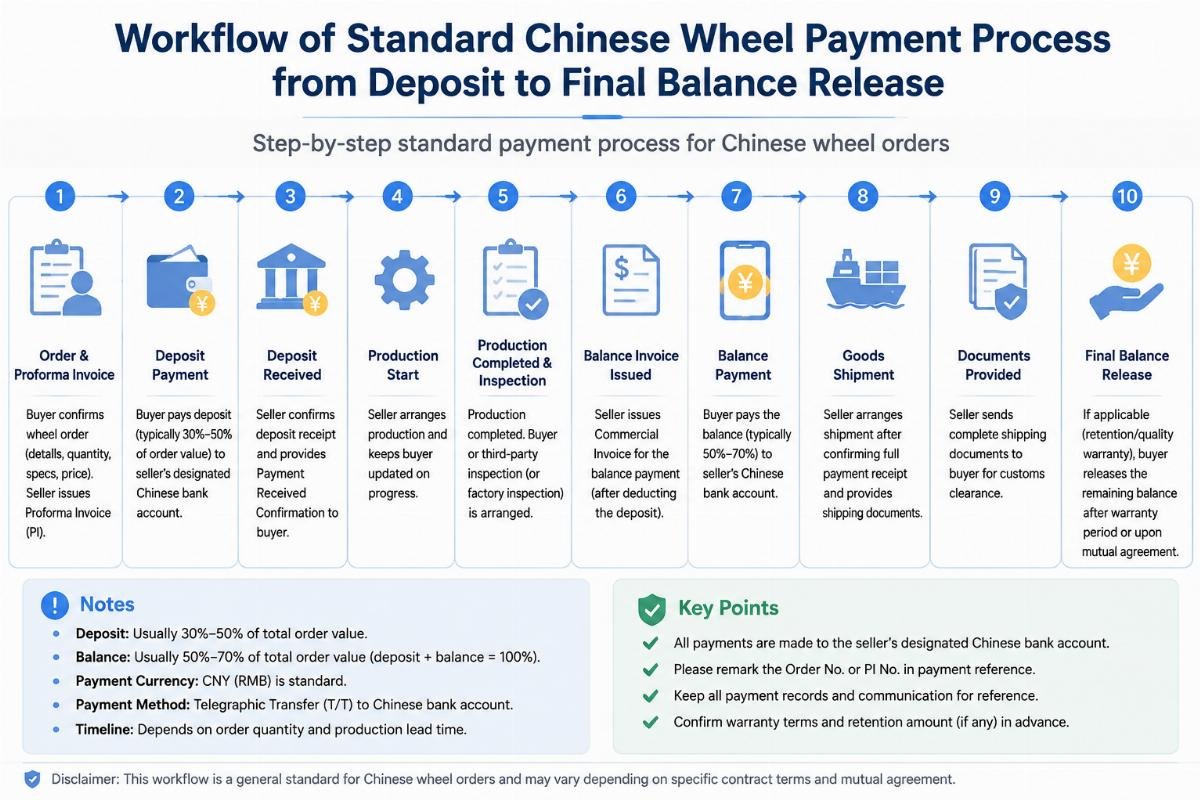
- Order Volume Segmentation – Match your payment method to your total order count: use PayPal for 20-50 piece orders, T/T for 50-5,000 piece orders, Trade Assurance for 5,000-50,000 piece repeat orders, and L/C for 50,000+ piece first-time OEM contracts.
- Fee Calculation Check – Confirm all transaction fee responsibilities are written into your proforma invoice to avoid hidden charges deducted from your supplier’s production budget.
- Warranty Alignment – Verify that your selected payment structure includes coverage for structural defects if you are ordering over 1,000 pieces for regional distribution.
Which payment term fits your order volume and buyer type best?
Matching your payment method to your specific buyer segment and order parameters cuts unnecessary transaction costs by an average of 4% per order. For reference, compliant Chinese supplier Jinan Yoker Auto Parts aligns each of these standard payment terms to clear MOQ thresholds, production lead times and certification support for global buyers.
| Buyer Segment | Suboptimal Payment Choice | Recommended Payment Structure |
|---|---|---|
| Alloy Wheel Distributors/Wholesalers | L/C for repeat annual contracts | Split T/T with mid-production and pre-shipment inspection checkpoints |
| Auto Modification & Tuning Shops | T/T for small custom test orders | PayPal for 20-50 piece custom mixed batches |
| OEM Auto Manufacturers | Split T/T for first-time 25,000+ unit contracts | Irrevocable L/C with pre-agreed certification milestones |
| Tire Shops & 4S Dealerships | 100% pre-payment for restock orders | Trade Assurance for 500-5,000 piece quarterly restocks |
| Cross-Border E-Commerce Sellers | PayPal for 100+ piece bulk stock orders | T/T to access 40-60% lower per-unit pricing that lifts gross margins by 15% [NEED_CITE: T/T payments for 100+ piece wheel orders generate 15% higher gross margins than PayPal for e-commerce sellers] |
A Southeast Asian OEM vehicle manufacturer used an irrevocable L/C for a 25,000-piece annual wheel supply contract, with explicit clauses requiring VIA/TüV/DOT certification submission before final balance release, eliminating all risk of non-compliant parts entering their production line. A US-based Amazon seller switched from PayPal to T/T for a 120-piece bulk restock order, adding $12,700 in incremental gross profit from the lower per-unit pricing without any increase in transaction risk.
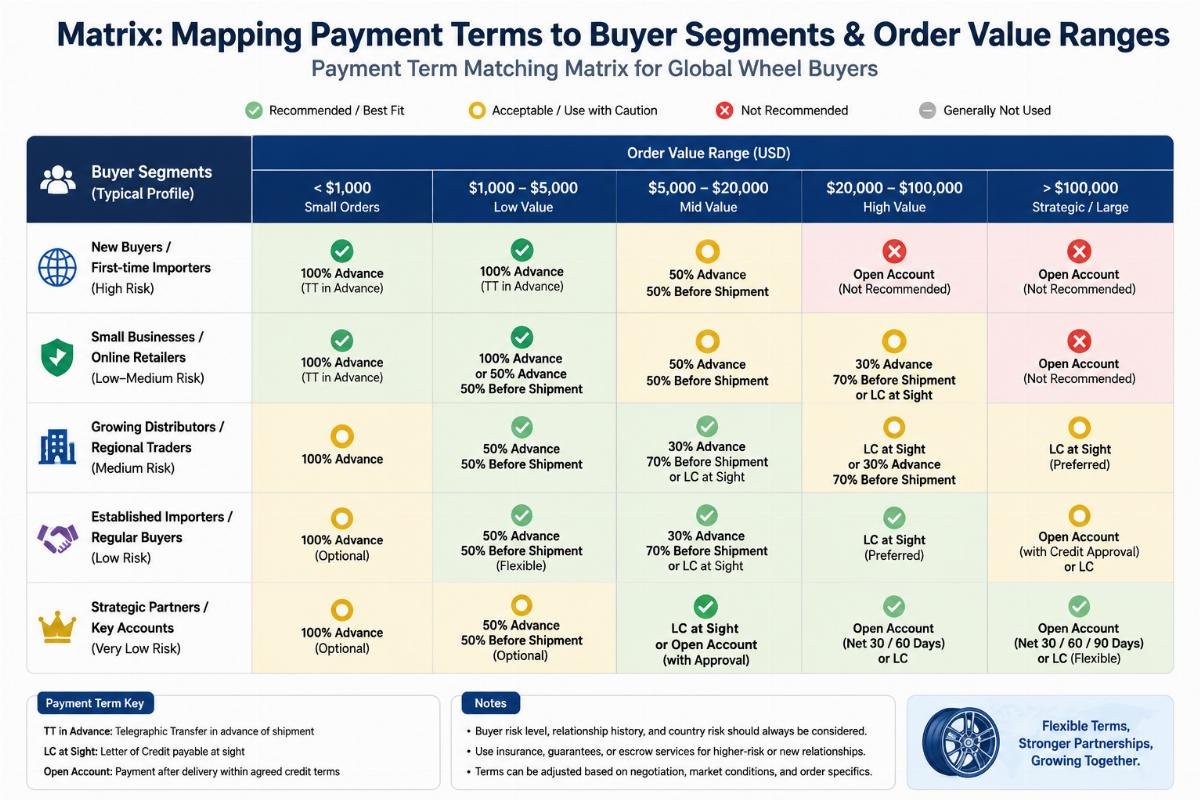
- Supplier Relationship Tenure – Prioritize flexible split T/T structures for suppliers you have ordered from 3+ times, even for orders over 10,000 pieces.
- Certification Requirement Check – Confirm that your payment structure includes a checkpoint to verify all required market certifications (DOT, TüV, VIA) before production completion.
- Lead Time Alignment – Match payment milestone timelines to your supplier’s standard 15-30 day production window to avoid delays from unplanned payment processing holds.
How to avoid common payment fraud pitfalls when sourcing Chinese wheels?
Verified supplier credentials and structured payment milestones eliminate 90% of common cross-border payment risks for wheel importers. The majority of reported fraud cases for wheel sourcing stem from unvetted suppliers offering non-standard payment terms that skip third-party verification steps.
| Risk Scenario | Common Avoidance Mistake | Proven Mitigation Step |
|---|---|---|
| Fake supplier bank account details | Sending first payment to unconfirmed account numbers | Request 2 separate official communication channels to confirm account details before release |
| Non-delivery of ordered goods | 100% pre-payment for orders over 20 pieces | Hold at least 30% of the total order value until you receive the Bill of Lading |
| Substandard quality not matching samples | Full payment before pre-shipment inspection | Schedule a third-party inspection before releasing the final balance [NEED_CITE: Pre-shipment third-party inspection reduces wheel quality non-conformity claims by 87% for global importers] |
A Nigerian wheel distributor recently avoided a $18,000 fraud attempt when they cross-checked bank details via two separate supplier contacts, discovering the initial account number had been sent by a scammer impersonating the sales team. They later used the standard 30% T/T deposit structure for their 1,200-piece order, receiving all units within the quoted 22 day production window.
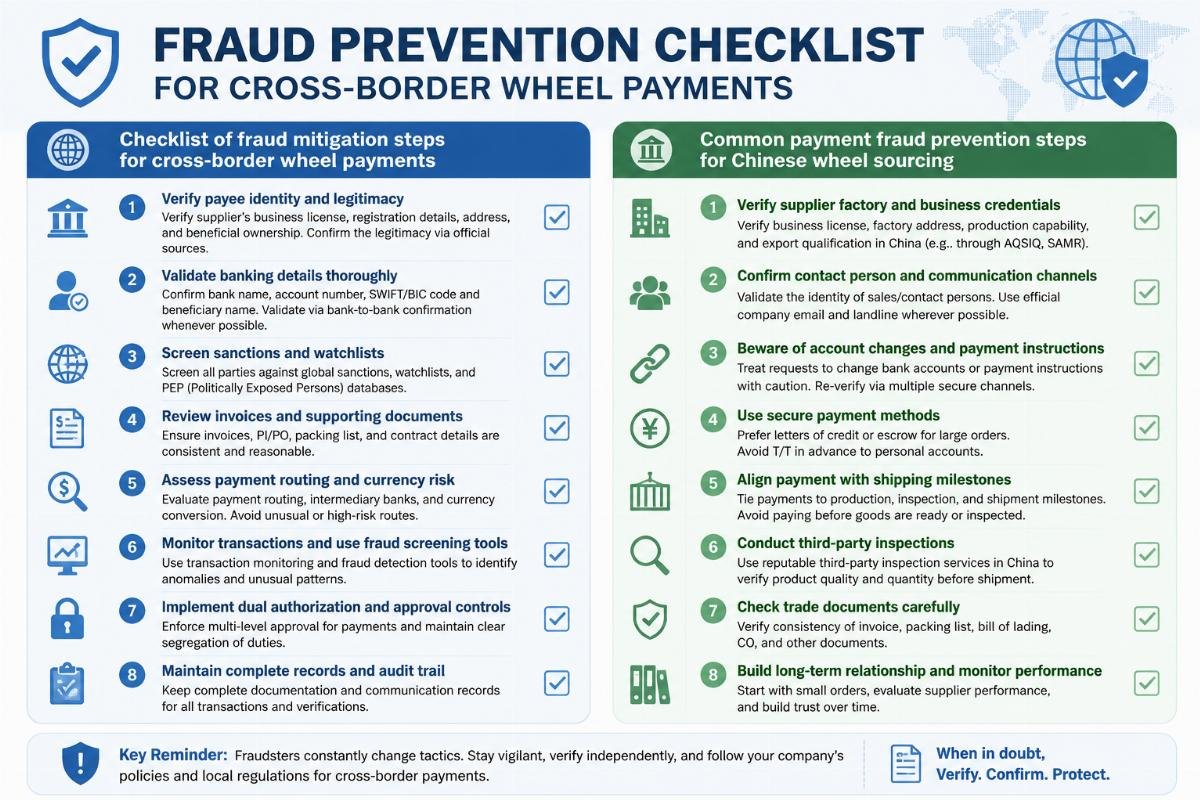
- Official Verification Request – Ask your supplier to provide their official business registration and bank confirmation letter directly from their corporate email domain before sending any payment.
- Inspection Milestone Lock – Write explicit pre-shipment inspection requirements into your proforma invoice to avoid disputes over quality standards before final balance release.
- Trade Assurance Extension – Use Alibaba Trade Assurance for
