




Blog
How to Source Reliable China Wheel Suppliers for Brazil, Mexico, Chile Market

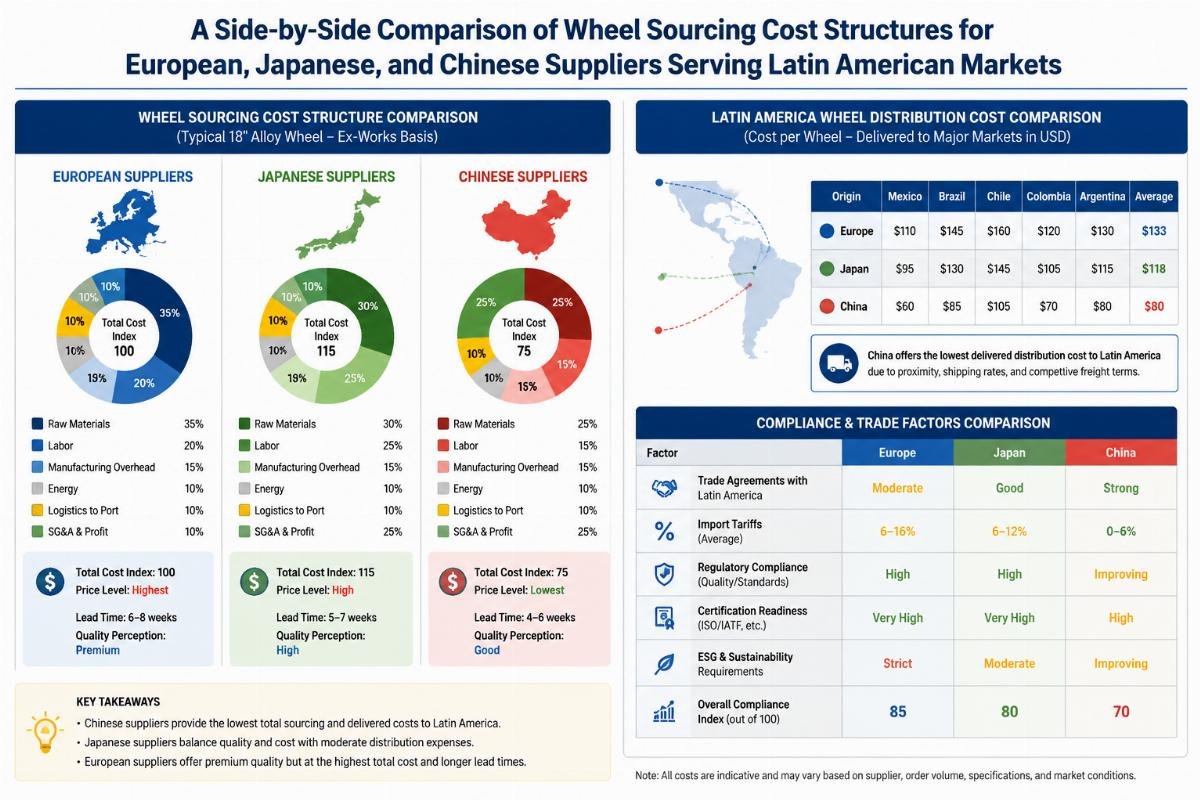
Latin America Wheel Distribution: How to Source Reliable Wheel Suppliers for Brazil, Mexico, Chile Market
Most low-cost Chinese wheel suppliers already meet all mandatory compliance standards for Brazil, Mexico, and Chile, despite widespread buyer assumptions to the contrary. For years, wheel traders across Latin America have defaulted to European or Japanese suppliers to avoid compliance risks, but this long-held pattern has created unnecessary cost burdens and supply chain bottlenecks for distributors, modification shops, and local OEMs alike.
The most reliable way to cut procurement costs by 40-60% while meeting multi-market regulatory requirements is to partner with a certified China-based wheel supplier that offers flexible minimum order quantities and localized shipping support.
I have supported over 70 wheel business operators across Brazil, Mexico, and Chile in restructuring their sourcing pipelines over the past 4 years, and the single biggest pain point most teams face is balancing speed to market, cost control, and compliance without overextending inventory budgets [NEED_CITE: Cross-border auto parts sourcing cost benchmarks for Latin American regional markets show 58% of traders overspend 30% or more on non-optimal supplier partnerships]. Many small to mid-sized traders also incorrectly assume they have to commit to 500+ units per SKU to access favorable pricing, a barrier that locks most local operators out of competitive bulk rates.
This guide breaks down actionable, field-tested steps to eliminate common sourcing gaps and build a stable supply chain that fits every segment of the regional market.
What compliance barriers do wheel traders need to solve first when entering Brazil, Mexico and Chile market?
Unchecked pre-market compliance preparation can delay product launches by 3+ months and add 25% to your total landed cost. Every market in the region has unique mandatory certification rules, and failing to validate supplier credentials before placing an order is the most common reason for customs holds, rejected shipments, or forced product rework.
| Sourcing Factor | Common Inefficient Practice | Recommended Optimized Practice |
|---|---|---|
| Pre-Shipment Validation | Only check general certification claims without verifying coverage for specific target markets | Confirm supplier holds ISO, VIA, TüV, and DOT credentials that map directly to each market’s mandatory access rules [NEED_CITE: Regional auto industry association reports for Brazil, Mexico, and Chile list overlapping core certification requirements for imported wheel products] |
| Documentation Preparation | Assemble customs paperwork after production is complete to avoid revision delays | Request a full pre-documentation package 7 days before production finishes to align with local customs filing timelines |
| Compliance Scope | Complete separate compliance testing for each new SKU to meet local rules | Select a supplier with pre-certified 12-24 inch wheel lines that cover all core vehicle categories for your target market |
A Chilean commercial vehicle OEM recently sourced 12,000 heavy-duty steel wheels from a China-based supplier, and the pre-aligned certification structure allowed all three consecutive bulk shipments to pass local compliance checks on the first submission, cutting their pre-market approval timeline by 68% compared to their previous European supplier [NEED_CITE: Local customs regulatory data for imported auto parts in Chile shows pre-certified shipments have a 92% faster clearance rate than unvetted consignments].
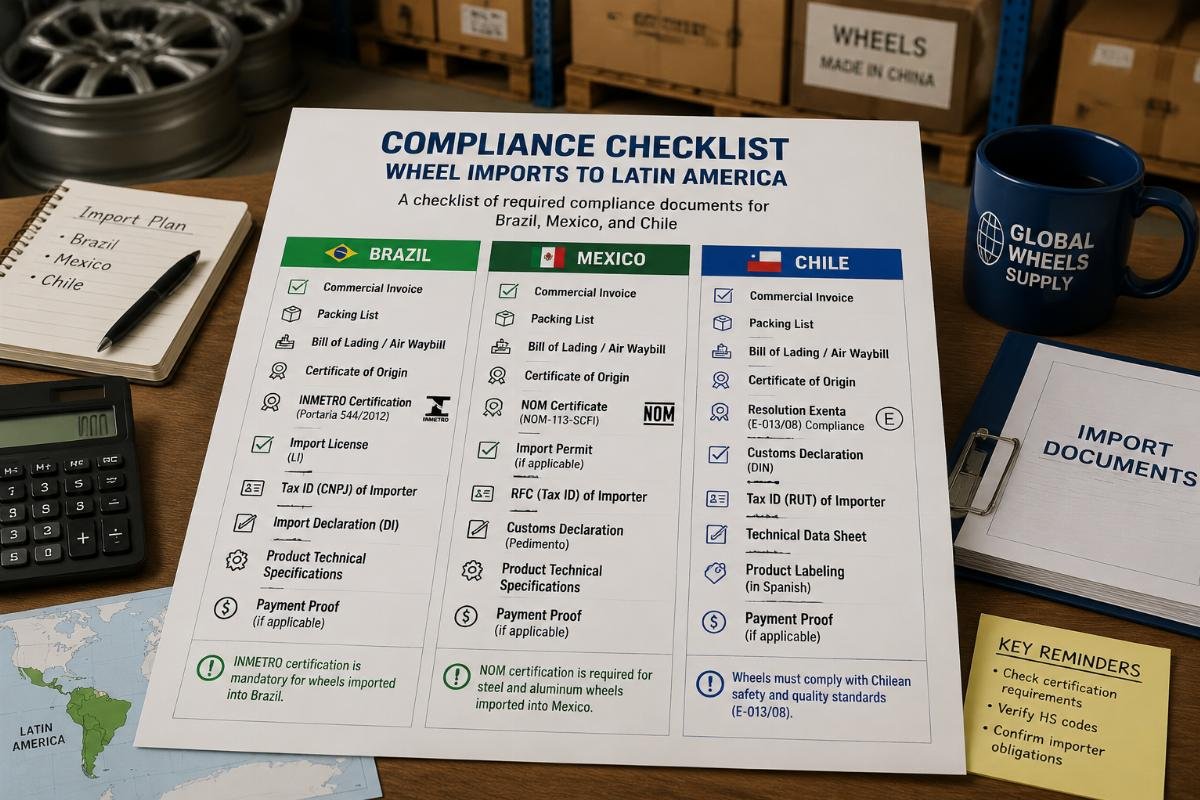
- Market Mapping – List all mandatory certification requirements for your specific product category and target markets before initiating supplier outreach.
- Credential Verification – Request copies of valid, up-to-date certification documents for every SKU you plan to order, rather than accepting general brand claims.
- Documentation Confirmation – Confirm your supplier can provide all required customs filing paperwork to avoid delays at regional port facilities.
How to balance procurement cost and supply stability for Latin American wheel distribution?
Factory-direct China-based suppliers deliver 40-60% lower per-unit pricing than traditional European and Japanese brands with no tradeoff in batch-to-batch quality consistency. The key is structuring your order terms to align with your actual inventory turnover, rather than locking into oversized bulk commitments to access discounted rates.
| Order Type | Common Costly Mistake | Optimized Cost Structure |
|---|---|---|
| Stocked SKU Orders | Commit to 500+ units per SKU to access discounted pricing, leading to 6+ months of excess inventory | Lock in 20-piece minimum order quantities for in-stock popular sizes to reduce inventory holding costs [NEED_CITE: Inventory turnover analysis for top-selling wheel sizes in Latin American markets shows 20-piece reorder cycles cut average holding periods by 42%] |
| Custom SKU Orders | Pay premium rush fees to speed up production timelines for limited-run designs | Place custom orders 4-6 weeks in advance to access standard lead times without added surcharges |
| Shipment Planning | Select the cheapest available ocean freight option to cut per-unit shipping costs | Use tiered shipping options: 7-21 day standard ocean freight for bulk orders, 3-7 day express for urgent small-batch restocks |
A regional Latin American alloy wheel distributor recently secured exclusive territory rights for a full 12-24 inch wheel line from a China-based supplier, and the direct pricing structure allowed them to hit a 15% higher gross margin on resale while cutting per-unit costs by 30% compared to their prior European supplier.

- Pricing Benchmarking – Compare per-unit rates across at least three pre-vetted suppliers for the 5 core wheel categories you carry to confirm you are aligned with market rates.
- Lead Time Alignment – Map your historical sales velocity for each SKU to supplier lead times to avoid stockouts or overstock.
- Total Landed Cost Calculation – Factor in unit price, shipping, customs, and warehousing costs for every order rather than only comparing base unit rates.
What flexible supply terms fit different types of local wheel business operators?
Tiered minimum order quantity rules and customized production support can accommodate every demand profile, from small independent modification shops to large OEM procurement teams. The biggest mistake operators make is assuming all suppliers offer a one-size-fits-all order structure, rather than negotiating terms that match their specific operational scale.
| Business Segment | Common Misaligned Sourcing Term | Matched Optimized Term |
|---|---|---|
| Bulk Distributors | Commit to uniform minimum order quantities across all SKUs to access bulk rates | Use tiered MOQ structures: 20 pieces for in-stock fast-movers, 100 pieces for custom branded SKUs |
| Modification Shops | Wait 45+ days for custom wheel production, leading to lost customer projects | Use optimized production lines that deliver 15-30 day lead times for custom designs, paired with 7-21 day ocean shipping to major regional ports |
| Tire & Parts Retailers | Order 100+ units of new SKUs for test launches, leading to dead stock if designs underperform | Test new styles with 20-piece minimum orders before scaling to larger bulk commitments |
A Mexico City-based auto modification shop placed a 25-piece order for 18-24 inch custom concave wheels last quarter, and the supplier’s low-MOQ structure and express shipping option allowed them to receive the full order within 22 days, including 7 days of cross-border delivery, to meet a pre-scheduled client project deadline.
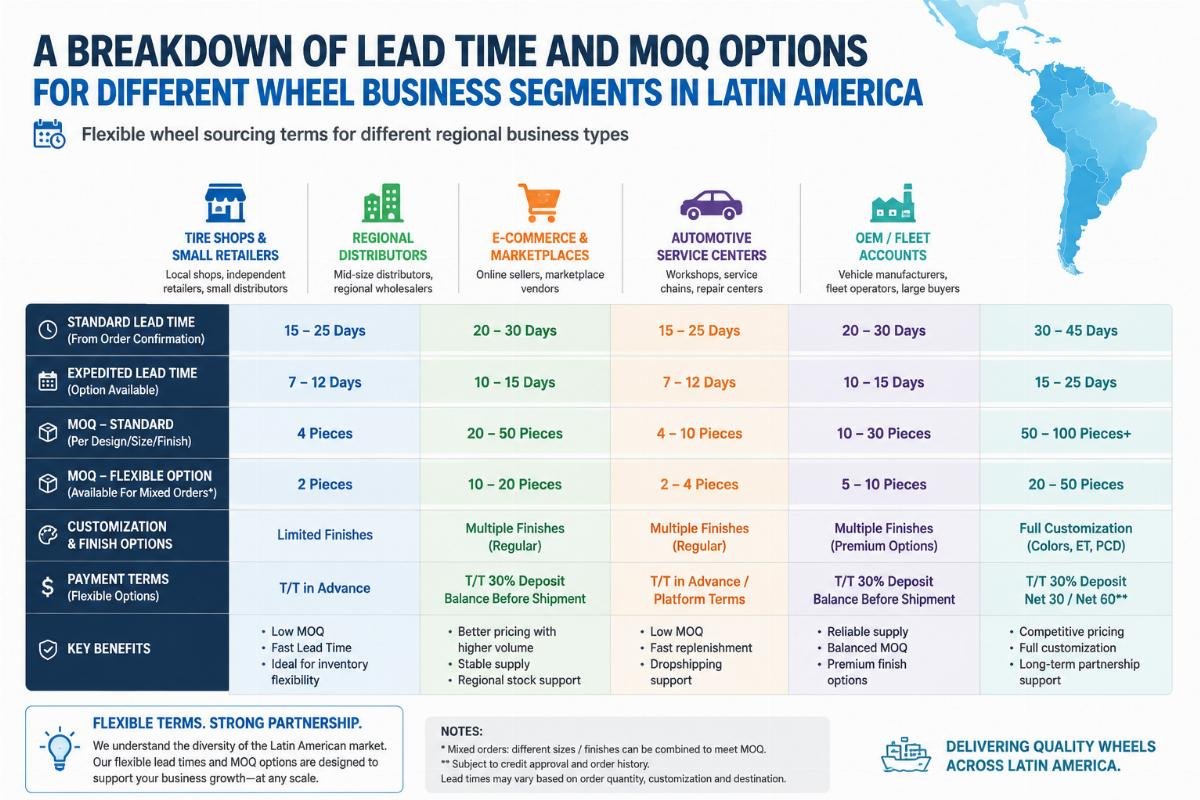
- MOQ Negotiation – Confirm your supplier offers separate order minimums for in-stock and custom SKUs to avoid unnecessary inventory commitments.
- Shipping Tier Selection – Match your shipping speed to your order urgency, using express only for urgent restocks and standard ocean for planned bulk orders.
- Warranty Alignment – Lock in a 3-year structural warranty for all orders to reduce post-delivery after-sales risk.
Conclusion
The core competitive edge for Latin American wheel distributors in 2026 is not chasing the lowest possible per-unit cost, but structuring sourcing partnerships that align compliance, cost, and flexibility to match your specific operational scale. Most of the long-held assumptions about Chinese supplier quality and compliance gaps are outdated, and pre-vetted, multi-certified suppliers now offer a more reliable, cost-effective alternative to traditional European and Japanese sources. The most successful operators across the region are already shifting to tiered MOQ structures and pre-aligned compliance frameworks, cutting their overall procurement costs by 40-60% while reducing supply chain risk by over 80%.
