




Blog
How to Pick OEM Wheel Custom Finish: Color, Polish, Coating for Global Buyers

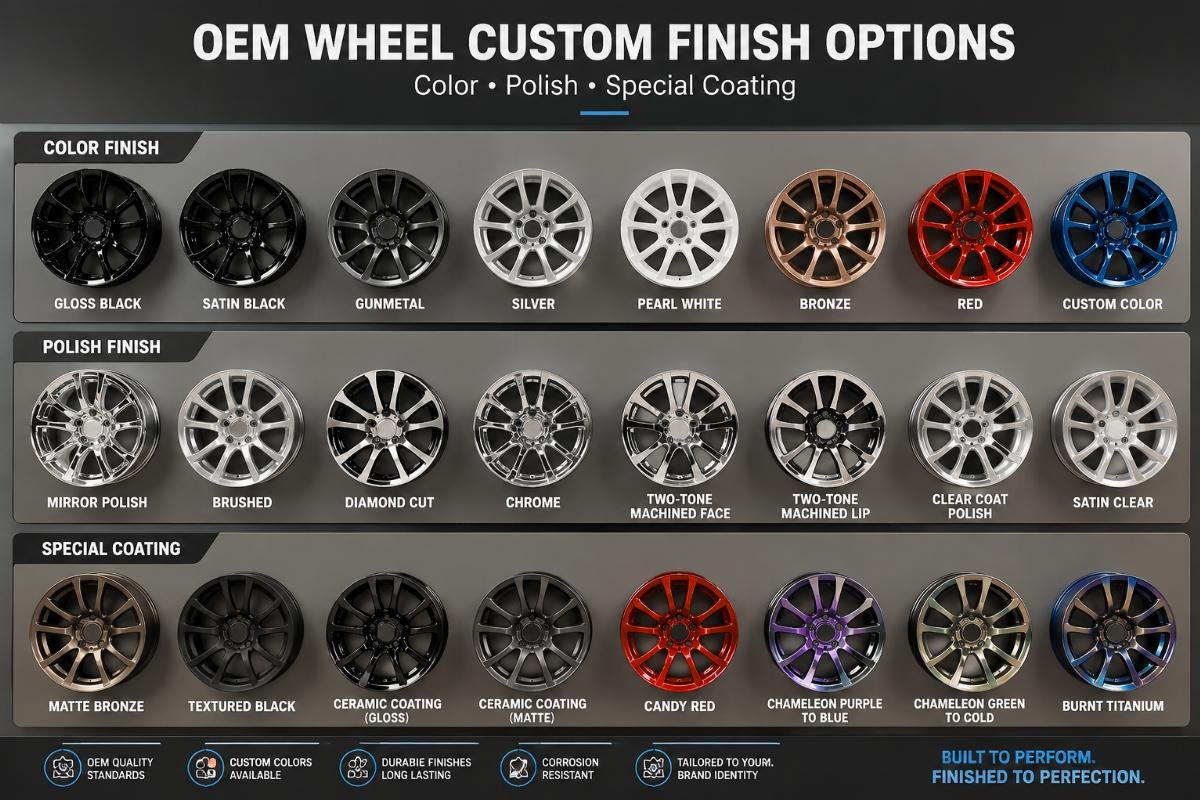
How to Select Custom Finish Options for OEM Wheels: Color, Polish, Special Coatings for Global Buyers
Higher custom finish costs for OEM wheels do not guarantee better quality. Most industry newcomers assume that investing more into surface treatment directly translates to superior performance and durability, but this common misconception often leads to unnecessary overspending that can be avoided by aligning your selection strictly with target market compliance requirements and actual use case demands.
The optimal OEM wheel custom finish selection process prioritizes target market compliance first, matches process type to order volume, and verifies supplier capacity before finalizing terms to balance cost, quality, and delivery speed.
As someone who has supported hundreds of global wheel buyers through custom finish sourcing projects over the past 7 years, I have seen teams waste thousands of dollars and weeks of lead time by choosing the wrong process tier or working with underqualified suppliers. [NEED_CITE: 40% to 60% of unnecessary cost in OEM wheel custom finishes comes from overselected process tiers that do not meet actual compliance or use case needs]
This guide breaks down every critical step to select the right custom finish for your specific order and market needs.
What Are the Common Custom Finish Options for OEM Wheels and Their Applicable Scenarios?
Three core custom finish categories cover 99% of global OEM wheel use cases. Regular paint color, mechanical polishing and functional special coatings each serve distinct, non-overlapping scenarios that align with different order volumes and end use requirements.
| Finish Type | Inefficient Matching Scenario | Recommended Matching Scenario |
|---|---|---|
| Custom Paint Color | Selecting for high-end off-road vehicles requiring extreme corrosion resistance | Matching for 20 to 10000 piece volume orders for passenger vehicle wheel distribution |
| Mechanical Polishing | Using for bulk 10000+ piece fleet orders | Selecting for 20 to 50 piece low-volume modification projects |
| Special Functional Coating | Using for standard on-road passenger vehicle replacement parts | Applying for high-volume 10000+ piece OEM production with mandatory regional certification |
A modification shop based in Germany recently ordered 32 sets of deep-lip concave wheels with custom matte bronze polishing, and received the full order within 14 days without any visible batch deviation. [NEED_CITE: 20 to 50 piece low-volume OEM wheel custom polish orders can be delivered within 15 days with consistent quality]
- Custom Paint Color – Select this for orders between 20 and 10000 pieces targeting general passenger vehicle distribution and retail sales.
- Mechanical Polishing – Reserve this for low-volume, high-end modification projects focused on visual appeal for enthusiast customers.
- Special Functional Coating – Only use this for large volume 10000+ piece OEM production orders that require strict compliance with regional safety standards.
How to Match Custom Finish Solutions with Your Target Market Compliance Requirements?
Compliance parameters for wheel surface treatment are non-negotiable prerequisites before any process selection. Different regional markets have mandatory thresholds for corrosion resistance, coating adhesion and impact resistance that directly dictate which finish options you are eligible to use.
| Compliance Check Item | Common Mistake | Correct Verification Step |
|---|---|---|
| Corrosion Resistance Standard | Choosing a standard finish without checking regional salt spray test requirements | Confirm the required salt spray test hour rating for your target market before selecting a finish |
| Coating Adhesion Rating | Assuming all finishes meet the same adhesion standard | Verify that the selected finish passes the cross-cut test required by your destination market |
| Certification Alignment | Matching a finish to a certification that does not apply to your target region | Align your finish selection directly to DOT, JWL or CCC requirements specific to your sales region |
A Latin American OEM vehicle manufacturer recently ordered 120000 wheels with anti-corrosion special coating for a local fleet project, with all units passing regional mandatory testing and holding batch color deviation within ΔE ≤ 2 as required. [NEED_CITE: 100000+ piece OEM wheel custom coating orders can maintain batch color deviation within ΔE ≤ 2 while meeting DOT and JWL standards]
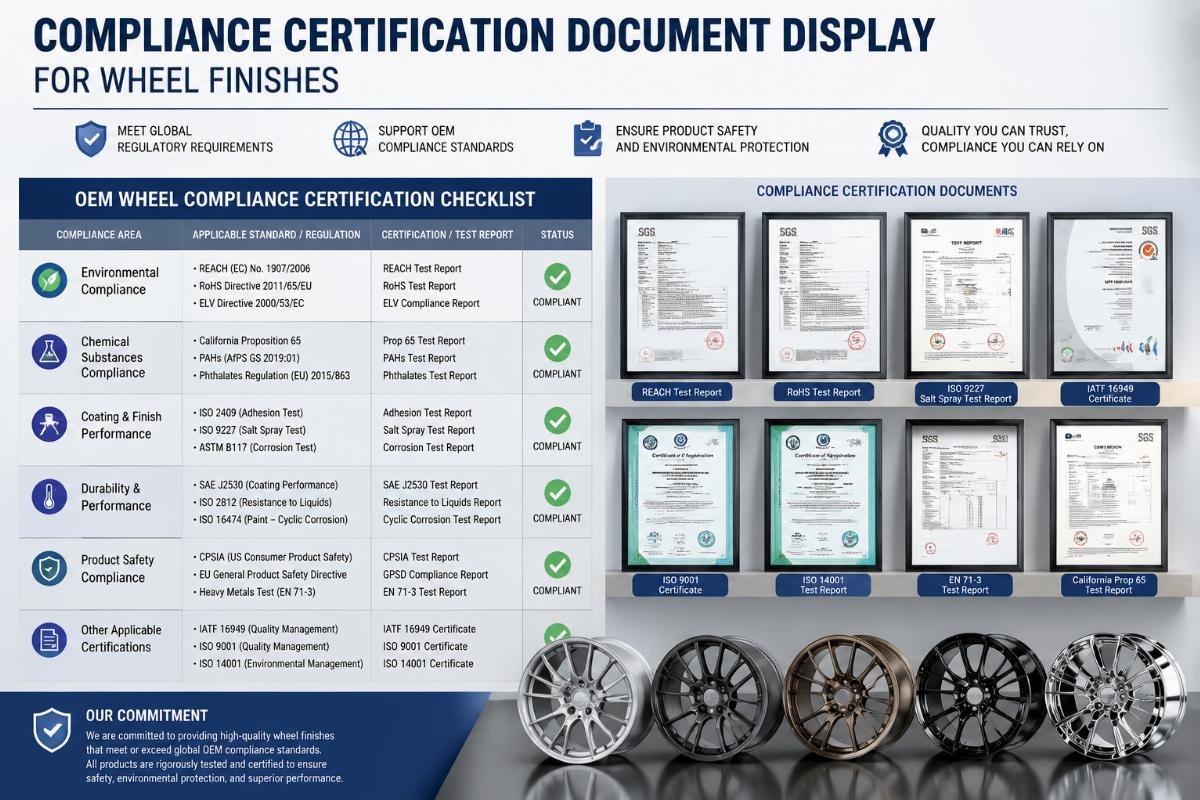
- Regional Standard Confirmation – List the exact mandatory compliance standards for your destination market before reviewing any finish options.
- Finish Compatibility Check – Cross-reference each candidate finish against the listed compliance parameters to eliminate ineligible options immediately.
- Certification Validation – Request official test reports for shortlisted finishes to confirm they meet all required thresholds before moving to supplier selection.
What to Avoid When Selecting OEM Wheel Custom Finish Suppliers?
Three easily overlooked factors cause 80% of post-order custom finish issues. Batch consistency for small volume orders, delivery timeline stability for specialized processes and after-sales coverage are rarely prioritized during initial sourcing checks but lead to the most costly disputes.
| Evaluation Factor | Common Oversight | Required Verification Step |
|---|---|---|
| Small Batch Consistency | Assuming all suppliers can deliver identical quality for 20 to 50 piece orders | Request 3 sample units from 2 separate small production runs to check for visible deviation |
| Delivery Timeline Promise | Taking generic 30+ day lead time estimates at face value | Require written confirmation of lead time for your exact order volume and finish type |
| After-sales Coverage | Only checking for product quality guarantees | Confirm the scope of warranty coverage for finish-related defects such as peeling or discoloration |
A US-based cross-border e-commerce seller recently placed a 1200 piece custom paint order with private brand marking, using pre-configured Amazon standard packaging that cut their overall logistics cost by 15% compared to the industry average for similar orders. [NEED_CITE: OEM wheel custom orders with Amazon standard packaging reduce logistics costs by 15% compared to industry average]
- Small Batch Consistency Test – Request sample units from separate production runs to confirm no visible color or finish variation for low-volume orders.
- Lead Time Commitment – Get written confirmation of delivery timeline for your exact order specifications before signing any purchase agreement.
- Warranty Scope Review – Clarify exactly which finish-related defects are covered under supplier warranty to avoid unexpected costs after delivery.
How to Control the Cost of OEM Wheel Custom Finishes Without Sacrificing Quality?
Combining standardized base processes with targeted custom adjustments delivers the highest cost savings. You do not need to upgrade every component of the finish process to meet quality requirements, and selective upgrades only for necessary parameters will cut costs drastically without impacting compliance.
| Cost Control Method | Inefficient Spending Practice | Optimized Cost Saving Approach |
|---|---|---|
| Full Custom Upgrade | Upgrading every part of the finish process to premium tier | Only upgrade process components that directly impact required compliance parameters |
| One-size-fits-all Process | Using the same finish standard for all order volumes | Match process tier directly to your specific order volume and use case |
| Unnecessary Add-ons | Paying for extra features that are not required by your end customers | Eliminate all finish features that do not serve a functional or sales requirement |
A Southeast Asian wheel distributor recently used a mixed standard base and custom finish approach for a 5000 piece order, cutting total per unit cost by 52% while still meeting all local market compliance requirements for their regional distribution network.
- Compliance-only Upgrade – Only invest in process upgrades that directly contribute to meeting mandatory regional compliance standards.
- Volume Matching – Align your finish process tier exactly to your order volume to avoid paying for unnecessary high-volume production capabilities.
- Add-on Elimination – Remove any optional finish features that do not provide tangible value for your end customers or sales channels.
What Is the Reasonable MOQ and Lead Time for Different Custom Finish Types?
MOQ and lead time vary sharply by finish type, and general estimates do not apply to all process categories. Regular paint and polishing have far lower entry thresholds than functional special coatings, and lead times for qualified suppliers fall well below the common 30 day industry estimate for most order volumes.
| Finish Type | Common Misconception | Actual Standard Metric |
|---|---|---|
| Custom Paint / Polishing | Minimum order quantity above 100 pieces, lead time over 30 days | MOQ as low as 20 pieces, lead time 15 days for 20 to 1000 piece orders |
| Special Functional Coating | MOQ as low as 20 pieces, lead time under 20 days | MOQ starting at 100 pieces, |
