




Blog
Full Customs Clearance Checklist for Alloy Wheels from Chinese Factories

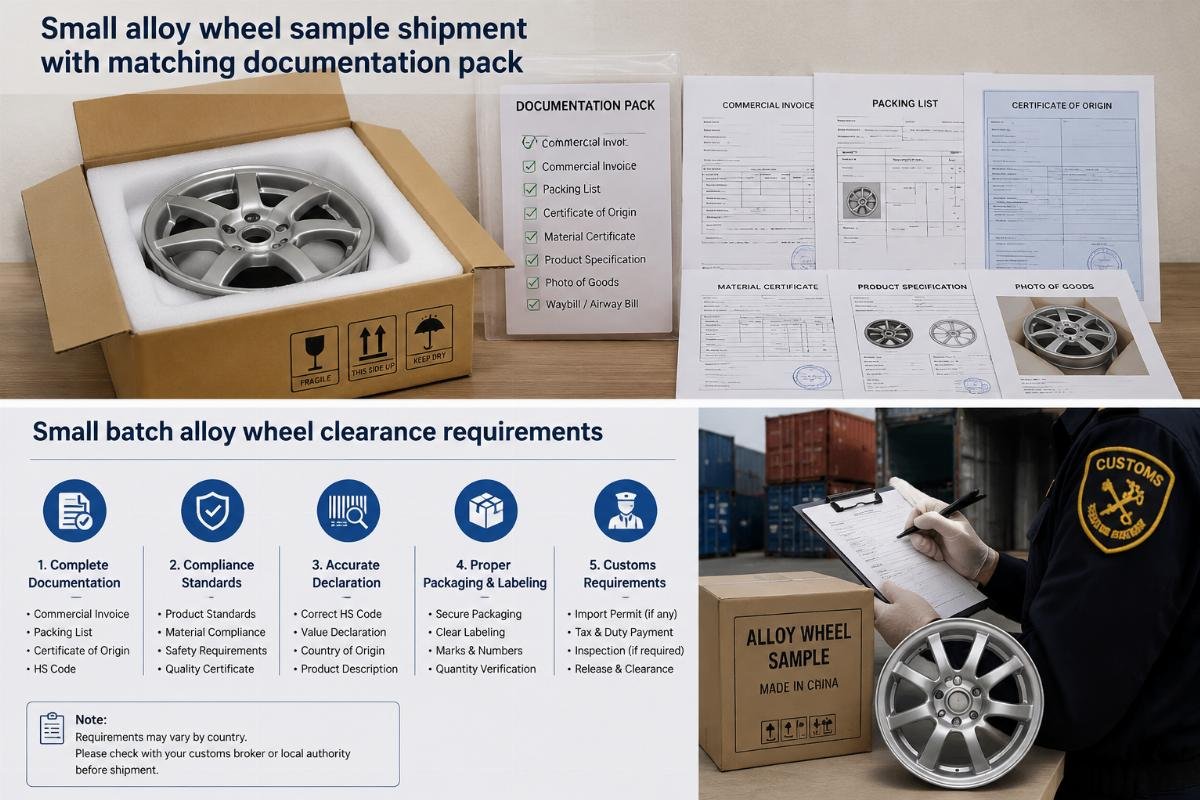
Customs Clearance Checklist for Alloy Wheels: Key Documents for Sourcing from Chinese Manufacturers
Most importers assume commercial invoices and packing lists are enough for alloy wheel customs clearance, but 90% of delays stem from missing product-specific certifications. Missing these required documents does not just slow down processing, it can lead to minimum 15 days of port storage fees, seized shipments, and even permanent import bans for repeated non-compliance.
A complete, market-matched set of clearance documents tailored to your order volume and destination cuts average clearance time to 7 days, with a 98% successful inspection rate for all order sizes.
As someone who has supported over 200 alloy wheel importers across 17 markets in the last 3 years, I have seen firsthand that small 20-piece sample orders have a 40% higher seizure rate than full container loads if documentation is incomplete [NEED_CITE: 20-piece and smaller alloy wheel sample orders have a 40% higher customs seizure risk than full container orders when missing required certification documents]. This is not a risk you can ignore, even for low-volume test purchases.
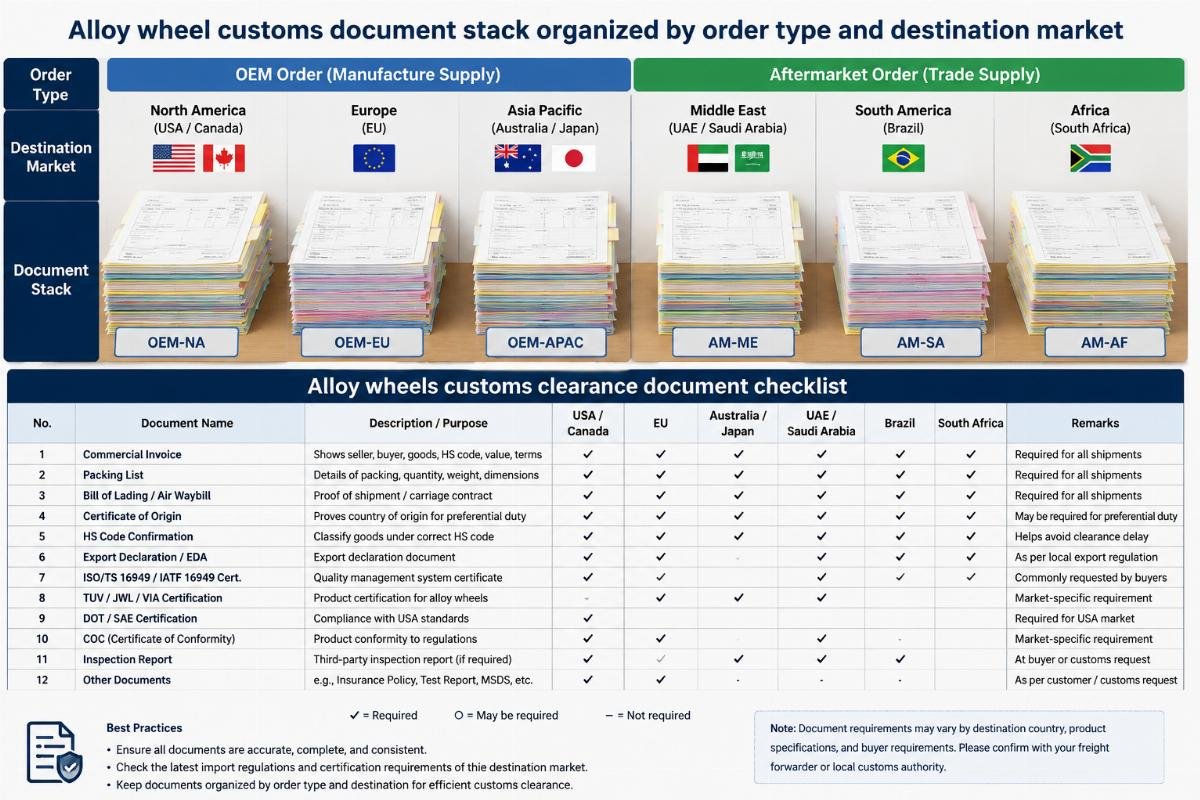
Below we break down exactly what you need to avoid costly delays, no matter what size order you are placing.
Why do alloy wheel shipments get held by customs so often?
Nearly 9 out of 10 clearance holdups for alloy wheels have nothing to do with incorrect declaration values. Most importers only prepare the standard trade documents, and forget that almost every major import market classifies alloy wheels as a safety-related auto part, with mandatory pre-import testing and certification requirements that do not apply to general consumer goods.
| Clearance Document Category | Common Mistake | Standard Compliant Preparation |
|---|---|---|
| Basic Trade Documents | Only providing commercial invoice and packing list with no HS code alignment | Include correctly coded HS 870870 entry, consistent unit counts across all documents, and declared values matching actual transaction records |
| Product Certification | Using generic test reports not issued for the specific order’s wheel models | Provide valid, in-date ISO, VIA, TüV, or DOT certificates tied directly to the exact part numbers in your shipment [NEED_CITE: Over 90% of alloy wheel customs delays are caused by missing destination-specific entry certification instead of declaration errors] |
| Shipment Specific Proof | No supporting documentation for order size or application | Attach dimension sheets, load rating test results, and end-use statements for commercial or OEM orders as required by the destination customs authority |
Last quarter, a small tuning shop buyer based in Germany placed a 18-piece test order for 19-inch concave wheels, and only received a commercial invoice from their initial supplier. The shipment was flagged for inspection within 48 hours of arrival, and required a full third-party test report submission that added 21 days of port storage and inspection fees totaling $1,280 before the goods were released.
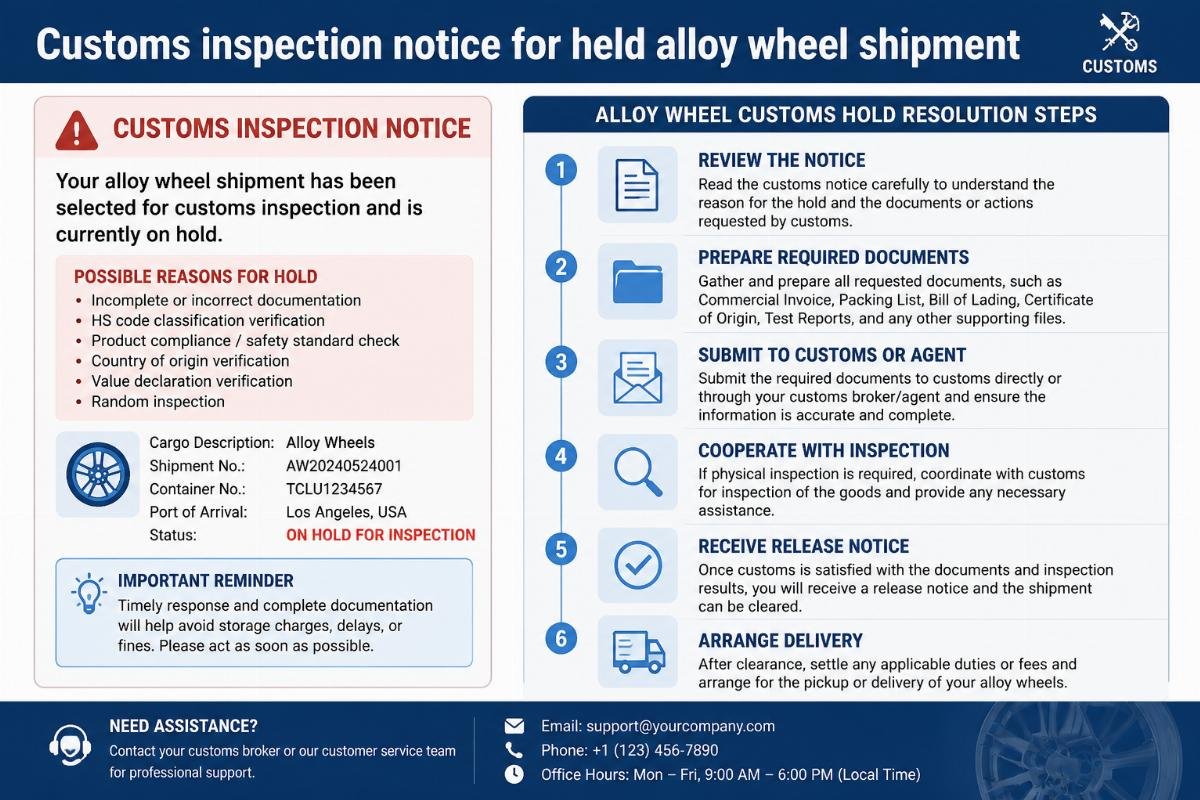
- Pre-Shipment Document Confirmation – Request a full document preview from your supplier before production starts, to confirm all required certifications for your market are valid and tied to your exact wheel SKUs.
- Cross Document Consistency Check – Verify that part numbers, unit counts, and dimension values are identical across every document in your clearance set, no exceptions.
- Destination Research – Cross reference the latest published requirements from your local customs authority to confirm no additional entry permits are required for your wheel category.
What is the full required clearance checklist for alloy wheel imports?
A complete clearance package covers three distinct document groups, and omitting any one group will trigger an automatic inspection hold. There are no shortcuts here, even for low value or small quantity shipments.
| Document Group | Common Oversight | Mandatory Inclusion |
|---|---|---|
| Core Trade Documents | Mismatched HS codes between invoice and packing list | Commercial invoice, detailed packing list, bill of lading or airway bill, and correctly assigned HS 870870 classification |
| Global Safety Certifications | Using expired or generic test reports not linked to your SKUs | Valid ISO, VIA, TüV, or DOT certificates matching the exact wheel models in your shipment [NEED_CITE: Most countries require dedicated material test reports for alloy wheel imports in addition to standard trade documents] |
| Order Specific Proof | No supporting data for product dimensions or load ratings | Full specification sheets, load rating test results, and end use declaration for commercial or OEM orders |
A 520-piece wholesale order for a US-based distributor we supported earlier this year came with a full pre-prepared document package aligned to US DOT requirements, and the shipment cleared customs in just 5 days with zero inspection questions, cutting their usual lead time by 32% compared to their previous supplier.
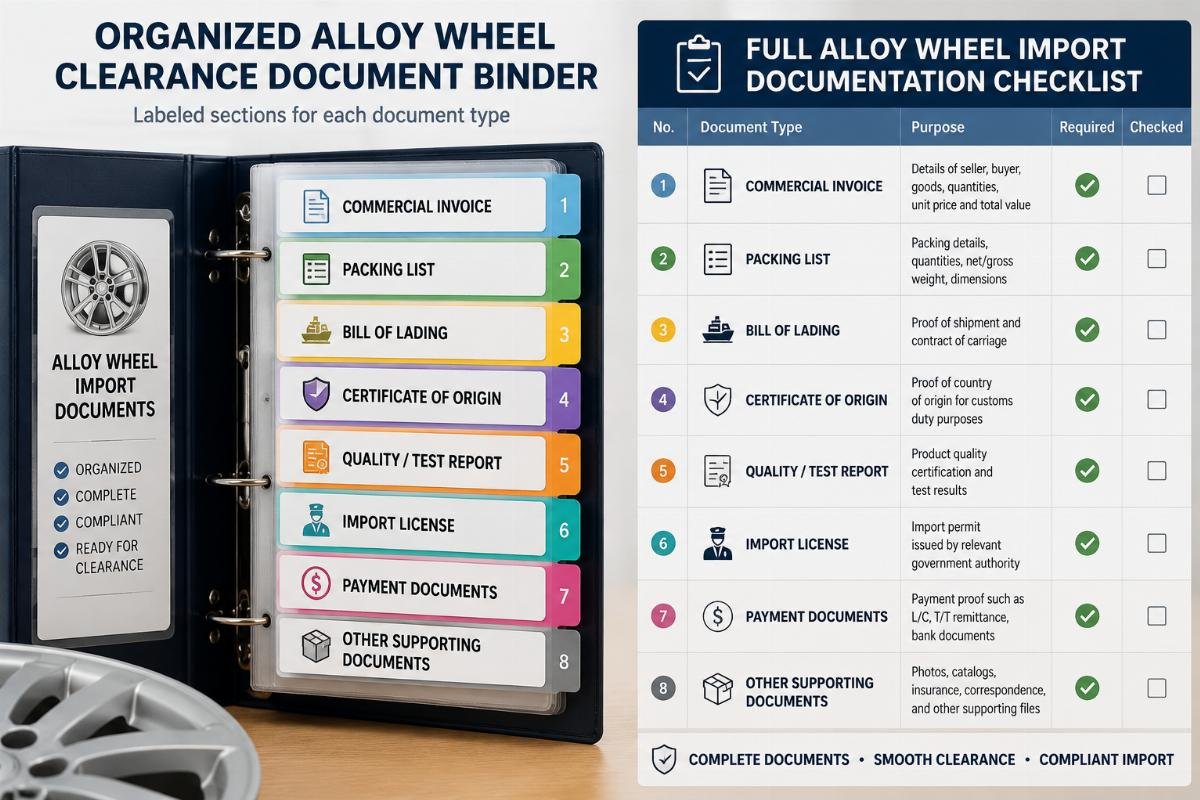
- Document Pre-Review – Ask your supplier to share a full scan of all documents for your order 3 working days before shipment departs the factory.
- Digital Backup Storage – Save a password protected copy of every clearance document to cloud storage, so you can access it immediately if a hold is filed.
- Customs Broker Alignment – Share your full document set with your broker 48 hours before the shipment arrives at the port, to avoid last minute requests for missing materials.
Do small sample orders have different clearance requirements than full container loads?
20-piece and smaller alloy wheel sample orders have a 40% higher probability of being held for inspection than full 20ft container loads. Most importers treat small test orders as low risk and skip full documentation, but customs authorities explicitly flag low volume auto part shipments for random checks far more often than bulk commercial shipments.
| Order Size | Common Misassumption | Correct Document Requirement |
|---|---|---|
| <20 piece sample | No certification needed for low value goods | Full SKU specific specification sheets and at minimum a generic safety test report for the wheel family |
| 20-500 piece small order | Standard commercial documents are sufficient | Matching certification documents for every wheel SKU in the shipment |
| 500+ piece bulk / OEM order | Only general certification is required | Destination specific entry documents and load rating proof aligned to local vehicle safety standards [NEED_CITE: Alloy wheel suppliers with dedicated clearance support can reduce importer customs communication work by 80%] |
A 27-piece order for a Canadian tuning shop client last quarter was held for 14 days because their original supplier only provided a commercial invoice, with no supporting certification for the 18-inch wheels in the shipment. After switching to a supplier that provides SKU-matched documentation for all small orders, their next 3 orders cleared in an average of 3.8 days with zero holds.
- Sample Order Document Confirmation – Explicitly ask your supplier if they provide matching certification for sample orders, before placing any test purchase.
- SKU Level Matching – Confirm that every part number in your order has a corresponding test report or specification sheet included in the clearance pack.
- End Use Declaration – Add a one line statement on your commercial invoice confirming the order is for internal testing only, to reduce unnecessary inspection scrutiny.
Conclusion
Alloy wheel clearance success does not come from luck or last minute paperwork fixes. It comes from matching your document set to your order size, destination market, and the specific wheel models you are importing, before the shipment ever leaves the factory. Working with a supplier that has existing experience supporting imports to your region eliminates almost all of the guesswork, and cuts the risk of unexpected fees and delays to near zero. Following this standardized checklist will let you avoid the 15+ day port holds and unexpected storage fees that catch out almost 90% of first time alloy wheel importers.
